What are the repercussions for Africa and Cameroon?
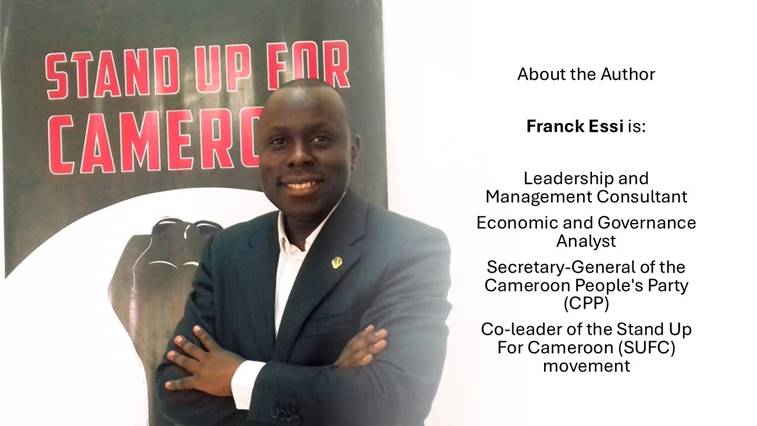
By Franck Essi, April 7, 2025

Donald Trump holds up a chart detailing the new tariffs from the White House in Washington, April 2, 2025. BRENDAN SMIALOWSKI / AFP
Donald Trump’s abrupt decision to impose punitive tariffs on global imports is a geopolitical earthquake whose aftershocks are spreading to African economies. Far from being mere collateral damage in a trade war between major powers, African countries, and particularly Cameroon, find themselves caught in a vice that threatens to strangle their fragile economic ecosystems. As additional tariffs ranging from 10% to 50% are imposed on African exports to the United States, one thing is clear: the rules of a trade game that the West itself established are now being unilaterally rewritten. Does this historic rupture signal the end of an era, or does it paradoxically offer an opportunity for Africa to fundamentally rethink its place in the global economic order?
To begin, let’s take stock of what happened on April 2, 2025, in Washington.
2. What happened on April 2, 2025?
On April 2, 2025, in the White House gardens, under a deceptive spring sky, Donald Trump unleashed a global economic storm. In a nearly 50-minute speech, the American president announced the imposition of what he called « reciprocal tariffs » on US imports. These duties are supposed to be set at the same level as those levied by Washington’s trading partners, although this « reciprocity » is highly subjective and partly calculated according to the US trade deficit with its partners [2].
The White House offensive is based on a minimum customs duty of 10% on all imports – an already considerable figure – to which are added targeted surcharges for countries deemed « hostile » in trade matters. Thus, China is being imposed an additional duty of 34%, which is added to the 20% already in place, bringing the total to a prohibitive rate of 54% [2]. The European Union is not spared for a tax of 20% [11]. In this tariff explosion, Africa, too often forgotten in major global economic maneuvers, is this time directly in line of fire.
« Our country has been pillaged, ransacked, raped and devastated by nations near and far, allies and enemies alike, » Donald Trump declared in his address, using warlike language to justify what he called a « declaration of economic independence » [11]. This « Liberation Day, » as the American president has dubbed it, marks a unilateral break with decades of free-trade policy that the United States itself has promoted throughout the world [3].
3. What were the global reactions?
The reaction of the financial markets to this announcement was immediate and brutal. A shock wave spread through the world’s major stock markets. As early as April 4, two days after the announcement, the Frankfurt Stock Exchange fell by 5.08%, Paris by 4.26%, London by 3.90%, while Milan plummeted by 7.57% and Madrid by 6.02% [4]. Wall Street was not spared with futures down 2.79% for the Nasdaq, 2.59% for the S&P 500 and 2.62% for the Dow Jones even before the market opened [4].
These figures are not mere financial abstractions; they represent the evaporation of billions of dollars of wealth in a matter of hours, affecting pension funds, investments, and ultimately the daily lives of millions of people. European banks were particularly hard hit: Société Générale lost 11.42%, BNP Paribas 9.15%, UniCredit 12.35%, Barclays 9.51%, and Deutsche Bank 10.55% [4]. This stock market debacle illustrates the fragility of the global financial system in the face of unilateral decisions by a single power, however great it may be.
China, the main target of this trade offensive, was quick to retaliate. Beijing announced the imposition of additional customs duties of 34% on American products as of April 10 [4]. This counterattack confirms the entry into a spiral of reprisals which could continue to escalate. As Alexandre Baradez , head of market analysis at IG France, pointed out: « China’s retaliatory measures herald the beginning of an escalation » of tensions between the world’s two leading trading powers [4].
The European Union, through its Commission President Ursula Von der Leyen, declared that this was a severe blow to the global economy and that the consequences « will be disastrous for millions of people » [12]. » Food, transport and medicines will cost more and it is mainly the most vulnerable citizens who suffer, » she added, highlighting the social impact that this trade war could have beyond just economic indicators [12].
4. What are the impacts for African countries?
There are several of them, varying in magnitude and manifestation over time. While not exhaustive, the following impacts are noteworthy:
4.1 A new shock for already weakened economies
For Africa, a continent still reeling from the economic aftermath of the COVID-19 pandemic and the Russo-Ukrainian conflict, Donald Trump’s trade offensive represents a major new shock. Starting April 9, African products exported to the United States will be subject to additional customs duties ranging from 10% to 50%, depending on the country and sector concerned [1]. These protectionist measures come at a cost of an already tense time, where African economies are struggling to recover from successive shocks.
4.2 Asymmetrical and sometimes paradoxical targeting
The case of Lesotho is emblematic of this unbalanced approach. This small southern African state, with a modest economy and heavily dependent on clothing exports to the United States, is hit with a 50% surcharge, the highest in the world [9]. This decision is accompanied by open contempt: Donald Trump recently described this country as « a territory no one has ever heard of » [9].
Other African countries are also hard hit: Madagascar (47%), Mauritius (40%), Botswana (37%), Angola (32%), Libya (31%), Algeria and South Africa (30%) [9]. This unequal distribution of customs duties suggests a logic of arbitrary punishment, often inversely proportional to the economic or geopolitical weight of the country concerned.
4.3 Cameroon under commercial and diplomatic pressure
Cameroon, for its part, is facing a tariff increase of 11 to 12% on its exports to the United States, particularly affecting key sectors such as timber, cocoa and oil [10]. This measure, perceived by several observers as an indirect sanction against the Paul Biya regime, comes in a climate already tense since Cameroon’s exclusion from AGOA in 2019 for human rights violations [8].
Beyond its immediate economic effects, this measure risks further deteriorating diplomatic relations between Yaoundé and Washington, further reducing Cameroon’s strategic room for maneuver on the international scene.
4.4 Unfair and double-standard rules of the game
These new taxes are officially justified by two criteria: the trade deficit of the United States with its partners, and the level of customs protection applied by the latter [1]. However, African countries today find themselves sanctioned for having adopted protective measures like those that the United States itself demands.
This situation highlights the structural asymmetry of the global trading system, where the tools of protectionism are tolerated for the powerful and condemned among the weak. Once again, the rules of the game seem flexible depending on the balance of power, revealing the hypocrisy of free trade as it is practiced.
4.5 AGOA under threat and the US-Africa partnership in question
With the introduction of these customs duties, the African Growth and Opportunity Act (AGOA), which allowed more than 1,000 African products to access the American market without taxes, has been de facto emptied of its substance [1]. This unilateral rupture completely rebuilds the economic relationship between the United States and the continent. As political scientist Serigne Bamba Gaye points out: « These customs duties violate the principles of AGOA, but it is also the time for raw material producing countries to demand reciprocal treatment from North American companies that exploit these resources, particularly in terms of taxation, technology transfer and compliance with social and environmental standards » [1].
4.6 Systemic economic repercussions
Beyond bilateral trade, this trade war will have major macroeconomic consequences. Increased US tariffs could generate imported inflation, due to higher costs passed on to the prices of products designed for Africa. In countries already marked by inflation, this could exacerbate social tensions and worsen poverty.
Furthermore, the decline in African exports to the United States risks worsening trade imbalances, putting pressure on local currencies. Some of these could face accelerated depreciation, or even, in the case of the CFA franc, devaluation,if parity with the euro becomes untenable over time.
Finally, many export-oriented African companies could be forced to downsize, threatening hundreds of thousands of jobs, particularly in the textile, agricultural, and extractive industries. This shock could have devastating social consequences if support mechanisms are not quickly put in place.
5. What does this Trump logic mean for the global trade order?
Several things are self-evident.
5.1 Free trade betrayed by its architects
Donald Trump’s decision marks a historic break with free trade as championed by the United States since World War II. The country that pioneered liberal trade institutions—from the GATT to the WTO—has now become one of their main destroyers. This about-face underscores a long-hidden truth: free trade has never been a universal principle, but a tool serving the interests of dominant powers.
Thus, the rules of international trade appear today for what they have always been: geopolitical instruments disguised as economic norms , adjustable according to circumstances and balances of power.
5.2 A fracturing globalization
The trade war reignited by the United States is not a cyclical accident, but a symptom of a structural shift. After several decades of increasing integration of global value chains, the system is moving towards accelerated fragmentation. The world is becoming multipolar, divided into increasingly antagonistic regional economic blocs.
The International Monetary Fund calls this dynamic « economic geofragmentation , » a situation in which economic decisions are now driven by political, security, and ideological logic. Economic efficiency is giving way to strategic sovereignty, the relocation of supply chains (friend-shoring, near-shoring), and a redefinition of trade alliances based on political affinities.
5.3 The fragility of free trade agreements revealed
The current unilateral logic is undermining existing free trade agreements. AGOA,which since 2000 has guaranteed preferential access for African products to the American market, is now rendered meaningless by the imposition of new tariff barriers [8]. Other agreements such as NAFTA /CUSMA are not immune to a brutal reversal, as soon as US interests require it [12].
This illustrates the precariousness of international commitments, particularly when they rely on asymmetric trust between peripheral powers and partners. Conversely, regional integration projects – such as the AfCFTA – now appear to be more resilient solutions in the face of external geopolitical shocks.
5.4 The WTO and multilateral institutions in a crisis of authority
The World Trade Organization (WTO) is the other major casualty of this new era. Already paralyzed by the blockage of its dispute settlement body under Trump, its authority is further eroded by the proliferation of unilateral measures that contravene its founding principles.
Even though some countries, such as Brazil, are considering filing a complaint with the organization [12], the WTO’s ability to enforce its rules now appears to be significantly weakened. This disengagement by the major powers marks a worrying development: the return to a system where trade relations are managed by bilateral power relations, rather than by collective and negotiated rules.
5.5 A reconfiguration of world trade… and an opportunity for Africa
In this context of global upheaval, Africa can – and must – learn the lessons of this ongoing fragmentation. The gradual withdrawal of the United States from trade multilateralism, the fragility of asymmetric agreements, and the regionalization of trade offer a strategic window to rethink the continent’s integration into the global economy.
Rather than continuing to depend on unstable and inequitable partnerships, Africa can build an alternative model, based on:
- Strengthening continental integration, via the AfCFTA;
- Diversification of commercial and technological partners.
- And the affirmation of economic principles aligned with its priorities: sovereignty, justice and sustainability.
In a changing world, Africa has the opportunity to occupy a new place – provided it thinks strategically, acts sovereignly and speaks with one voice.
6. In the light of this trade war, what ideological critiques of neoliberalism should we keep in mind?
The brutality with which Donald Trump has challenged the global trading system offers an opportunity for a fundamental critique of the neoliberal model that has dominated international economic relations since the 1980s.
This model, as Jean-Claude St-Onge points out in « The Neoliberal Imposture », attempts to « pass itself off as what it is not, namely the champion of freedoms, prosperity and well-being, while the vision of the world that it proposes is the subordination of reality to market forces and the law of the strongest » [6].
Neoliberalism promoted the conception of freedom reduced to property and the accumulation of wealth, the preserve of an ever more powerful minority. Under the pretext that society would be governed by natural laws, it was necessary to bow before the divinity of the market [6]. This ideology imposed on African countries, through the structural adjustment programs of the 1980s and 1990s, a disengagement of the State and a forced commercial opening which often had disastrous effects on their economies and their social fabric.
Philosopher and historian Achille Mbembe has analyzed how this neoliberal logic is a continuation of the colonial project, imposing exogenous economic models on African societies without consideration for their specific social and historical realities. In his book « Critique of Black Reason, » he demonstrates how global capitalism continues to extract value from the African continent while keeping its populations trapped in a form of « necropolitics »—the politics of death—where certain lives are considered dispensable.
Joseph Stiglitz has demonstrated how free trade promoted by international financial institutions has systematically benefited developed countries at the expense of emerging economies. In « Globalization and Its Discontents, » he reveals how the policies of the Washington Consensus have contributed to increasing global inequality rather than reducing it as promised.
Dani Rodrik has highlighted what he calls the » globalization trilemma »: the impossibility of simultaneously reconciling hyperglobalization, political democracy, and national sovereignty. African countries have often had to sacrifice their economic sovereignty, and sometimes their democratic representation, on the altar of integration into the global economy dictated by rules they did not contribute to establishing.
In the face of these criticisms, the emergence of Trumpian protectionism does not constitute an emancipatory alternative but rather a reconfiguration of power relations. As Thomas Piketty emphasizes in « Capital and Ideology, » the real issue is not the binary opposition between free trade and protectionism, but the construction of an international trading system that integrates social and environmental justice as fundamental objectives.
7. What strategic lessons for Africa?
For decades, countries in the Global South have been encouraged to open their economies. But the promise of shared prosperity has resulted in:
- A structural dependence on raw material exports,
- industries dismantled,
- vulnerability to external shocks.
Trump exposes the fundamental hypocrisy of Western neoliberalism: when the crisis comes, every man for himself.
So, what lessons can we learn? Without being exhaustive, we see at least seven:
- The first lesson to be learned from this trade upheaval is that dependence on external markets constitutes a structural vulnerability for African economies. When 60% to 80% of an African country’s exports are destined for a few Western or Asian markets, any unilateral change in trade rules can have devastating effects. The potential collapse of African exports to the United States following the imposition of new customs duties is a perfect illustration of this [9].
- The second lesson concerns the fundamental asymmetry of the global trading system. The countries that yesterday advocated the opening of African markets and the removal of trade barriers are today those erecting the highest tariff walls. This contradiction reveals that the principles of free trade have never been applied fairly and have often served as instruments of economic domination rather than vectors of shared development.
- Third, the value of Africa’s raw materials and strategic resources could be reassessed in this new context. As Serigne Bamba Gaye pointed out: » African states have raw and strategic materials. The time has come for us, for African states, to open our eyes and truly create the conditions in which these countries will now be able to exploit their raw materials and deal on an equal footing with American private companies » [1]. An outline of these conditions was published by the consulting firm STRATEGIES! in a document entitled « Africa is in critical need of a strategy for critical minerals » ( https://strategiesconsultingfirm.com/trends/criticial-minerals/ ). The scarcity of trade could paradoxically strengthen the bargaining power of resource-rich African countries provided they have the leadership, counter-powers and governance structures at the right level.
- Fourth, this crisis underscores the urgent need to accelerate intra-African economic integration through the African Continental Free Trade Area (AfCFTA). With a potential market of 1.3 billion consumers and a combined GDP of $3.4 trillion, Africa theoretically has the resources to develop its own domestic market and reduce its dependence on exports to Western or Asian markets. The challenge is to wake up and finally move from theory to practice, transforming this immense potential into a tangible reality for the people.
- Fifth, the crisis reveals the need for African countries to diversify not only their export markets but also their export products. Overspecialization in a few raw materials (oil, minerals, unprocessed agricultural products) makes these economies particularly vulnerable to external shocks. Industrialization and upgrading value chains are becoming more imperative than ever.
- Sixth, this situation highlights the urgent need for a structural transformation of African economies, based on the development of a strong, competitive and resilient local industrial fabric. African states must invest massively in productive sectors, support national industrial champions and create innovation ecosystems capable of meeting domestic and regional demand. It is no longer just a question of integrating global value chains, but of building African value chains, bringing jobs, sovereignty and stability.
- Finally, this crisis demonstrates the need for African states to to stabilize politically, unite regionally and act with one voice on the international stage. The continent’s fragmentation limits its negotiating capacity with the major powers. A coherent African commercial diplomacy, supported by strengthened continental institutions, would be able to carry more weight in global economic arbitrations. Unity, strategic coherence and internal stability are becoming essential levers for existing in a changing world.
8. In the current context, what proactive measures should be taken?
We can consider things on two levels: immediate measures and medium-term measures.
8.1. Immediate measures: respond with pragmatism and coordination
Faced with the sudden and brutal impact of the new tariff barriers imposed by the United States, African countries must activate a series of emergency measures. These aim to limit the immediate economic effects, preserve productive capacities , and prepare the ground for deeper adjustments in the medium term . They fall under several complementary registers:
- Create national trade crisis units: Each affected African country should quickly establish a dedicated crisis unit, bringing together government experts, private sector representatives, researchers and civil society actors. The objective is to precisely assess the impact of the new US taxes, identify the most exposed sectors and formulate appropriate and coordinated responses. In Cameroon, this unit could be placed under the coordination of the Ministry of Commerce, in collaboration with the Chamber of Commerce, Industry, Mines and Crafts.
- Engage in strategic bilateral dialogue with the United States: Urgent diplomatic discussions must be initiated with the American authorities to try to negotiate sectoral exemptions, particularly for products with high social added value such as crafts or processed agricultural products. The example of Australia, which has obtained similar arrangements, shows that there is room for diplomatic maneuver [12].
- Rapidly diversify trade outlets: Dependence on a limited number of export markets constitutes a structural vulnerability. It is therefore crucial to quickly redirect part of trade flows to other partners such as the European Union, China, India or emerging economies in Latin America. For Cameroon, this could mean strengthening trade ties with the European Union, via the Economic Partnership Agreements (EPAs) already in force, and further exploration of the Chinese market, particularly for timber exports.
- Support the most exposed export sectors: Governments should put in place temporary support mechanisms to avoid cascading bankruptcies and preserve jobs. These measures could include tax credits, targeted subsidies, tax deferrals, or loan guarantees. In Cameroon, particular attention should be paid to the timber sector, which represents a significant share of exports to the United States and is likely to be significantly impacted.
- Mobilize a concerted regional response: Beyond national responses, it is essential to mobilize African regional organizations to develop a common position in the face of this trade offensive. The African Union, ECOWAS, CEMAC and SADC can play a decisive role in developing collective bargaining strategies and, where appropriate, in implementing coordinated retaliatory measures.
8.2. Medium-term measures: laying the foundations for strategic resilience
In a context of dwindling international funding and unstable external partnerships, African countries must undertake structural reforms to build a more integrated, more autonomous, and more attractive economy. This involves not only strengthening the continent’s ability to cope with external shocks, but also seizing the opportunities offered by the reconfiguration of global trade. Below are some suggestions:
- Strengthening regional integration:One of the most powerful levers for strengthening African economic resilience lies in the effective implementation of the African Continental Free Trade Area (AfCFTA). There is an urgent need to remove the remaining obstacles to the free movement of goods, services, and people between countries on the continent. Today, intra-African trade represents only 15% of total trade, compared to 68% in Europe: considerable potential therefore remains to be exploited.
- Developing strategic regional value chains:Integration cannot be purely tariff-based: it must be accompanied by a common industrial and productive structure. Regional value chains must be developed in priority sectors such as agri-food, pharmaceuticals, automobiles, and information technology. Cameroon, with its central position in Africa and its membership in CEMAC, is ideally placed to become a regional hub, particularly in the cocoa and timber sectors.
- Modernize cross-border trade infrastructure: For regional integration to become a reality, massive investment in transport and energy infrastructure is imperative. Roads, ports, railways, and energy interconnections must be modernized to reduce logistics costs, which are among the highest in the world. The Douala–N’Djamena–Bangui corridor is a prime example of a supply chain that needs to be revitalized to support regional trade.
- Harmonizing industrial policies within economic communities: African industrial policies often remain fragmented and competitive, even between neighboring countries. It is therefore necessary to harmonize them at the level of regional economic communities, such as CEMAC or ECCAS. These could adopt a common industrial strategy, allowing each State to specialize in segments where it has comparative advantages, while promoting complementarities rather than sterile rivalries.
- Attracting and securing foreign direct investment (FDI): In an increasingly competitive environment for access to capital, attracting quality FDI is becoming a strategic priority. This requires significantly improving the business climate by simplifying procedures, guaranteeing legal security for investors, and strengthening transparency. Financing industrial upgrading, regional integration, and infrastructure will largely depend on the ability to mobilize these private resources. For Cameroon, this includes reviving economic governance reforms, strengthening investment promotion agencies, and establishing targeted sectoral incentive frameworks.
- Strengthening institutional and human capacity: Finally, the success of these transformations depends on strengthening local skills. It is crucial to train more experts in international trade negotiations, to create strategic analysis centers on trade issues, and to equip public administrations with effective management tools. The University of Yaoundé II, for example, could host an institute specializing in trade and industrial policies.
9. Who should do it and where should we start in the current governance context in Cameroon?
In the current governance context of Cameroon, characterized by a strong centralization of power and persistent challenges in terms of transparency and administrative efficiency, the implementation of the proposed measures requires an approach that is both pragmatic and innovative, involving various actors at different levels:
- At the government level, The Ministry of Commerce, in coordination with the Ministry of Economy, Planning and Regional Development (MINEPAT), should take the initiative to develop a national trade resilience strategy. This strategy should include a specific action plan with quantifiable objectives, clear deadlines, and transparent monitoring and evaluation mechanisms. However, the effectiveness of this initiative will depend on the political will at the highest levels of government, particularly from President Paul Biya himself, who should view this crisis as an opportunity to reposition the Cameroonian economy in the global trade landscape.
- The private sector, through the Cameroon Business Association (GECAM) and the Chamber of Commerce, Industry, Mines and Crafts (CCIMA), must play a leading role in identifying opportunities for market and product diversification. These organizations could establish sectoral working groups to support businesses as they adapt to this new business environment, particularly through the sharing of strategic information, pooling of logistics resources, and developing joint business strategies to address new markets.
- Civil society and academia also have a crucial role to play. Specialized think tanks could produce independent analyses on the impact of US measures and propose solutions adapted to the Cameroonian context. Cameroonian universities should further integrate international trade issues into their training programs and develop partnerships with similar institutions in other African countries to promote the exchange of expertise.
- Regional economic communities, notably CEMAC and ECCAS, constitute essential levers to amplify the impact of Cameroonian initiatives. Cameroon, as the main economy in the Central African sub-region, should assume leadership in promoting a coordinated regional response to American protectionism. This could involve the organization of an extraordinary CEMAC summit specifically devoted to trade issues and the acceleration of regional economic integration [7]. But given the state of integration in Central Africa, the critical economic situation of the various States, the ongoing security crises, the resolutions of the last Extraordinary Summit of CEMAC and the electoral deadlines in various countries, such an initiative would be a real feat.
Concretely, where to start? A national conference on Cameroon’s trade strategy could be organized in the coming weeks, bringing together all the aforementioned stakeholders to collectively develop a roadmap. This conference should lead to the creation of a multi-stakeholder steering committee tasked with overseeing the implementation of the recommendations and maintaining momentum beyond the immediate response to the crisis. Yet another committee, we’ll hear. But with consistent leadership and governance systems, this is a realistic step in the current context.
10. Conclusion
The trade war unleashed by Donald Trump clearly marks a turning point in the history of international economic relations and presents Africa, and particularly Cameroon, with unprecedented challenges but also new opportunities. The unilateral imposition of punitive tariffs by the United States starkly reveals the asymmetries of a global trading system that has never truly worked to the benefit of African countries.
Faced with this shock, the continent has two options: passively endure the consequences of decisions made elsewhere , or seize this rupture as a historic opportunity to fundamentally rethink its integration into the global economy. The second option, although more demanding, is the only one that can lead to true economic emancipation for Africa.
For Cameroon, a country with immense potential but long hampered by economic structures inherited from the colonial period and structurally poor governance, this moment could mark the beginning of a profound transformation provided that things are driven and steered by a new, dynamic, and visionary political leadership. At the end of the current electoral cycle? By strengthening its ties with its African neighbors, diversifying its trade partnerships, and moving upmarket in value chains, the country could emerge stronger from this crisis.
As Frantz Fanon wrote : « Each generation must, in relative opacity, discover its mission, fulfill it, or betray it. » The mission of the current generation of African leaders, entrepreneurs, and citizens is clear: to transform adversity into opportunity and lay the foundations for a new economic order that finally places Africa at the center rather than the periphery.
Trump’s trade war is not the end of history, but perhaps the beginning of a new era for Africa and Cameroon—provided that lessons are learned and the necessary actions are taken with determination and vision. The time has passed for lamentations over the injustice of the international system, but for concrete action to build a viable and prosperous African alternative.
Africa no longer has the luxury of waiting. It must think strategically, act sovereignly, and speak with one voice.
……….
This reflection was nourished by several sources:
[5] https://fr.wikipedia.org/wiki/Le_Monde_diplomatique
[6] https://ecosociete.org/livres/limposture-neoliberale
[7] https://press.un.org/fr/2019/cs13973.doc.htm
[8] https://www.bbc.com/afrique/region-50263167
[10] https://www.youtube.com/watch?v=sHiomzfURkE
[16] https://legrandcontinent.eu/fr/trump-et-la-guerre-commerciale-x/
[20] https://journals.openedition.org/lectures/15137?lang=en
[21] https://journals.openedition.org/asterion/5452
[22] https://lobserver.info/article/102591/afrique/cameroun-des-mesures-de-stabilization-economique
 franckessi.com