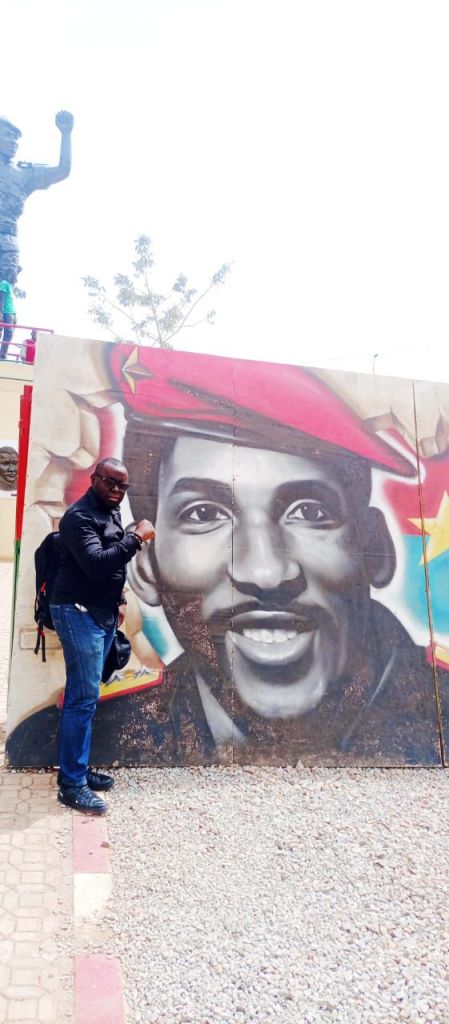
I share with you this short reflection after my umpteenth visit to the Thomas Sankara monument. Each visit to this site always leaves me with a particular emotion. This time again, it was a strong moment. I would have liked to meditate on the new site of his tomb, but the work in progress did not allow it. That said, the strength of his thought and the power of his legacy resonate well beyond physical places. It is impossible not to leave with ideas in mind. It is impossible not to ask questions.
Sankara is more than a face on a monument. He is a spirit that challenges. A voice that disturbs. An example that inspires. And I tell myself that we, progressive activists today, still have so much to learn from him. So much to assimilate.
Here are some of the ideas and postures that I believe are essential to keep in mind:
1. Think for yourself, act for yourself
Sankara repeated tirelessly that no authentic revolution could be made in dependence. We must break the chains of economic and intellectual submission. Imagine our own solutions, with our own resources.
I wonder: Are we really ready to assume this degree of independence?
Do we have the courage to propose another way, far from imported recipes?
2. Align your actions with your words
With Sankara, there was no double talk. He lived what he preached. Simplicity. Integrity. Refusal of privileges. He understood that a credible leader must first govern himself.
Honestly, who among us can claim to live totally in coherence with his commitments?
This personal reminder to order is more than necessary.
3. Making Women’s Liberation a Priority
Sankara said it clearly: “Revolution and women’s liberation go hand in hand.” No change without equality. No future without the full participation of women.
Frankly, where are we on this point?
Are we as radical as he was on this fundamental issue?
4. Promoting local production and building a sovereign economy
“Let’s consume what we produce.”
It was not just a slogan. It was a political strategy. A way to assert our economic sovereignty.
The real question: How, in a world dominated by imported overconsumption, can we put this idea back at the heart of our priorities?
5. Having the courage to say no
Say no to unjust debt. No to corruption. No to interference. Sankara paid a high price for his refusals. But his “no”s restored dignity to a people.
I wonder: Do we still have this ability to say no, even when it costs us?
6. Placing ecology at the heart of the fight
Well before the climate became a global issue, Sankara had already understood the urgency of protecting the environment. Reforestation, sustainable management of resources: that was also his revolution.
Today, can we still claim to defend a progressive cause without integrating the ecological question?
—
Every time I visit this monument, I realize that Sankara did not just leave us speeches. He left us a call. A challenge. That of continuing an unfinished work.
We do not have to agree on everything. But we have a duty to assimilate the essential. Because deep down, his vision was simple: dare to invent the future.
So, let’s dare. Let’s dare to think differently. Let’s dare to live differently. Let’s dare to fight differently.
“Woe to those who gag the people.”
The warning remains relevant. The mission too.
— Franck Essi
 franckessi.com