By Franck Essi, February 5, 2025
January 2025 marked the formal withdrawal of Mali, Burkina Faso, and Niger—the three member states of the Alliance of Sahel States (AES)—from the Economic Community of West African States (ECOWAS). Announced a year earlier, this rupture is now a reality, occurring at a symbolic moment: the sub-regional organization is celebrating its fiftieth anniversary. Far from being a trivial event, this constitutes the most severe institutional crisis in ECOWAS’s history, casting doubt on its ability to maintain its leadership in the West African integration project.
In light of this institutional fracture, several pressing questions arise: Why did ECOWAS’s approach prove inadequate in managing this crisis? What lessons can be drawn to prevent further fragmentation? This analysis seeks to examine the shortcomings of the regional strategy in responding to political shifts in the Sahel and to propose avenues for effectively rebuilding the mechanisms of integration and conflict management.
I. Structural Limits of ECOWAS’s Approach to the Crisis with AES
In dealing with the succession of coups in Mali, Burkina Faso, and Niger, ECOWAS accumulated errors of judgment, execution, and communication. Three core issues deserve particular attention: the ineffectiveness of sanctions, the inadequacy of the security response, and a widespread perception of unjust and biased treatment.
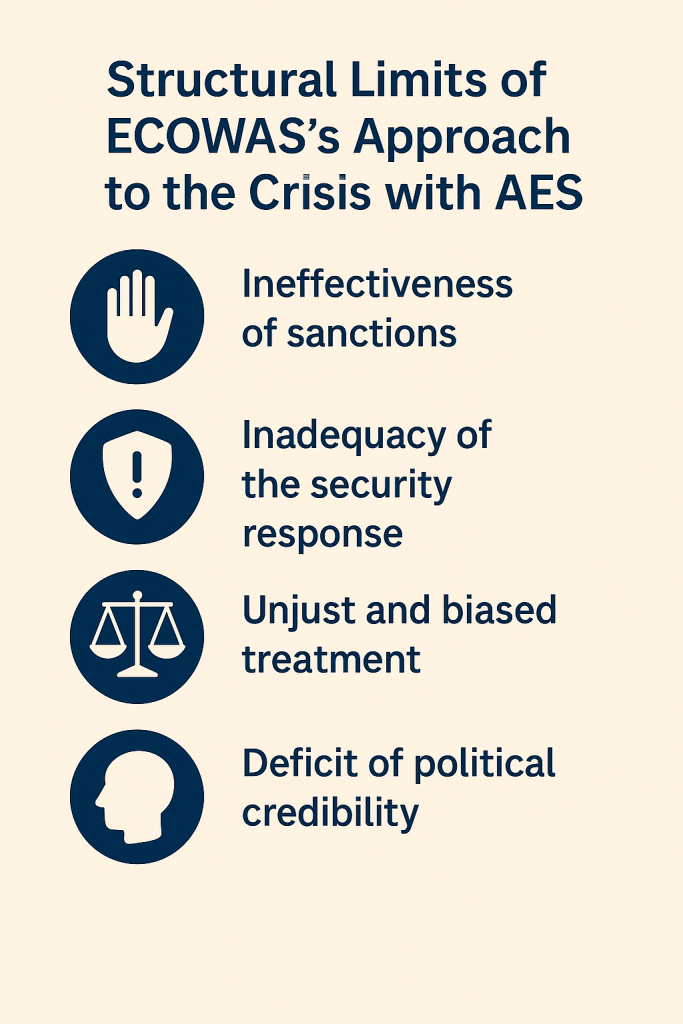
First, the sanctions imposed by ECOWAS on the Sahelian military regimes not only failed to change their course but also generated counterproductive effects. Far from weakening these governments, the measures actually bolstered their domestic legitimacy. Perceived as unfair, the sanctions disproportionately affected civilians while largely sparing military elites. Their legality was frequently contested, and inconsistent application fueled a sense of injustice. ECOWAS was seen as harsh toward military regimes but lenient with civilian leaders who altered constitutions to cling to power.
Second, on the security front, ECOWAS proved incapable of offering a coherent, adaptive, and united response to the growing terrorist threat. Sahelian countries, at the forefront of the jihadist onslaught, condemned the lack of regional coordination, underfunding of joint military operations, and insufficient collective engagement. Existing mechanisms like the Accra Initiative and the Multinational Joint Task Force failed to contain the expansion of insecurity. This strategic inertia deepened the feeling of abandonment among the most exposed nations.
Finally, ECOWAS suffered from a deficit of political credibility in the eyes of its members, particularly in its enforcement of its own principles. The organization is accused of applying double standards—tough on military regimes, lenient on civilian autocrats. Moreover, suspicions of alignment with foreign geopolitical agendas, especially those of France, further eroded trust. Decisions often appeared unilateral, lacking consultation and local legitimacy.
These compounded shortcomings highlight ECOWAS’s struggle to adapt its tools to shifting political and security realities. They underscore the urgent need to rethink its governance model, operational principles, and connection to the people of the region.
II. What Next? Five Priorities for a Resilient and Inclusive ECOWAS
The withdrawal of AES countries must serve as a catalyst for ECOWAS’s structural reform. To regain legitimacy, credibility, and effectiveness, five key priorities must guide its renewal: institutional strengthening, democratic governance, inclusive security, financial autonomy, and renewed strategic dialogue.
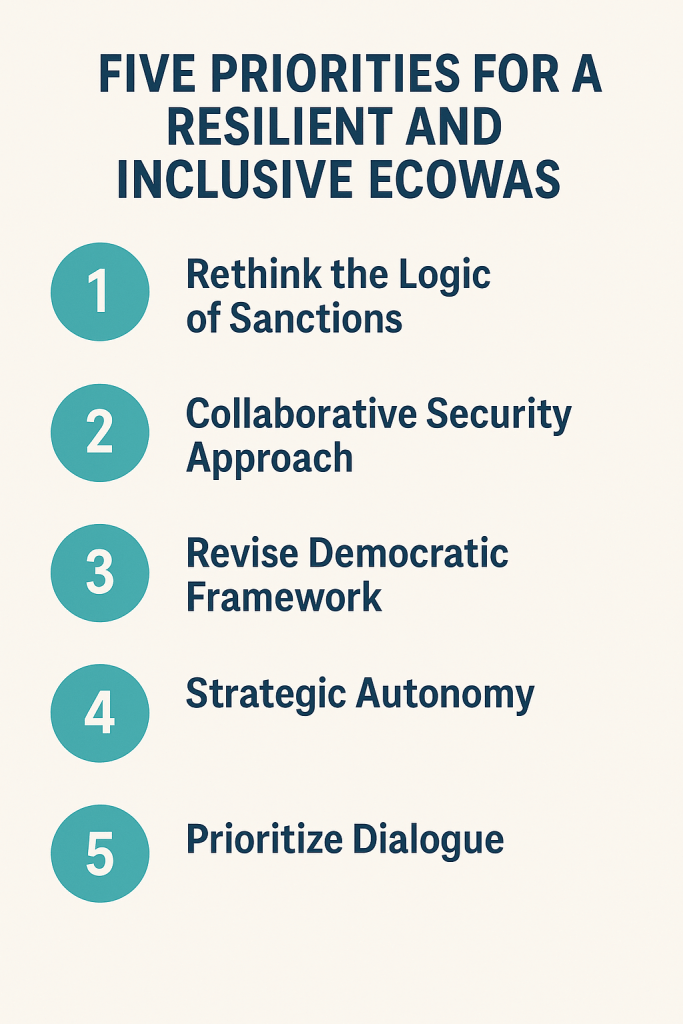
The first area of focus should be rethinking the logic of sanctions. These must become tools of targeted, transparent, and proportionate pressure. Rather than punishing entire populations, sanctions should be directed at political and military actors responsible for constitutional violations. ECOWAS must define objective criteria, establish a permanent monitoring committee, and improve communication on the intended outcomes. Preliminary national dialogue and humanitarian aid in tandem with economic sanctions could ease tensions and give new meaning to the idea of a “people’s ECOWAS.”
Second, in terms of security, the organization must embrace a more collaborative approach, including with AES, avoiding exclusionary postures. An effective response requires sustainable funding, the establishment of a transparent regional security fund, and a shared strategy against transnational threats. This also involves strengthening the ECOWAS Standby Force, expanding cooperation with the African Union, and grounding peace efforts in local realities by involving affected communities.
Politically, ECOWAS should thoroughly revise its Additional Protocol on Democracy and Good Governance. In effect since 2001, it no longer meets today’s challenges. It must enshrine strict presidential term limits, impose automatic sanctions for constitutional manipulations, and establish permanent monitoring mechanisms that include civil society and independent experts. Transparency and fairness in enforcing democratic norms are critical to rebuilding trust.
A fourth challenge concerns ECOWAS’s strategic autonomy. Its dependence on external funding undermines both political independence and operational flexibility. Diversifying financial sources is crucial—this means expanding community levies, creating a regional investment fund, encouraging private capital, and strengthening internal financial management. These efforts must be accompanied by capacity building and the creation of an independent regional audit agency.
Finally, ECOWAS must prioritize dialogue at all levels. This is not about capitulating to AES, but recognizing that shared interests—such as counterterrorism and regional trade—require minimal cooperation. Regular consultation platforms, neutral mediators, joint coordination mechanisms, and transparent communication about progress are essential to maintaining political ties, even amid institutional rifts.
Ultimately, the split between AES and ECOWAS is not merely a passing crisis—it reveals a structural deficit in West Africa’s regional governance. To avoid irrelevance or becoming an empty shell, ECOWAS must reinvent itself, return to its founding principles, and reconnect with its citizens. Though painful, the current rupture could become a historic turning point—one that leads to a more inclusive, fair, and strategically sound ECOWAS, equipped to confront the continent’s profound transformations.
 franckessi.com