By Franck Essi
Crime, Emotion, and the Manhunt
On May 10, 2025, Cameroon woke up shaken by horrific news: a six-year-old child was fatally beaten by the biological father of Lydol, a renowned Cameroonian poet and artist.
The horror of the crime quickly gave way to another, more insidious violence: mob justice.
On social media, a wave of hatred arose. Through comments, montages, accusations, and calls for « cancel culture, » it is now Lydol herself who is being pilloried, accused of being complicit, responsible, or simply « indefensible » simply because of her blood relationship with the perpetrator of the crime.
This tragic incident reveals much more than a family and social tragedy. It highlights a growing trend of our times: the substitution of debate for digital lynching, of justice for the emotional tribunal of social media.
This climate should worry us. Not only for its consequences for the victims of media injustice, but also for what it says about our collective relationship with truth, justice, and human dignity.
—
Lydol and the syndrome of guilt by association
Lydol didn’t kill anyone. She wasn’t present at the scene of the crime. To my knowledge, she never supported or encouraged violence. But her name is now associated, conflated, and confused with that of her father. Why? Because she is a public figure. Because she is visible. Because pain demands a culprit within reach.
This is how pack logic is born: outrage, initially understandable, becomes a hunt. We no longer seek to understand, to distinguish, to reason. We seek to accuse, to condemn, to eradicate. In this collective frenzy, the basic principles of justice are swept aside: the presumption of innocence, the right to a fair trial, the separation of individual responsibility.
—
Mob justice, without rules or checks and balances
The Lydol case illustrates a broader phenomenon: the rise of a « parallel justice » on social media, where accusation becomes sentence, and where collective emotion replaces the law. This form of justice operates without evidence, without procedures, without defense. It does not seek to establish the truth, but to satisfy a collective impulse: that of « punishing. »
However, in a state governed by the rule of law, no one can be held responsible for a crime committed by another—even one’s father. Accepting this logic of guilt by descent means returning to archaic practices of collective stigmatization, denying individuality, and trampling on justice itself.
—
Social Media Becomes Instruments of Oppression
Social media, which were supposed to open up spaces of freedom, sometimes become places of oppression. Lives are shattered by a hashtag. Reputations are destroyed by a video taken out of context. Artists, activists, and ordinary citizens find themselves pinned to the wall of digital shame, unable to defend themselves.
Speech is freed, they say. But what speech? And in the service of what? A society does not progress when it exchanges complicit silence for accusatory noise. It progresses when it builds spaces for debate, peaceful confrontation, and shared truth.
—
The Cameroonian Paradox: Demanding Justice but Renouncing Justice
In Cameroon, frustration with impunity runs deep. Institutional injustice fuels rage. But this rage, if left unchecked, becomes a source of injustice itself. What we are experiencing today with the Lydol affair is a society that, having been repeatedly betrayed by its institutions, seeks to take justice into its own hands—but without respecting their principles.
This is the great paradox: demanding a stronger justice system while practicing a weaker one. Calling for the rule of law while normalizing witch hunts. Defending victims while trampling on presumed innocents.
—
What to do? For an ethic of collective responsibility
It’s time to pause. To breathe. To question our own stance. What do we really want? A society guided by justice or by rumor? A coexistence based on dignity or on denunciation?
Faced with the temptation of the pack, we must relearn prudence. Before sharing, verify. Before judging, listen. Before condemning, reflect. This is not just a moral requirement: it is a condition of democratic survival.
We must also forcefully remind ourselves that the pain of a tragedy does not justify all excesses. Grief must not serve as a pretext for collective banishment. And no suffering will be repaired by the injustice inflicted on another innocent person.
—
Lydol today, who tomorrow?
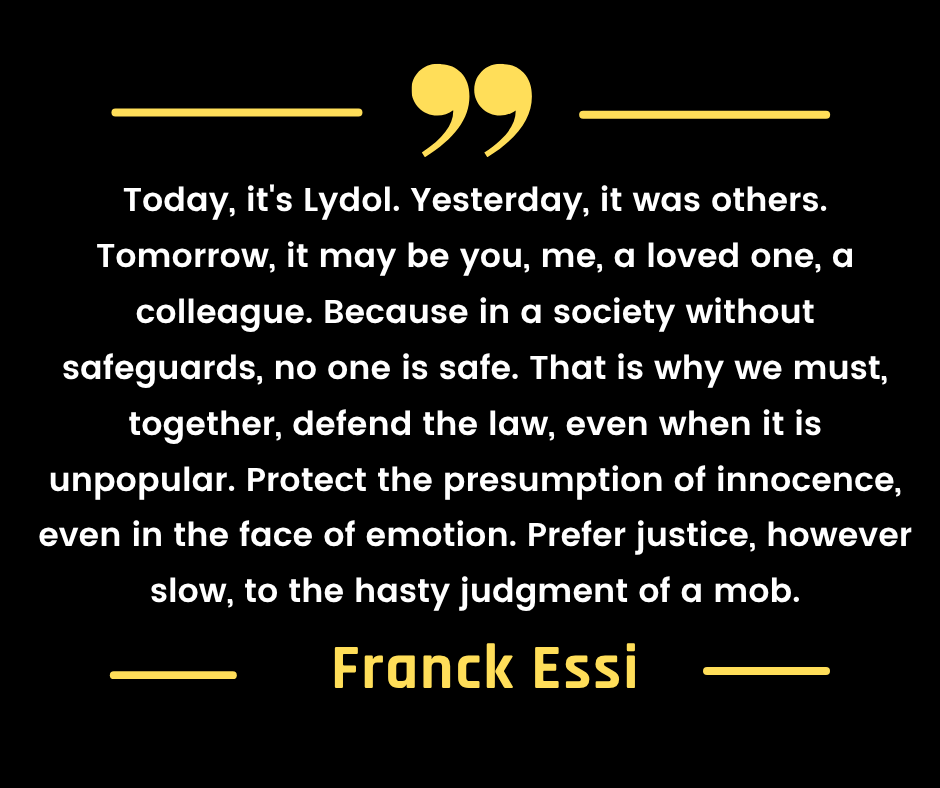
Today, it’s Lydol. Yesterday, it was others. Tomorrow, it may be you, me, a loved one, a colleague. Because in a society without safeguards, no one is safe. That is why we must, together, defend the law, even when it is unpopular. Protect the presumption of innocence, even in the face of emotion. Prefer justice, however slow, to the hasty judgment of a mob.
Justice, true justice, is never a lynching. It is slow, demanding, and sometimes imperfect. But it is the only path to a just and humane society. It is this path we must choose, despite the temptation of noise and revenge.
Franck Essi
#WhatIBelieve
#WeHaveTheChoice
#WeHaveThePower
#TurnOnOurBrains
#CitizenEducation
 franckessi.com