By Franck Essi
Is the Network Tribunal the New Social Norm?
In the digital age, a new form of « justice » has emerged: immediate, viral, and often brutal. It stems neither from the law nor from open debate, much less from investigation or nuance. It begins with a tweet, escalates in a Facebook Live broadcast, and takes root in the comments of a WhatsApp post. This is mob justice 2.0, a disturbing phenomenon where accusation is enough to convict, where the presumption of innocence is a weakness, and where collective indignation turns into symbolic execution.
In Cameroon, as elsewhere, this trend is gaining momentum. Political figures, artists, activists, entrepreneurs, and ordinary people alike: no one is safe. As soon as a suspicion is raised—whether founded or not—the media lynching begins. This climate, which sometimes presents itself as an act of civic justice or an awakening of consciences, nevertheless conceals dangerous excesses.
—
Justice without rules: the reign of raw emotion
The first characteristic of mob justice is emotion. Anger, frustration, fear, resentment—all legitimate feelings, but often amplified and exploited on social media. Emotion becomes judge, jury, and executioner. Legitimate anger at impunity or corruption thus transforms into a generalized impulse for revenge.
But a society cannot be governed by emotions alone. They need to be controlled, confronted with reason, the rule of law, and critical examination. When emotion takes precedence over reflection, nuance disappears. The accused automatically becomes guilty. And we forget that in a state governed by the rule of law, an individual is not judged on the basis of a « buzz, » but on the basis of a body of verifiable evidence, debated in a contradictory manner.
—
A formidable political and social weapon
Mob justice is all the more dangerous because it becomes an instrument. Some use it to eliminate political, professional, or ideological opponents. A scandal is fabricated, digital relays are activated, popular anger is fueled… and the accused is discredited, sometimes destroyed, before even having a chance to defend themselves.
In a context like Cameroon’s—where distrust of judicial institutions is high—this parallel justice sometimes seems more effective and faster. But it is also more arbitrary and more unjust. It does not liberate society; it radicalizes it. It does not construct the truth; it imposes a narrative.
—
A Collective Weakening of the Culture of Justice
The normalization of mob justice is dangerously weakening the culture of justice in our societies. It blurs the lines. We no longer know what constitutes fact, rumor, defamation, or legitimate criticism. This confusion undermines the very foundations of critical thinking.
Worse still, it creates widespread fear. The fear of being falsely accused, publicly humiliated, or socially excluded. This fear creates a society of mutual surveillance, where everyone fears to speak, think, or even exist outside the mainstream of the moment.
In this climate, fundamental rights—freedom of expression, the right to a defense, and privacy—become secondary. And democracy is slowly but surely eroding.
—
What We Collectively Risk
If we don’t react, we risk sliding toward a society where public accusation is worth a sentence. Where image is worth truth. Where virality is worth proof. In such a society, there is no recourse, no possible redress for the innocent. There is only fear, silence, or servility.
This logic of constant denunciation is not progress. It is not a democratic awakening. It is a pathology of the connected society. It produces monsters while claiming to combat them. It does not replace institutional injustice: it doubles it.
—
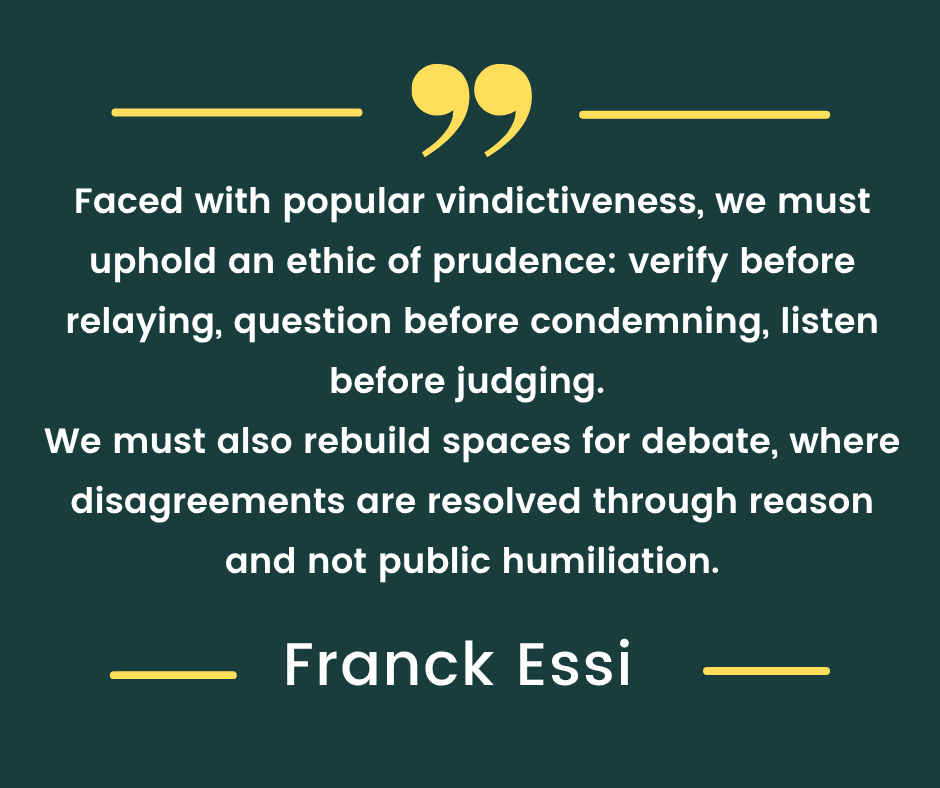
For an ethic of prudence and the reclamation of debate
This is not about denying the abuses, crimes, or misdeeds committed by certain figures. It is not about protecting the powerful from criticism. It is about defending a certain idea of justice, based on truth, contradiction, and moderation.
Finally, we must advocate for responsible use of social media: not to lynch, but to awaken; not to defame, but to question; not to destroy, but to build.
—
My conviction: There is an urgent need to relearn justice, together.
Justice will never be perfect. But it must remain a horizon. And we must refuse to let digital violence take its place. Progress in our societies will come neither from collective outcries nor from digital manhunts, but from a constant effort of discernment, respect, and moral courage.
In a world that confuses virality with truth, indignation with justice, it is urgent to remember that human dignity—even that of a presumed guilty person—must never be thrown to the wolves. Rejecting mob justice means defending not the guilty, but the very idea of a just society.
Franck Essi
#WhatIBelieve
#WeHaveTheChoice
#WeHaveThePower
#TurnOnOurBrains
#CitizenEducation
 franckessi.com