By Franck Essi
We don’t build a just society with laws alone. We first build it with a culture of justice, that is, with women and men deeply committed to fairness, truth, respect for the law, and human dignity.
In Cameroon, the absence of a spirit of justice in daily behavior, in social relations, in the way power is exercised or conflicts are managed, is one of the greatest obstacles to the country’s transformation.
Developing this spirit isn’t just about calling for institutional reforms. It’s about triggering an inner and collective drive that places justice as a core value in every space of life, decision-making, and organization. Here’s what this entails at different levels.
1. At the individual level: Dare to practice justice in everyday life
It all starts within. Developing a sense of justice means rejecting injustice, even when it benefits us. Refusing to cheat in school, to bribe an officer, to take advantage of a special privilege. It also means having the courage to say no to the unacceptable, even when it doesn’t directly concern us.
A just mind means an awakened conscience. It means knowing how to question one’s own privileges, recognizing the injustices one doesn’t experience, and rejecting complicit silence.
It means asking simple but radical questions:
Is this fair? Is it true? Is it good for everyone?
It is these personal reflexes, repeated, that nurture a strong civic culture.
2. In associations: practicing justice internally
Too many associations, even those that fight for human rights, reproduce the patterns of injustice they denounce elsewhere: cronyism, sexism, authoritarianism, favoritism. Developing a sense of justice within an organization means:
• Guaranteeing financial transparency;
• Making decisions inclusively;
• Ensuring equal voice, opportunities, and responsibilities;
• Actively combating internal discrimination.
The association is a school of citizenship. If its governance is not fair, it loses all legitimacy to demand change in society.
3. In political parties: Break with the logic of leadership and impunity
The majority of parties in Cameroon operate as private properties or loyalty circles, where justice is replaced by allegiance.
But how can we embody national change if we reproduce injustice internally?
To prepare to do things differently, more, and better within political parties, it is necessary to:
• Put an end to the personalization of power;
• Organize frank and democratic internal debates;
• Demand accountability for resource management and political choices;
• Protect minority opinions, guarantee appeal and mediation procedures.
A fair political party does not simply seek to win power, it seeks to embody it differently.
4. In local communities: building justice at the grassroots
Neighborhoods, villages, churches, chiefdoms, tontines, and unions are the primary places where the experience of what is just and unjust is forged.
But too often, these spaces perpetuate:
• The exclusion of women,
• Contempt for young people,
• Arbitrary decision-making,
• Silence in the face of abuse.
Developing a sense of justice in communities in this context means:
• Creating genuine spaces for dialogue;
• Ensuring accessible and credible mediation;
• Valuing the voice of everyone, especially the most vulnerable; • Demand accountability from local authorities, whether religious, traditional, or political.
A just community is one that repairs, protects, listens, and uplifts.
5. At the institutional level: Make justice a state priority
Without justice, no peace lasts, no development sustains.
Justice can no longer be just another ministry. It must become the living foundation of the Republic, the basis of all public policies.
This requires:
• A profound reform of the judicial system;
• An end to the political exploitation of judges;
• Real and free access to legal aid for the poorest;
• Restorative, equitable, and humane justice;
• Local justice, rooted in local languages and realities.
But this is not enough. The demand for justice must permeate the entire state:
• In the awarding of scholarships,
• The management of competitive examinations,
• Public procurement,
• The exploitation of natural resources,
• Social policies.
• Etc.
What we need is not technocratic governance, but just governance.
—
My conviction: More than a system, justice is a culture in a well-functioning country.
We can have exemplary laws and resigned people. Solid institutions and a society without a moral compass.
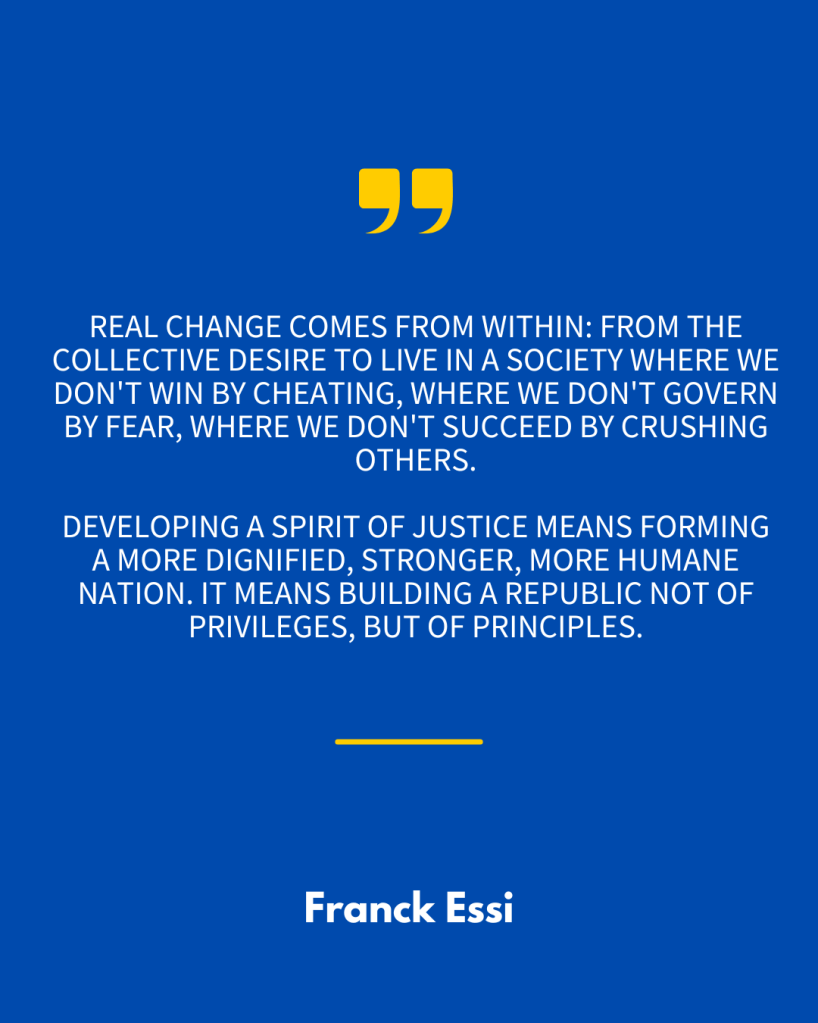
Real change comes from within: from the collective desire to live in a society where we don’t win by cheating, where we don’t govern by fear, where we don’t succeed by crushing others.
Developing a spirit of justice means forming a more dignified, stronger, more humane nation.
It means building a Republic not of privileges, but of principles.
It means creating people who ask not only:
« What is the State doing for me? »
But also:
« What are we doing together for justice? »
Franck Essi
#WhatIBelieve
#WeHaveTheChoice
#WeHaveThePower
#CitizenEducation
#TurnOnOurBrains
 franckessi.com