By Franck Essi
May 20: what are we really talking about?
Every May 20, Cameroon celebrates « national unity » or, more precisely, the « Unitary State ». But what are we actually celebrating? A date? A ritual? A fiction? For decades, this celebration has been reduced to a parade, a stage show, a smokescreen that poorly masks the deep pain, the visible fractures, the gaping wounds of our national body.
In a country where the majority struggle to make a decent living, where so many citizens are marginalized, precarious and forgotten, national unity cannot be reduced to slogans, official songs and expensive agape. Unity cannot be built on empty words. It’s built on values, an accepted history, a credible collective project, real justice, equitable sharing of resources, and effective respect for human dignity.
Celebrating national unity should be an occasion for retrospection, evaluation, commemoration and foresight:
- Looking back, to honor the battles fought and the gains hard-won;
- Evaluation, to recognize shortcomings, failures, renunciations;
- Commemorating heroes and heroines too often forgotten or erased from official memory;
- Foresight, to plan together for the construction of a truly just, inclusive and supportive society.
But today, what we’re seeing is a decline in national feeling, a crumbling of civic ties, a crisis in living together. It’s never too late to open our eyes. And to ask the real questions. For my part, I’m convinced that at least ten major flaws today threaten the cohesion of our country and are cracking the foundations of our national unity. If we are to rebuild our nation, we need to take up ten challenges and open up ten new avenues.
Before I get to that, a few clarifications are in order to better define what we mean by national unity – and thus better situate the diagnosis and collective invitation I’m about to make.
What is national unity?
National unity is not a date, a slogan or an administrative ritual. It’s a living collective project, founded on harmony, mutual respect and a consensus on our common identity and fundamentals as a Nation.
It’s based on a sincere desire to live and move forward together, respecting our differences and committed to truly shared justice.
It necessarily implies :
- A consensus on institutions, the fundamental law and the rules of the political game;
- Political, economic and social inclusion of all Cameroonians, without distinction;
- A rejection of structural injustice, chronic inequality and the monopolization of wealth by the few;
- Genuine, ongoing political and social dialogue, not a masquerade of consultation with no follow-up.
National unity is actively built every time we strengthen consensus, reduce inequalities, share resources equitably, value our history in all its truth, and bring democratic values to life in our institutions as well as in our behavior.
On the contrary, it is deconstructed as soon as debate is silenced, injustices are concealed and symbols are used instead of embodying the ideals they are supposed to embody.
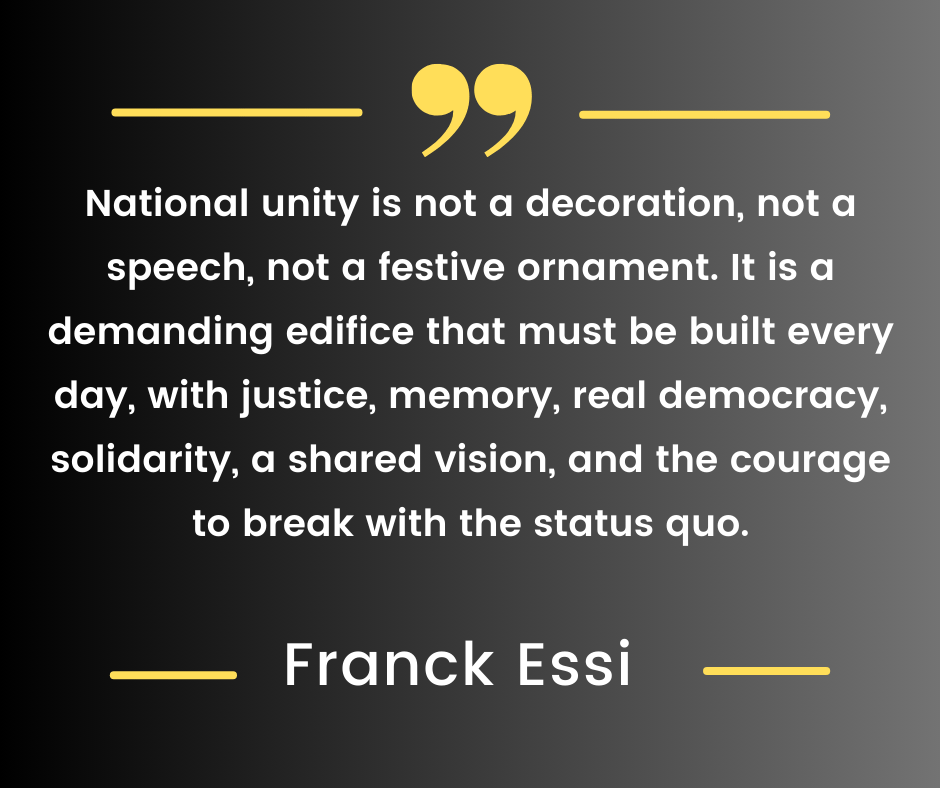
National unity is not a decoration, not a speech, not a festive ornament. It is a demanding edifice that must be built every day, with justice, memory, real democracy, solidarity, a shared vision, and the courage to break with the status quo.
So what are the gaps that need to be filled and the projects that need to be launched to rebuild the nation?
Here, in my opinion, are ten major challenges, ten fault lines that we absolutely must confront if we want national unity to become anything more than a meaningless slogan. Ten urgencies for a truly shared common future.
Gap 1. The question of tribal identity: when misunderstood ethnicity takes precedence over citizenship
Cameroon is a mosaic of peoples, a crossroads of languages, cultures, spiritualities and memories. An inestimable wealth. But also, all too often, a minefield. Undermined by identity-based divisions, ethnic prejudice and the cynical instrumentalization of diversity for the purposes of power. What should be our greatest strength has become, by dint of manipulation and nurtured fear, one of our greatest hindrances.
Instead of being perceived as a common base to be enhanced, diversity is systematically trapped in a logic of mistrust, quotas and compartmentalization. Citizenship itself is diluted in an ethno-mathematical vision of the Republic: every position, every advantage, every opportunity must now correspond to a « regional balance », as if the country were a cake to be cut according to origins, rather than a collective project to be built on solidarity and competence.
A nation isn’t built on ethnic partitions. It’s built with bridges. Bridges between peoples, between memories, between generations. Bridges of meaning, values and projects. As long as we place community belonging above the general interest, national sentiment will remain fragile, contingent and conditional.
This is not inevitable. But it does require a break.
We need to put an end to political ethnicism, the logic that allows local elites to harness the anger of their communities, the better to channel it into preserving the status quo. We need to decolonize our reflexes, because even in colonial times, diversity was used to divide. The poison has never been completely purged. It has simply been transformed, modernized and disguised as « representativeness ».
The truth is blunt: as long as the other is perceived as a threat, as long as the « us » is built against a « them », as long as the State gives in to the logic of withdrawal, any attempt at unity will be doomed to failure.
That’s why we need a national policy of identity reconciliation. What’s needed is a new kind of education that doesn’t deny people’s allegiances, but transcends them. An education that fosters shared citizenship, awareness of a common destiny, and pride in a diversity that is embraced – not feared.
Retrograde practices and discourse must be abolished at all levels: in institutions, in the media, in parties, in families. We must break the tacit pact between power and ethnicism, which has no other purpose than to reproduce a system of exclusion and rent.
The movement of history, and particularly that of Cameroon, is a movement towards intermingling, towards overcoming, towards nationhood. But for this to become a reality, it will take courage. Political courage, intellectual courage, moral courage.
So let’s ask the real questions:
- How can we deconstruct the idea that Cameroon is an ethnic cake to be shared?
- How can we create an active citizenry that transcends birthplace allegiances?
- How can we build a Nation that protects without dividing, that recognizes without categorizing?
Because you can’t build a nation on fear. It’s built on trust, justice, truth and the courage to reinvent ourselves together.
A nation is not built with ethnic partitions. It’s built with bridges.
Gap 2. Extractive governance: when the state becomes a booty and unity a lure
In Cameroon, the State no longer functions as a common good. It has become the private affair of a false elite obsessed with rent, disconnected from the realities of the people, and clinging to the levers of power as a source of personal enrichment. Governance, far from being inclusive, transparent or oriented towards the general interest, is dominated by a logic of monopolization.
Administration is inefficient. Public policies lack vision, continuity and results. Corruption spreads, impunity sets in, and the State itself ends up appearing as a mere window of privileges reserved for insiders. The Republic is no longer seen as a place of equality, but as a rigged market where only the best placed win.
The principle of redistribution is distorted. Public investment is concentrated in politically favored areas, with no link to the real needs of the territories. Instead of correcting imbalances, the State budget exacerbates them. And the gap is widening between an over-protected center and relegated outlying areas.
But there can be no national unity without real national integration, based on three pillars:
- Culturally, a common vision, shared values, collective references that unite rather than divide.
- Economically, equitable access to the production and redistribution of wealth, without regional, social or ethnic discrimination.
- Politically, the recognition of all groups and currents in the democratic game, and the full exercise of rights and freedoms for every citizen.
But integration is not just wishful thinking. It is the product of the way in which a state designs, implements and evaluates its policies. It depends on the capacity of institutions to guarantee justice, performance and equity in the distribution of efforts and the fruits of development.
Today, governance in Cameroon does exactly the opposite: it excludes, marginalizes and stigmatizes. It feeds frustration and encourages identity-based withdrawal. It pushes citizens to see themselves no longer as members of the same national body, but as adversaries in a competition for scraps.
This logic is reinforced by a political practice reduced to clientelism, the distribution of positions and the clannish management of institutions. Instead of structural reforms, tinkering is proposed; instead of a real debate on social justice, false symbols of unity are brandished, such as the Indomitable Lions’ sporting achievements.
The tragedy is that this system is not based on ignorance, but on a well-thought-out strategy for capturing power. Those in power know what they’re doing. They know that the privatization of the state weakens the sense of national belonging, but they profit from it. They know that exclusion creates tensions, but they put up with it.
This raises an essential question:
How can we break with this culture of rents and rebuild governance that serves the people?
This implies :
- A break with the State’s patrimonial logic;
- Governance based on performance, accountability and equal opportunity;
- An end to impunity and a genuine policy of social justice;
- An equitable redistribution of resources, serving the development of marginalized regions and communities.
National unity cannot be empty rhetoric masking the reality of despoilment. It must be the fruit of a credible collective project, lived in justice, dignity and inclusion. As long as the state is perceived as a booty, the people will have no reason to believe in the national narrative imposed on them.
It’s a huge undertaking. But it is inescapable. You can’t build a nation on rent, contempt and lies. It’s built on justice, respect and truth.
Gap 3. The Anglophone question: a historical dispute that has become an open wound
The Anglophone question does not date back to 2016. It has its roots in an older history, marked by the betrayal of the spirit of reunification, the unilateral abolition of federalism, and the gradual marginalization – symbolic, political, economic and cultural – of the so-called English-speaking regions.
What could have been a political issue handled with lucidity and justice has been transformed, through wilful blindness and the logic of internal domination, into a profound crisis. And this crisis has become a creeping war, which has been bloodying the North-West and South-West regions for over eight years, with repercussions far beyond these territories.
The toll is heavy: thousands dead, schools closed, children enrolled in the violence, entire communities displaced or traumatized. And all the while, the official discourse persists in denial, reducing a political demand to a simple security issue.
By refusing to listen to the historical grievances of a section of the population, by betraying the initial commitments to reunification, by responding to legitimate aspirations with repression, the State has contributed to turning discontent into insurrection.
Where we are today:
- Can we continue to ignore the deep sense of injustice felt by millions of our fellow citizens?
- Can we hope for peace without acknowledging wrongs, without sincere reparation, without structural reform?
- Can we talk of national unity without a rethought institutional framework to guarantee, at last, equality in diversity?
Neither pretence of dialogue, nor falsification of history, nor force alone will overcome such deep-rooted resentment. National unity cannot be decreed. It is not built on the ashes of denial. It is built on truth, justice and the shared will to be a nation.
The road to reconciliation lies before us. It requires us to look the past in the face, mend broken ties, and rebuild a national project that leaves no one behind.
Gap 4. Social injustice: the silent poison of national dislocation
In Cameroon, social injustice is not a passing anomaly. It is a systemic reality. It silently eats away at the bedrock of national unity, undermines social cohesion and fuels a deep sense of abandonment among millions of citizens.
One in three Cameroonians does not have enough to eat. Women struggle to find their place in decision-making circles. People with disabilities are largely invisible. Thousands of overqualified young people wander around with no prospects. The informal economy absorbs the majority of precarious workers. Poverty is becoming a hereditary inevitability. Schools, supposed to correct injustice, reproduce it. Hospitals, which are supposed to treat, exclude those who cannot afford to pay.
The Republic is supposed to guarantee everyone access to the common good: drinking water, electricity, healthcare, education, justice. But in reality, these rights are increasingly a matter of privilege. When daily life is made up of deprivation, humiliation, arbitrariness and survival, the very idea of living together becomes an illusion.
In a country where the elite accumulate wealth and privileges while the majority fight for their dignity, there can be no talk of unity. Mass unemployment, social exclusion, economic violence and widespread insecurity are fracturing the nation from within. The social contract is broken.
How can we build national solidarity in such a context? How can we believe in a common destiny when so many Cameroonians live in anguish about the future? Can we still speak of justice when the State seems to turn its back on the weakest?
National unity cannot take root in a country where suffering is unevenly distributed, and where privileges crush rights. Without social justice, there can be neither true peace nor a stable political community.
Rebuilding the nation also means re-establishing equal opportunities, making fundamental rights effective, redistributing resources fairly and repairing lasting injustices. It means treating social injustice not as an inevitability, but as a national emergency.
Let’s not forget this basic truth: a nation with structural inequality is a social time bomb.
Gap 5. Political lock-in: when democracy becomes a façade
Cameroon’s « peaceful democracy » has run out of steam. The electoral process has been perverted. The body responsible for organizing the polls is cruelly lacking in independence and competence. The Constitutional Council has become a recording chamber. Opposition parties are harassed and their actions hindered. Fundamental freedoms – of association, expression and demonstration – have been whittled away to nothing, due in particular to the acceleration in recent years of the narrowing of the space for freedoms by a certain « Moulinex ».
The citizen no longer chooses. They witness a staged event where the outcome is written in advance. It’s no longer a vote, it’s resignation. This is no longer democracy, it’s a sham.
National unity cannot be built without real representation, open debate and shared legitimacy. A nation is founded on the participation of all its components, on the possibility of alternation, on confidence in the rules of the game. Where these rules are skewed, the very idea of a social contract disintegrates.
When political space is closed off, when public order becomes a pretext for systematically banning demonstrations, when administrative authorities become the watchdogs of a single party, then the democratic scene is transformed into a closed field. And the people, deprived of a voice, end up looking for other ways to express themselves – more brutal, more unpredictable.
Therefore :
- Can we still speak of national unity in a country where dissident voices are muzzled, where the opposition is demonized, where citizens no longer believe in the usefulness of the ballot paper?
- Can we hope for lasting peace when popular anger finds no credible institutional outlet?
Locking down politics undermines democracy. To undermine democracy is to inflame tensions. When you make a peaceful revolution impossible, you pave the way for a violent rupture.
Rebuilding the Nation means reopening political space. It means guaranteeing everyone the right to act, to challenge, to propose. It means restoring confidence in institutions by rebuilding the democratic pact on sound foundations: independence, fairness, transparency and pluralism.
National unity only makes sense if it includes all citizens in defining the common future. And that starts with a real, open and living democracy – not a locked-in illusion.
Gap 6. Land and water: a muted war and a major risk of implosion
Cameroon soil is not just a territory: it has become a silent battlefield. A social, community and political time bomb. Land and water, vital resources, are today at the heart of growing tensions. And yet, this major issue remains relegated to the margins of national debate, as if we refuse to open our eyes to an imminent peril.
Land conflicts are everywhere. They resurface when expropriations are carried out in the name of an often dubious « public utility ». They explode when communities denounce the gradual invasion of their ancestral lands by other groups or by companies backed by political-administrative networks. They explode when multinationals monopolize thousands of hectares for projects whose real impact on the common good remains uncertain, if not harmful.
In 2020, according to several civil society organizations, 85% of disputes before Cameroonian courts were related to land disputes, in a country where almost 85% of land is unregistered. This simple observation is enough to gauge the scale of the chaos.
The legal system inherited from the 1974 ordinance is obsolete. Disorder, opacity and clientelism reign in the field. The duality between customary and modern law creates permanent insecurity. Local populations often have no recourse. The legal vacuum is filled by well-organized networks of land predators. Instead of being a lever for integration and stability, land tenure has become a factor of fragmentation and resentment.
This land injustice is compounded by long-standing and recurring conflicts over access to water and grazing land, particularly in rural, agro-pastoral and cross-border areas. With the acceleration of climate change, pressure on these vital resources can only intensify. Inter-community tensions will become more frequent, more violent and more difficult to contain if nothing is done.
Land and water are not luxuries. They are conditions for survival.
And when access to survival becomes a field of injustice, national unity disintegrates.
And for good reason:
- How can we build a nation when part of the population feels dispossessed? How can we build peace without land justice?
- How can we reconcile development, sovereignty and community rights?
- How can we prevent conflicts from exploding if the rules of the game remain opaque, unequal and exclusionary?
We can no longer put off the debate. As part of a new national pact, we must build a clear, fair and inclusive consensus on land governance and the management of essential natural resources. This consensus must be based on :
- Recognition of the rights of local communities;
- Reform of the 1974 texts, in line with current realities and future climate challenges;
- Transparency in land transactions;
- Accessible, impartial and efficient land justice.
Rebuilding the nation requires a peaceful relationship with the land. For a people dispossessed of land is a people fractured. And a country without land security is a country on the road to instability.
Gap 7. State deficit and non-state armed groups: a country where the state retreats, chaos advances
Since 2013, a deadly war has shaken Cameroon’s Far North. Boko Haram, then the Islamic State in West Africa (ISWAP), have established their bases there, spreading terror across hundreds of villages. Schools burned. Families decimated. Young people conscripted by force or necessity. Entire communities displaced. Soldiers, gendarmes, policemen and members of vigilance committees losing their lives.
Islamist terrorism is not just an echo of a global problem. It has taken root in a very local breeding ground: the vacuum left by an absent, ineffective or incapable state. In the Far North, as in the East and other border areas, the state did not disappear because of the war – it was its absence that enabled the war.
Where the state guarantees neither schooling, nor health, nor security, nor hope, spirits become vulnerable. Where there is no administrative authority, warlords, traffickers and road cutters impose theirs. When young people have no jobs, no future and no dignity, 40% of them end up joining terrorist groups for purely economic reasons, according to the few studies available.
The state deficit has thus become an incubator for radicalization, a factory of resentment, a cancer for national unity.
How can a young person from Kolofata, exposed to terror on a daily basis, feel solidarity with a young person from Yaoundé, protected, stable and integrated? National unity can only be real if access to services, rights and fundamental protection is equitable throughout the territory. Otherwise, the unitary state becomes a fiction. A facade. A fracture.
It is this inequality of treatment, this lack of equitable deployment of public authority, that fuels the feeling of abandonment. And this feeling, in turn, drives a mental, political and emotional wedge between marginalized regions and the rest of the country. This is not just a security crisis. It’s a crisis of the national bond.
To be complete, the Republic must be present. Not just through repression or military operations. But through schools, health care, drinking water, roads and hope. The State must exist in everyday life, in proximity, in solidarity.
Let’s ask the real questions:
- How can we hope to make a nation when the State is invisible or ineffective in entire areas?
- How do you get people to love Cameroon when they receive nothing but oblivion?
- What kind of policy is needed to rebuild the public presence on the bangs of the territory?
Defeating Boko Haram won’t be enough if we don’t develop a « Functional State » in the Far North and elsewhere. We need to build solid, visible, useful institutions. We need to build an everyday state, not a parade state.
National unity is only possible if the state ceases to be a phantom in certain regions and finally becomes a shared reality.
Gap 8. The diaspora held at the border: when the Nation rejects its own children
The Cameroonian diaspora is a force to be reckoned with. An economic, social, cultural and intellectual force. Every year, it sends over 300 billion FCFA in remittances. They finance healthcare, pay school fees, build houses, create businesses and support families back home. It invests, it commits, it militates. And yet, it is kept at a distance.
Far from being recognized as a full-fledged component of the national body, the diaspora is often viewed with suspicion, even contempt. Institutional distrust, political exclusion and the refusal to grant them full rights – starting with recognition of dual nationality – make them second-class citizens, both indispensable and undesirable.
But national unity cannot stop at physical borders. It must include the community of destiny, wherever it may be. A Cameroonian living in Berlin, Dubai or Johannesburg is not a foreigner. He’s a citizen. A member of the Nation. A player in the present and the future.
The refusal of dual nationality is a costly absurdity. It breaks up families, prevents the return or participation of many expatriates in public affairs, and deprives the country of strategic skills in key sectors such as medicine, research, education, finance and entrepreneurship. It also fuels deep resentment, particularly among young people in the diaspora who have grown up with a dual culture and want to contribute without having to give up part of their identity.
This institutional stance is all the more incoherent given that Cameroon is cruelly lacking in talent, qualified human resources and solid external links. In a globalized world, where diasporas are becoming levers of development and influence for many countries, Cameroon remains trapped in a logic of exclusion, as if it feared its children who had gone far away.
And yet, the diaspora is playing an increasingly visible political role. In the Anglophone crisis, for example, activists based abroad are strongly influencing the national debate, in the absence of any real space for expression within the institutions. By politically marginalizing this essential component of the nation, the state only feeds frustration and radicalization.
What sense does national unity have when millions of Cameroonians are deliberately excluded from the republican pact? How can we build a dynamic democracy, a competitive country, a community based on solidarity, if part of the population is deemed too « foreign » to participate in decision-making, but « national » enough to send money every month?
There is an urgent need to rethink the place of the diaspora in Cameroon’s national project. This implies :
- The adoption of clear and inclusive legislation on dual nationality;
- Facilitating the political participation of Cameroonians living abroad, in particular through the right to vote and stand for election;
- The systematic valorization of their contributions to public policy, local development and Cameroon’s international projection.
You don’t build a strong nation by amputating its strengths. You build it by uniting all its children, from within and without, because a homeland that rejects its expatriate children is an amputated homeland.
Gap 9. Fractured memory, confiscated history: when the past prevents the nation from building itself
Cameroon has never really faced up to its past. It has sidestepped it. Falsified it. Enslaved. Since independence, official history has become a tool of power, a field of silence and manipulation, a mutilated narrative in which the essential has been erased. As a result, the country is now riven by a conflict of memories, a historical fracture that is eating away at the foundations of national unity.
The latest episode is the controversy surrounding Ernest Ouandié, hero of the anti-colonial struggle, executed in public in 1971 and recently described as a « bandit » by a political and media figure. Instead of provoking unanimous condemnation, this scandalous outburst revealed the persistence of a political imaginary in which freedom fighters are still perceived as enemies of the Republic. As if time had not repaired anything. As if independence had been achieved without struggle, without martyrs, without pain.
Meanwhile, the remains of Ahmadou Ahidjo, the Republic’s first president, remain in Dakar, exiled like their owner. No national agreement, no serious political will has made it possible to bring this symbol of the post-colonial state back to his native land. Here again, the refusal to accept the contradictions of our history prevents any real reconciliation.
Even attempts to reopen the past, such as the joint Cameroon-France commission on colonial and post-colonial history, struggle to convince. The debates are opaque, the archives still locked and the conclusions received with scepticism. Can we really hope for a shared truth if it depends on the goodwill of former colonizers and current heirs to silence?
A nation cannot be built on oblivion. It needs a common narrative. Not a single, uniform narrative, but a shared memory, where all sorrows have a place, where all historical figures can be viewed with lucidity, where inconvenient truths are no longer criminalized.
Today, the UPC figures, the trade unionists, the women resistance fighters, the students massacred in the 60s, the despised heroes, the families of the disappeared, the thousands of anonymous people… all are waiting for justice to be done in the collective memory. As long as these memories are marginalized, the historical divide will continue to fuel mistrust, radicalization and rejection of the state.
This situation calls for strong action. For many compatriots, rebuilding national unity today requires :
- Officially recognize the political crimes of the past and rehabilitate the victims of post-colonial repression;
- Restore the national memory to its great historical figures, from independence to the present day, including in public places, school curricula and national commemorations;
- Bring back Ahidjo’s remains to open a calm debate on his historic role, far from passions, in a spirit of peaceful remembrance;
- Open all archives, in Cameroon as in France, and guarantee public access to true history, not state propaganda;
- Create an independent, pluralist Fondation nationale de la Mémoire et de la Réconciliation (National Foundation for Remembrance and Reconciliation), tasked with implementing an inclusive remembrance policy.
For as long as we have not settled our accounts with history, as long as we allow the ghosts of the past to haunt the present, we cannot form a society. We cannot be a nation.
National unity is not built on forgotten corpses. It is built on recognition, truth, justice and the shared will to make peace – with the past, to invent a common future.
Gap 10. Relegated youth, confiscated future: generational divide and transmission crisis
Cameroon is going through a silent but profound rupture. More than 70% of its population is under 30, according to the latest World Bank data. And yet, this immense majority is absent from decision-making circles, marginalized in public policies, sacrificed in the national economy.
In contrast, the over-65s, who represent barely 5% of the population, continue to monopolize the overwhelming majority of positions of power: in ministries, general management, political parties, constitutional bodies and public companies. This concentration of power in the hands of an ageing ruling class, which has remained in power without alternation or convincing results, is fuelling growing intergenerational resentment.
But it’s not just a problem of representation or employment. It’s a profound crisis of transmission.
The chain of heritages struggles and landmarks has been broken. Young people grow up in an environment where historical narratives are truncated, heroic figures forgotten, collective values weakened. Schools no longer transmit much of anything, elders are perceived as the guardians of blockage, and the State as a wall with no echo.
Only 23% of young people master a Cameroonian language (UNESCO, 2023). This is no small matter. It’s the symptom of a generation losing its cultural bearings, caught up in globalized, consumerist cultures, but with no solid roots in a national history or project.
These young people, full of energy, creativity and dreams, are up against a locked system. They are relegated to biased competitions, to scavenging in the informal sector, to fleeing abroad, or to anger on social networks. When they dare to protest, they are repressed. When they propose, they are ignored. When she hopes, she is reminded that she must « wait her turn ». A turn that never seems to come.
Questions!
- What kind of country can build itself by sacrificing its youth?
- What country can transmit a national ideal when those who embody authority no longer transmit anything but fossilized power?
National unity cannot be the monopoly of a tired generation. It can only be solid if it is based on a living transmission between generations – a transmission of memory, of responsibilities, of ideals, of struggles, but also of the right to invent a new future.
We need to rebuild the intergenerational bond on a fair and bold basis. This means :
- A rebalancing of representations: young people must have access to political, economic and cultural responsibilities now, not tomorrow;
- Ambitious policies of transmission and co-construction: making our elders the passers-by, not the guardians of immobility;
- A focus on youth as the driving force of the country, not as a category to be managed or contained;
- A new national pact that makes youth the living heart of Cameroon, not its eternal margin.
A society that no longer passes on knowledge condemns itself to repeated failure. A society that no longer listens to its youth is cutting itself off from its own future.
National unity is an intergenerational endeavor. It requires sincere dialogue, real handover, and active confidence in those who are coming.
Only then will Cameroon be able to reconcile with itself. Not by repeating the formulas of the past, but by making room for the next generation, for the transmission of knowledge, for the shared creation of a just and common future.
My conviction: Only a process of refounding and democratic transition can help us truly rebuild our nation.
Cameroon is at a turning point in its history. The ten fault lines we have identified – identity, social, political, territorial, memory and generational – are not mere dysfunctions. They are structural fractures that are weakening the very foundations of our way of living together. They have faces, angers and open wounds. They call not for management, but for transformation.
Faced with this situation, the status quo is no longer tenable. Institutional tinkering is no longer enough. Words without action are no longer convincing. What’s needed, what this moment demands, what the national emergency calls for, is a political transition with a new foundation.
To remake Nation is not simply to improve on what already exists. It means changing course, horizon, method and logic. It means rebuilding a new national pact based on truth, justice, territorial fairness, democratic openness, shared memory and real solidarity. This presupposes a thorough overhaul of our institutions, our relationship with power, and our very conception of citizenship.
But this transition will not come from above. It will not be granted. It will have to be carried, thought out, organized and wrested by those who appreciate the urgency of the situation. By all the civic, political, social, intellectual and spiritual forces who refuse to watch the country collapse in silence.
This text is both a reminder and a clear appeal. An appeal to those who know they are concerned, to those who, in the shadows or in the light, are ready to organize, to build, to confront what needs to be confronted.
Yes, it’s time for those who care most about national renewal to get their act together. Not in expectation or complaint, but in strategic, clear-sighted and bold action. Inhabited by a sense of urgency, driven by a spirit of conquest, they must stand up to the conservatism that clings, the routines that kill, the apparatuses that suffocate.
Frantz Fanon warned us:
« Each generation must, in relative opacity, discover its mission, fulfill it or betray it. »
Ours is clear: to refound Cameroon. And to fulfill it, together.
This means:
- Building an inclusive and courageous political transition oriented towards the common good;
- Put citizens back at the center of decision-making, not on its periphery;
- Rebuilding an efficient, fair, protective and equitable state;
- Reconciling generations, territories, memories and projects.
Rebuilding the Nation is not a utopia. It’s a responsibility. A commitment. A matter of urgency.
What if this May 20th were finally to become the starting point for a real collective awakening? What if, instead of marching behind frozen slogans, we dared to think the future in the face? What if, instead of celebrating a ritualized unity, we decided to build it, to prove it, to embody it – together?
Cameroon, our mission is here. It’s up to us to fulfill it. And now.
 franckessi.com