By Franck Essi
NB: This text should be read with a clear head. It is of no use to those who refuse to slow down, reflect and put things into perspective.
There are times when history seems to accelerate. Powers collapse, peoples rise up, narratives clash. Africa, like the rest of the world, is currently at one of those crossroads of truth where political passions are running high: between military coups presented as ‘revolutions’, contested constitutional reforms, popular uprisings led by exasperated young people, and authoritarian backlashes disguised as stability. Everything seems to be in flux, and yet there is no guarantee that we are really moving forward.
In Mali, Burkina Faso and Niger, the military has seized power in the name of popular sovereignty. In Senegal, massive mobilisations have succeeded in bringing down a government tempted by a third term. In Tunisia, the Central African Republic and Chad, constitutions have been carved up, reworked and then buried under boots or intrigues. These dynamics give rise to legitimate anger, sincere aspirations and courageous attempts at change. But there is also blindness, opportunism and dead ends.
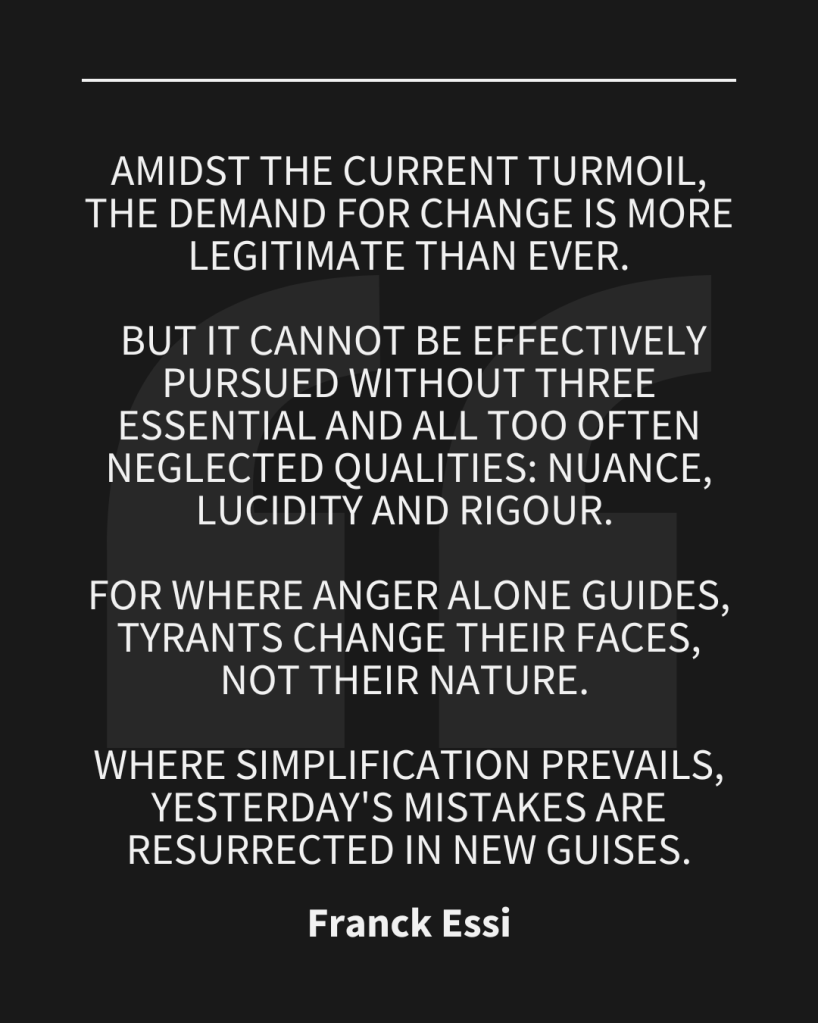
Amidst the current turmoil, the demand for change is more legitimate than ever. But it cannot be effectively pursued without three essential and all too often neglected qualities: nuance, lucidity and rigour. For where anger alone guides, tyrants change their faces, not their nature. Where simplification prevails, yesterday’s mistakes are resurrected in new guises.
—
Nuance: resisting slogans, embracing complexity
Nuance, first and foremost, is not weakness but courage. It rejects hasty judgements, binary discourse and tribal logic. It forces us to listen to what is uncomfortable, to recognise the complexities of each situation and to avoid locking reality into our ideological fantasies.
It prevents us from confusing the rejection of an unjust order with blind adoration for everything that challenges it.
Thus, when faced with a coup d’état, the question is not simply: ‘Is it against the old regime?’, but: ‘What is it proposing? With whom? And to what end?’ When faced with a president who resists the temptation of authoritarianism, the question is not simply, ‘Is this a victory?’ but also, ‘What guarantees are there for the future? How will the civic pact be rebuilt?’
In a world overexcited by social media and consumed by viral narratives, nuance is resistance. It reminds us that every society is built perhaps more in the grey areas and certainly less in slogans.
—
Lucidity: looking at our own blind spots
Lucidity, then, is the ability to look things in the face, without filters or fetishism.
Lucidity about our opponents, of course, but also about our own limitations, contradictions and blind spots. Being lucid means understanding that not all regimes that fall necessarily give way to freedom. That not all ‘ruptures’ are progress. That today’s providential man can become tomorrow’s despot.
It also means knowing that emancipation will not come solely from rejecting ‘the system’, but from the patient construction of a collective project, a new political culture, and a popular capacity to govern oneself beyond indignation. For the African experience is full of examples of peoples betrayed by those they had raised to the heavens.
Lucidity is not cynicism. It is mental hygiene, an ethical requirement, a duty of clarity in a troubled world. It prevents every uprising from becoming a revolution and every criticism from becoming treason.
—
Rigour: laying the foundations for lasting change
Finally, rigour is the discipline of those who want to last. It is not the opposite of passion, but its embodiment. Rigour means verifying, reading, comparing and organising. It means basing our positions on facts, not impressions. It means preferring the long work of popular education to viral shortcuts. It means refusing to flatter our base by betraying our principles.
It is not enough to denounce. We must propose. It is not enough to mobilise. We must structure. It is not enough to exist on social media. We must exist in neighbourhoods, trade unions, municipal councils, schools, courts, and assemblies where Africans gather.
Rigour also means rejecting the cult of gurus, even when they speak well. Because African peoples do not need new media prophets, but builders of thought, action and memory.
—
Between urgency and patience: act without haste, think without laziness
Some will say, ‘But there is urgency! We cannot wait for everything to be perfect before we rise up.’ They are right. But we must distinguish between two things: acting urgently does not mean thinking hastily. Discernment is not a luxury, it is a condition for survival.
It is not a question of telling people who are struggling to wait. It is a question of telling them to move forward, but to know where they are going. Fight, but know why you are fighting. Reject injustice, but do not open the doors to new forms of domination on the pretext that they have changed their uniform.
True radicalism is not found in grand gestures. It is found in consistency. In fidelity to principles. In the ability to combine popular aspirations with demands for justice, enthusiasm and method.
—
For conscious and consistent transformation
At a time when some celebrate military coups as popular revivals, while others sanctify dead institutions as guarantors of stability, we must choose another path. A more demanding, less spectacular, but profoundly radical path: that of clear-headed transformation, based on respect for freedoms, social justice and genuine popular sovereignty.
A transformation that does not confuse noise with change, anger with vision, speed with depth. A transformation that is not content with replacing elites, but transforms the rules of the game, power relations and collective imaginaries.
Africa does not just need to be in motion. It needs a direction. This direction will not be provided by the demands of the streets alone, nor by the incantations of isolated intellectuals, but by a demanding alliance between the mobilised masses, organised forces and committed intellectuals.
And this alliance will only hold if it is led by women and men who are rigorous, clear-headed, nuanced — and fiercely committed.
Franck Essi
#WhatIBelieve
#WeHaveTheChoice
#WeHaveThePower
#TurnOnOurBrains
#CitizenEducation
 franckessi.com