By Franck Essi
When a serious crisis occurs, as human beings, we often tend to engage in a series of impulsive, irrational, emotional, and sometimes counterproductive actions. These reactions are all the more common when we believe that we, or members of our community, are victims of unjust attacks.
These reactions translate into violent words and actions toward those we hold responsible for our ills. We then enter into an « us versus them » logic, where everything « we » do is justified, and everything » they » do is condemnable. This type of reasoning excludes any nuance, perspective, or search for a shared truth and/or solution.
It is precisely this dynamic that fuels conflicts, wars, and sometimes genocides. This pattern is not new: it is as old as human history.
As we celebrate our national unity amid multiple crises, I offer ten key ideas—or compasses—around key words and phrases to guide us in times of crisis. These principles can, I hope, help us adopt more constructive approaches during times of crisis.
KEY 1: BASE OUR APPROACHES ON OUR NOBLE VALUES
In my opinion, values are, in principle, the most precious and noble things we have. They serve as a beacon in times of trial, giving us clear direction and keys to decision-making.
When a crisis arises, we must remember our noblest values and consider what they mean in the present circumstances.
Can you imagine someone whose core value is harmony acting in ways that create more conflict?
Let us remember our values in times of crisis. They exist to guide us through troubled times.
KEY 2: ACT FROM OUR OBJECTIVES
When faced with a crisis, it’s crucial to keep our goals in mind. To do this, we can ask ourselves the following questions:
➡ What is the objective of my approach in this crisis?
➡ What are my life goals?
➡ What common goals can I share with those I perceive as my adversaries?
➡ Is what I say or do aligned with these objectives?
In times of crisis, we must strive to align our goals with our values, our individual goals with collective goals, and our actions with our goals.
KEY 3: DETERMINEDLY SEEK SUSTAINABLE SOLUTIONS
A crisis is a problem, and problems are meant to be solved.
When we are guided by the search for sustainable solutions, we adopt a different posture from those who simply observe problems or amplify their scope.
We can ask ourselves:
▪ What does a sustainable solution to this problem look like?
▪ What means do we have at our disposal to achieve this?
▪ What concrete actions can we take to implement this solution?
The world is full of critics and problem-diagnosers. What if we became bearers and agents of solutions?
KEY 4: STRIVE TO STICK TO THE FACTS AND EVIDENCE
We often think we know the facts, but sometimes we don’t.
We are frequently exposed to narratives that are distorted, amplified, or skewed by those who seek to influence our reactions.
Faced with this, it is essential to ask yourself some simple questions:
✔ What objective and irrefutable facts do I have?
✔ How can I be sure that these facts are true or proven?
✔ What are my sources? Are they credible?
✔ Am I 100% sure of what I am being told?
✔ Is there any evidence? Where is it?
Facts and evidence are essential pillars for building effective and sustainable solutions.
KEY 5: BE CRITICAL THINKING
Every story has multiple sides. To achieve constructive truth and inclusive solutions, we must consider these different perspectives.
This involves listening, questioning, and reflecting before drawing conclusions. This principle applies everywhere: in an essay with thesis, antithesis, and synthesis, or in a court of law where each side is heard before a justified verdict is delivered.
To be critical is to strive to listen and analyze rigorously in order to reach discerning conclusions.
KEY 6: REFER TO LAWS
When a crisis erupts, it is essential to refer to the law. Whether it is legislation or customs, they are there to guide our actions.
Generally speaking, without being perfect, they allow us to qualify the facts, to establish responsibilities and to direct the steps towards solutions.
When faced with a crisis, let us try to ask ourselves the following questions:
▶ What does the law say?
▶ Do my behavior or words comply with the law?
Let us remember: no one is supposed to be ignorant of the law and respect for the law allows us to form a society.
KEY 7: REFUSE EASY GENERALIZATIONS
In times of crisis, let us avoid generalizations.
The actions of an individual or group do not necessarily represent an entire community.
Essentializing, in times of crisis, means irrevocably attributing negative characteristics to a group. This mentality fuels hatred and can lead to the worst.
Let us strive to resolve individual and intercommunity conflicts without falling into essentialism.
KEY 8: STRIVE TO UNDERSTAND HISTORICAL DYNAMICS
A crisis has causes and consequences. To overcome it, we must understand the historical, cultural, and social factors that gave rise to it.
To better understand the current crisis situations, we can ask ourselves the following questions:
🔹 What are the root causes of this crisis?
🔹 What are the likely consequences if we do nothing?
🔹 What will be the long-term effects of our decisions?
Trying to understand is a sign of strength, not weakness.
KEY 9: ADDRESS SYSTEMIC CAUSES
Recurring problems are often symptoms of systemic failures.
To address this, we need structural and sustainable solutions, not one-off or superficial measures.
With this in mind, let us ask ourselves:
▪ What are the sustainable and just solutions to these problems?
▪ What structural changes do we need to make?
Systemic problems cannot be solved with short-term measures.
KEY 10: BE CONCERNED ABOUT LEGACY
In times of crisis, let us think of future generations.
After us, there will be other people, our children and our grandchildren.
For the sake of future generations, let us ask ourselves the following questions:
✔ What legacy do we want to leave them?
✔ How do we want them to remember our crisis management?
✔ What do we teach them about the art of building just societies?
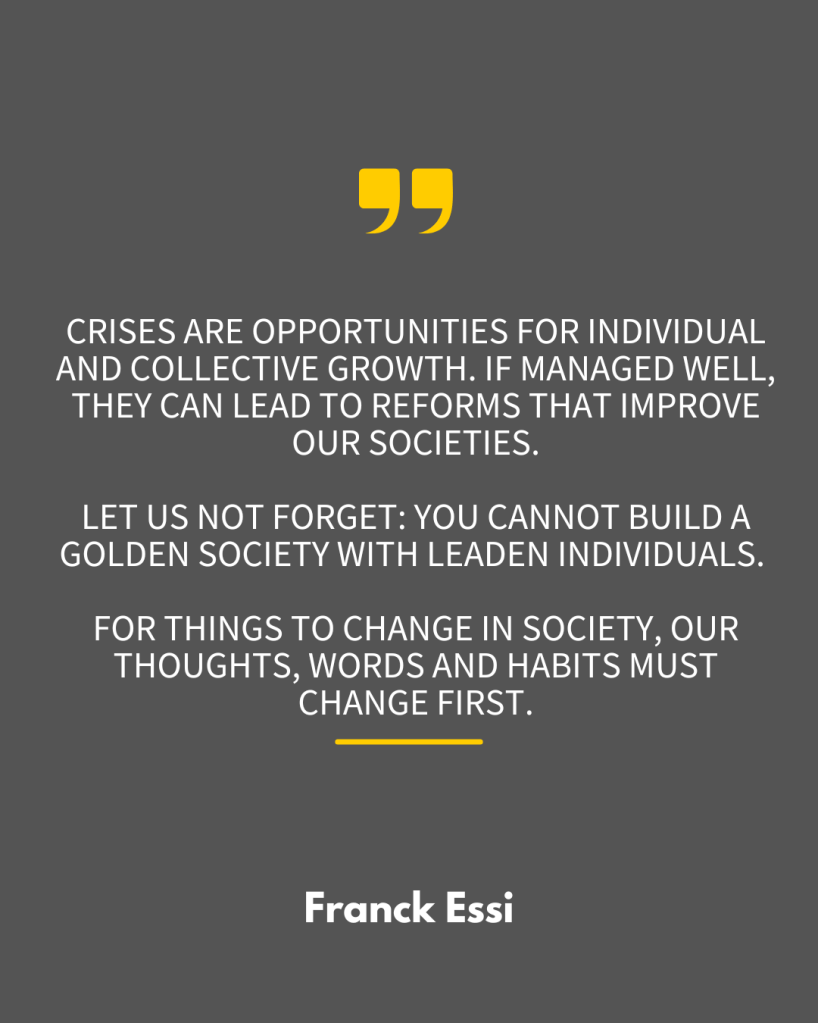
Crises are opportunities for individual and collective growth. When managed well, they can lead to reforms that improve our societies.
Let’s remember: you can’t build a society of gold with individuals of lead. For things to change in society, our thoughts, words, and habits must first change.
NB: This in no way excludes the duty to be indignant, to denounce and to vigorously challenge those responsible for and profiting from crises.
Franck Essi
#WhatIBelieve
#WeHaveTheChoice
#WeHaveThePower
#TurnOnOurBrains
#CitizenEducation
#NationalUnity
 franckessi.com