By Franck Essi
—
Cameroon is suffocating less from a lack of skills than from an excess of conformity. It is not grey matter that is lacking, but integrity, stature and vision. And yet, with each new political phase, the same refrain returns: ‘We need someone with experience.’ ‘We need someone with money.’ ‘We don’t need someone who is hungry.’ ‘We need someone with lots of qualifications.’ These criteria — prestige, wealth, academic background — have become totems that are supposed to guarantee competence and credibility.
But if these qualities were enough, Cameroon would have long since become an emerging, stable and prosperous country. However, on closer inspection, our recent history is full of leaders armed with degrees, decorations and years of service to the system… but incapable of bringing about profound change in society.
The truth is harsh but necessary: what Cameroon needs to get back on its feet is not technocrats, billionaires or overqualified academics. It needs, first and foremost, courage, wisdom and exemplary leadership.
—
The courage to break with the prevailing hypocrisy
Leading a country in crisis is not a comfortable task. It is a test of truth. Courage, here, is not the audacity of easy promises. It is the ability to say no to what destroys, to put an end to undue privileges, to resist pressure — including that from ‘friends’, ‘brothers’ and donors.
Courage means daring to confront mafia structures disguised as respectable elites. It means choosing justice, even when it is inconvenient. It also means refusing to allow power to be a refuge for the mediocre, a treasure trove for courtiers, or a free pass for the corrupt.
Today’s Cameroon needs people who are capable of taking unpopular but fair decisions, of saying no to endemic corruption, tribal appointments and selective impunity. Not cautious managers of appearances, but clear-headed agents of change.
—
The wisdom to see beyond the term of office
This country has been governed for too long with a short-term view: pleasing the boss, holding on until the next elections, maintaining the balance of clienteles. Political wisdom looks further ahead. It thinks in terms of decades, not deadlines. It is inspired by future generations, not just perceptions of current expectations.
It knows that governing a nation is like planting a tree: to provide shade tomorrow, you have to dig today, water and wait.
It also knows that you govern a country not for immediate applause, but for the foundation you leave behind.
This wisdom is sorely lacking at the head of the State. It requires humility in the face of complexity, listening to those we do not understand, patience in reform and clarity in compromise. It scorns decorations if they are merely the adornment of blind loyalty.
—
Exemplarity as a driving force
In a country where counter-values have become the norm, exemplary behaviour is a strategic imperative. What we call a ‘crisis of confidence’ is nothing more than a feeling of discontent with the gap between what leaders say and how they actually behave.
No programme, however well written, will hold if it is not supported by people who are consistent, steadfast and honest.
Being a role model is not about being perfect.
It is the visible effort to do what one says, not to grant oneself what one denies to others, to live as one speaks, to renounce undue advantages, and to be accountable, even without being compelled to do so.
In a disillusioned country, the example set by those at the top is the only antidote to resignation. It shows that power can also be used to uplift, not just to dominate.
Cameroon has been led by many graduates: polytechnicians, “agrégés”, doctors. It has been managed by rich men, owners of opaque fortunes. It has been shaped by veterans of the senior civil service. And yet, it remains mired in poverty, fear and cynicism.
—
Redefining the criteria for leadership
It is time to redefine the criteria for legitimacy. It is not titles, bank accounts or former positions that should count. It is actions, consistency, the ability to inspire by example and to build change with the people — not above them.
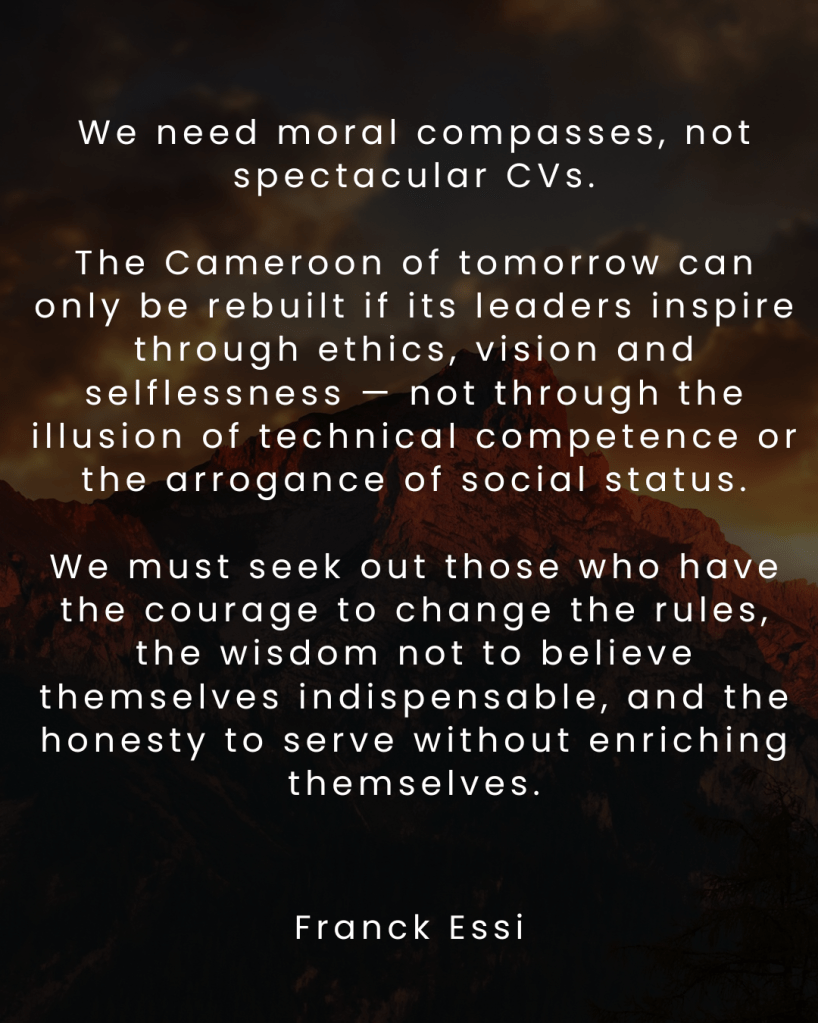
We need moral compasses, not spectacular CVs.
The Cameroon of tomorrow can only be rebuilt if its leaders inspire through ethics, vision and selflessness — not through the illusion of technical competence or the arrogance of social status.
We must seek out those who have the courage to change the rules, the wisdom not to believe themselves indispensable, and the honesty to serve without enriching themselves.
—
For a country rising through shared virtue
Cameroon’s future will depend less on the intelligence of some than on the conscience of others. Less on the words of the powerful than on the vigilance of citizens.
But for that, we need dignified, sober, steadfast, deeply human women and men at the helm. Figures of healing, not domination. Servants, not saviours.
Greatness does not lie in the diplomas displayed or the palaces frequented. It lies in the courage to do what is right, in the wisdom to listen before deciding, and in the exemplary behaviour of those who refuse to betray their people.
The time has come to choose not those who shine, but those who uplift. Those who love the people more than they love power.
Franck Essi
#WhatIBelieve
#WeHaveTheChoice
#WeHaveThePower
#TurnOnOurBrains
#CitizenEducation
 franckessi.com