By Franck Essi
—
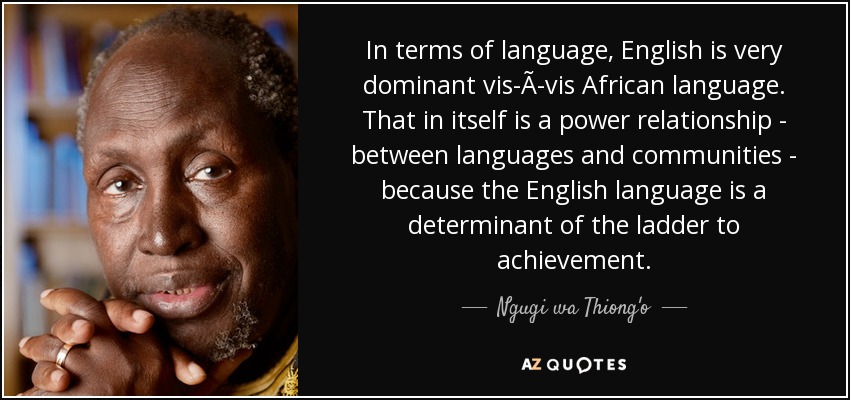
On 28 May 2025, a voice fell silent. A rare voice. A clear voice. A voice that the powerful feared, that the people listened to, and that free spirits cherished. That of Ngũgĩ wa Thiong’o, writer, thinker, activist for intellectual freedom, and tireless defender of the decolonisation of African consciousness.
His passing is an immense loss. But it is not the end. For Ngũgĩ never aspired to posthumous glory. He wanted to pass on his knowledge. To awaken. To dismantle invisible chains. And, above all, to equip us to think for ourselves.
It is urgent that we read him. It is more vital than ever that we understand him.
—
A thought for ‘dusting off’ the African mind
Ngũgĩ wa Thiong’o never stopped reminding us of a truth that our elites too often prefer to ignore: the most enduring colonisation is not that of land, but that of minds. For him, political independence was worthless without linguistic, cultural and epistemic independence.
In his seminal book Decolonising the Mind (1986), he makes a stark diagnosis: as long as Africans think in English, dream in French, judge in Portuguese, teach in Arabic or Spanish, they will remain prisoners of a mental world shaped by others.
His decision to give up writing in English and return to Kikuyu was not anecdotal. It was an act of resistance. An act of rupture. A political act. He thus affirmed that language is not neutral: it carries an imaginary world, references, hierarchies and omissions. It structures our relationship with the world.
—
A call for African intellectual renaissance
Ngũgĩ was not content with mere denunciation. He called for a re-founding. For a re-creation. For a rebuilding of the mental architecture of post-colonial Africa. He argued for a reappropriation of African languages, for a literature rooted in its origins, for a liberating pedagogy.
For him, the colonial school had never ceased to function, and it was imperative to break this cycle.
His struggle echoes that of Cheikh Anta Diop, Frantz Fanon, Aimé Césaire, but also our contemporary resistance to neoliberal dogmas, dominant narratives and institutions that stifle independent thought.
—
Ngũgĩ, what we owe to your words
Today, we must read and reread him. Read For a Free Africa (2017). Reread Decolonising the Mind (1986). And all his other works of great quality.
Today, we must take action. We must teach his thinking in our schools, our universities, our circles of awareness. We must translate his works into African languages. We must organise critical reading circles. We must incorporate him into our history, philosophy and literature curricula. We must celebrate not only the man, but the spirit of radical freedom that he embodied.
—
Decolonise to liberate
In paying tribute to him, we must hear his voice as a call to action. Africa is today hostage to its linguistic, economic and academic dependencies. It reproduces models it does not understand. It dresses itself in foreign concepts. It praises intellectual imports. It is time to dare to revolt cognitively, to deepen and accelerate the epistemic rupture.
Ngũgĩ left us with a cry. A cry of love for Africa. A cry of truth against the lies of one-way universalism. A cry of rage against the impostures of alienated elites. But also a path to mend our torn imaginations.
—
A promise to keep
It is now up to us to keep his words alive. To continue his struggle. To respond to his demands.
Because decolonising the mind is not a slogan: it is a daily task, a civilisational project, an intimate and collective endeavour.
Farewell, master. And thank you.
Franck Essi
 franckessi.com