By Franck Essi
When a single crab tries to climb out of the basket, it succeeds. But as soon as there are several, they cling to each other and none of them can get out.
—
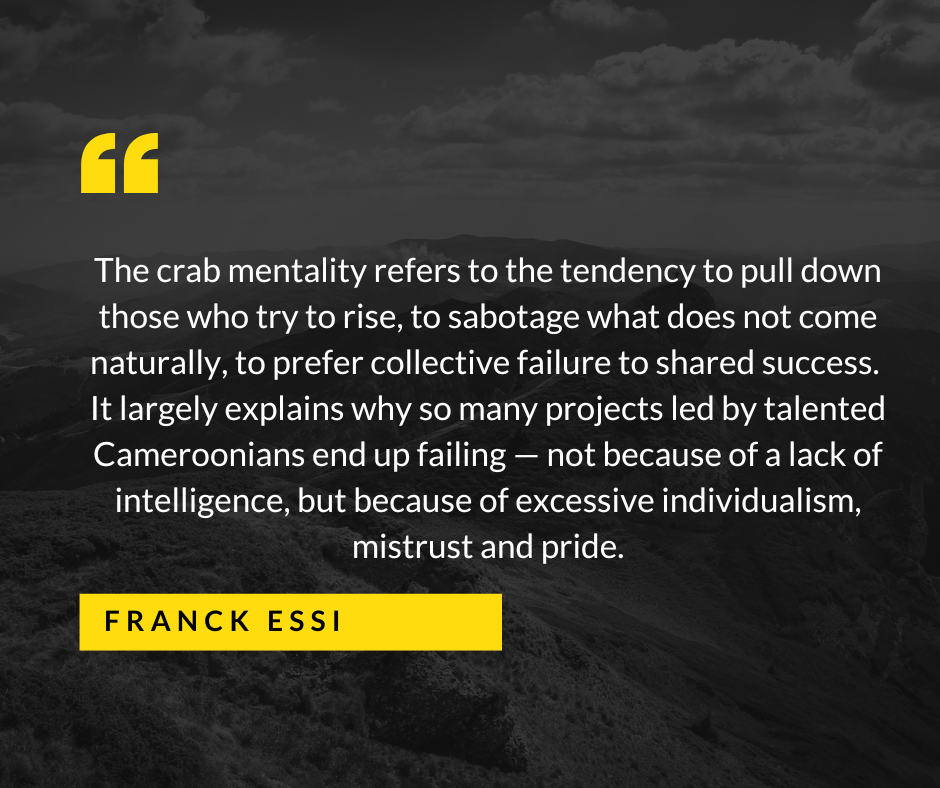
There is an insidious evil in Cameroon, rarely named but widely experienced: the crab mentality. It does not manifest itself in grand speeches, but in everyday gestures, in micro-choices, in silences, suspicions and unspoken rivalries. It refers to the tendency to pull down those who try to rise, to sabotage what does not come naturally, to prefer collective failure to shared success. It largely explains why so many projects led by talented Cameroonians end up failing — not because of a lack of intelligence, but because of excessive individualism, mistrust and pride.
—
A nation rich in talent, poor in sustainable cooperation
Cameroonians have no shortage of creativity or skills. Whether they are young engineers, artists, academics, activists or entrepreneurs, initiatives are constantly emerging in all sectors. However, these isolated talents struggle to generate lasting collective momentum. This is not due to a lack of resources or ideas, but rather to the absence of that invisible yet essential link: the ability to unite, to build together and to defend a higher interest.
The dominant reflex is one of strategic isolation: everyone for themselves, everyone in their own little world, everyone with their own ‘small project’ that they control alone. People prefer to be the head of an unstable micro-organisation rather than a partner in a solid but shared organisation. They prefer to create their own newspaper, even if it is fragile, rather than pool resources to build a truly influential media outlet.
Behind this logic lies a persistent fear: that of disappearing if you do not dominate.
—
The deadly logic of the zero-sum game
The crab mentality is based on a distorted view of social and political life: the idea that any success is a threat to others. For me to win, you have to lose. For you to rise, I have to step aside. What should inspire pride or emulation instead provokes hostility. We cannot stand to see others shine, not because it is unfair, but because it is visible. The elevation of a peer becomes unbearable, not because it is undeserved, but because it is a cruel reminder of what we could have been, if we had dared.
This is how many citizen movements, economic initiatives and political fronts fail. It is not external repression that defeats them – that often comes later – but internal disintegration, the struggle for visibility, ego wars and constant suspicion. As soon as a project gains momentum, it becomes suspect. As soon as a leader emerges, they must be brought down or neutralised. The result is that we remain stuck in the basket, clinging to each other, unable to get out together.
—
Self-hatred disguised as lucidity
This behaviour is not just a matter of strategy or cynicism. It also reflects an acute form of self-hatred that is internalised, cultivated and sometimes even sanctified. We deeply doubt our collective value. We are afraid of failure, but even more afraid of success, because success requires us to commit ourselves, to expose ourselves, to cooperate without dominating.
This self-hatred is coupled with a deep hostility towards others — not as ideological enemies, but as rivals for recognition. Those who succeed without us are seen as traitors. Those who dare without asking for our approval become a problem. Thus, the reflex is less to understand, embrace or amplify the actions of others than to slow them down, discredit them or even torpedo them.
—
The silent price of fragmentation
The crab mentality has a cost. It slows down political transitions, paralyses social dynamics and blocks collective innovation. It kills coalitions, exhausts leaders and discourages goodwill. It establishes mistrust as a way of life. It destroys the social fabric through subtle but persistent divisions. It ruins opportunities for co-creation in business, education, activism and the media.
This cost is all the greater because it is often invisible. We don’t say that a project has failed because of internal jealousies. We don’t dare explain that a movement has imploded because of ego clashes. We prefer to blame the economic climate, ‘difficult conditions’, lack of resources or fate. But these are excuses. The problem runs deeper: we don’t yet know how to build a nation, a movement or a community that can stand the test of time.
—
Ubuntu: a remedy from our own traditions
To break this deadlock, it is not enough to prescribe management techniques or imported theories. We must also return to our own sources. Africa has no shortage of traditions of solidarity, co-construction and collective ethics. Among these, the philosophy of Ubuntu offers a powerful reference point.
‘I am because we are.’
Ubuntu is not just a moral ideal. It is a way of organising society, thinking about power and living relationships. It is based on the idea that the success of others does not diminish me, but rather extends me; that the dignity of each individual depends on the recognition of all. This communal wisdom is the antithesis of the crab mentality. Where the latter divides, Ubuntu connects. Where one destroys, the other builds.
We are convinced that now more than ever, it is time to make a strategic return to this African compass — not to fantasise about a golden age, but to rearm our political and social imagination.
—
Ten projects to rebuild strategic solidarity
Breaking the stranglehold of the crab mentality requires fundamental work. It is not enough to condemn; we must rebuild. Here are ten essential areas of action to put cooperation back at the heart of our collective future.
1. Decolonise our imaginations of power
We must move away from the obsession with strongmen and charismatic, omnipotent leaders. We must revalue forms of shared, horizontal and rotating leadership. We must stop equating authority with domination.
2. Celebrate collective successes
Bring stories of successful cooperation, coalitions that have held together, and groups that have built together into the public sphere. These stories must become as common as those of ‘personal failures’.
3. Build strong alliance structures
Establish shared governance mechanisms in organisations, companies and movements. Consider legal and functional forms that promote shared responsibility and limit hyper-personalisation.
4. Embed Ubuntu in our practices
Make this philosophy a frame of reference for organisational life: in operating rules, selection criteria and conflict management. Ubuntu must structure, not just inspire.
5. Establish mediation as the norm
Learn to manage disagreements without breaking ties. Create spaces for negotiation, ethics committees, and rules for honourable exits. Put an end to the culture of conflict and humiliation.
6. Value loyalty and continuity
Make fidelity to commitments a criterion for recognition. Celebrate consistency, presence in times of trial, and silent support. Deconstruct the figure of the brilliant but unstable activist.
7. Encourage pluralistic leadership
Establish collegial leadership structures, with pairs or trios sharing responsibility. Increase the number of faces without diluting the message. Create spaces for shared visibility.
8. Learn from our failures
Publicly analyse experiences of division, implosion and split. Not to accuse, but to understand and pass on lessons. Build a political memory of failure.
9. Teach cooperation from school onwards
Integrate modules on teamwork, conflict management and non-violent communication into school curricula. Build a pedagogy of solidarity, not just individual performance.
10. Transform our media narratives
Promote the production of content that showcases collective action, fraternity and emulation. Replace the myth of the ‘self-made man’ with that of the ‘self-made community’.
—
Let’s get out of the basket. Together.
It is not enough to have ideas. We must know how to carry them forward together. It is not enough to want change. We must learn to build it collectively, despite disagreements, tensions and differences. The crab mentality is not inevitable. It can be unlearned. Provided we cultivate a different logic: that of connection, loyalty and commitment to the service of a ‘we’.
It is time to stop pulling down those who are trying to pull themselves up. It is time to understand that we will only rise together. Or not at all.
Franck Essi
#WhatIBelieve
#WeHaveTheChoice
#WeHaveThePower
#TurnOnOurBrains
#CitizenEducation
 franckessi.com