By Franck Essi
NB: Text originally published in January 2025. I am republishing it for reference purposes. This text is primarily intended for those who deeply aspire to bring about profound change in our country but have not yet succeeded despite their efforts, desires and sacrifices. It aims to refine our attitudes and suggest ways to increase individual and collective effectiveness.
—
We are in 2025, a year that promises to be very difficult, according to almost all analyses.
Among the facts and trends that justify this are: the persistence of old crises, the possibility of new ones, general price increases, tax hikes, declining purchasing power, job destruction and scarcity, and increased precariousness of life.
Added to this is the fact that we are entering a cycle of highly risky elections, with a presidential election scheduled for 2025, followed by local elections in 2026, in principle.
At this stage, no one can predict with any certainty what the outcome will be.
In such a context:
▪Worrying is pointless.
▪Denouncing the situation will not change much.
▪Thinking about solutions is a necessity.
▪Taking steps to overcome difficulties is the wisest thing to do, whether at the individual or collective level.
In Chinese culture, the term ‘crisis’ is represented by two pictograms: one means “threat” and the other ‘opportunity’.
2025, a year of crisis, may, under certain conditions, be a year in which our fears and threats become reality.
2025, a year of crisis, may also be a year of opportunities and progress. It is often in adversity that we deploy our talents and reveal new qualities.
What can we do to make 2025 a year of victories and progress for those who are fighting for systemic change?
Below are some ideas for building the right mindset in these troubled and difficult times.
—
1️⃣ Less criticism, more proposals.
Criticism is useful, necessary and remains essential for development.
However, even if we are convinced of the bad faith of our leaders, it is important to formulate proposals on how to do better and more than them.
The proposals we formulate are first and foremost for ourselves, then for the people, and finally for future leaders who are motivated by good faith.
On a personal level, proposing solutions to problems allows us to move beyond the resentment and anger generated by crises and think concretely about the change we want to build.
At the level of the people, presenting our proposals keeps alive the hope that an alternative exists. This strengthens their conviction that the suffering they are experiencing is not inevitable.
At the level of leaders, our proposals force them to react.
If communicated well, they can force even leaders acting in bad faith to do better, under pressure from public opinion.
—
2️⃣ Less criticism, more critical thinking.
Criticism focuses on the limitations of others, but it is often blind to their progress, efforts, or qualities. It also frequently ignores the faults of one’s own camp.
Critical thinking, on the other hand, involves questioning everything in light of positive principles and values.
It allows us to:
– Recognise our own limitations,
– Appreciate the qualities of our opponents,
– Promote truth and consistency, even within our own camp.
In 2025, let’s cultivate critical thinking so that we can face challenges with greater accuracy and clarity.
—
3️⃣ Less ‘how are we going to do it?’ and more ‘this is what we are going to do’.
The expression ‘how are we going to do it?’ has become a marker of powerlessness and fatalism.
In 2025, let’s think more in terms of:
– ‘What can we do?’,
– ‘What should we do?’,
– ‘What are we going to do?’
This mental shift pushes us to seek solutions rather than wallowing in complaints.
—
4️⃣ Less talk, more action.
Talking doesn’t change anything if no action follows.
To make 2025 a year of progress, let’s take massive, methodical and persistent action to turn our ideas into reality.
The key question is: what actions are we going to take to solve this problem?
—
5️⃣ Less distraction, more information and training.
In difficult times, it is essential to reduce distractions and focus on useful information and training.
The internet is not just for following the latest buzz.
It can become a powerful tool to liberate us on all levels.
Let 2025 mark this transition!
—
6️⃣ Less superficiality, more depth.
Superficiality is the disease of our time, amplified by social media.
To progress in 2025, let’s cultivate simple but essential skills:
– Concentration,
– Deep thinking,
– Sustained, high-quality work.
Depth and quality always triumph over superficiality.
—
7️⃣ Less winging it, more planning.
Three sayings illustrate the importance of planning:
– ‘Failing to plan is planning to fail.’
– ‘There are no favourable winds for those who have no destination.’
– ‘There are no unfavourable winds for those who have a destination.’
For each challenge of 2025, whether social, economic or political, let’s set goals and develop plans. A plan does not always guarantee success, but the absence of a plan guarantees failure.
—
In conclusion
2025 and beyond will be what we decide to make of it, thanks to our goals, our plans, and our ability to act and adapt.
These ideas are, in my opinion, common sense, but common sense is rarely shared in practice.
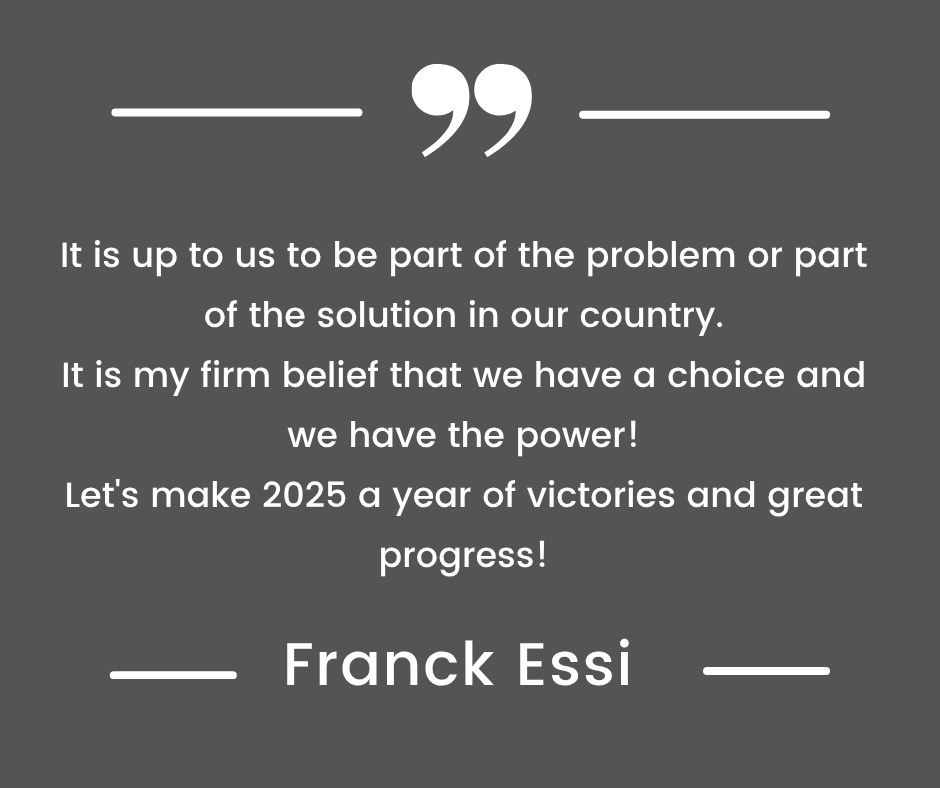
It is up to us to be part of the problem or part of the solution in our country.
It is my firm belief that we have a choice and we have the power!
Let’s make 2025 a year of victories and great progress!
Franck Essi
#Let’sTurnOnOurBrains
#WeHaveThePower
#WeHaveTheChoice
#CivicEducation
#WhatICreed
 franckessi.com