By Franck Essi
Note: This text is absolutely useless if you don’t take the time to read it carefully, reflect on it calmly, and analyze it deeply. Understanding it requires that you make time for it. Everything of value requires time.
—
Let us not mistake the horizon.
The election is not the end of the struggle—nor its sole condition. It is a moment, a step, sometimes useful, often hijacked. But the transformation of a country, a society, a shared destiny is a long, deep, organized movement—often invisible at first.
In an Africa saturated with elections that offer no real choice, where the electoral ritual is too often emptied of its democratic substance, it becomes urgent not to confuse the event and the process, the show and the work, the ballot box and the people in motion.
While some are fixated on electoral calendars, others are forging the real tools of change: consciousness, solidarity, and organization.
—
An Election Can Lie. A Movement Bears Witness.
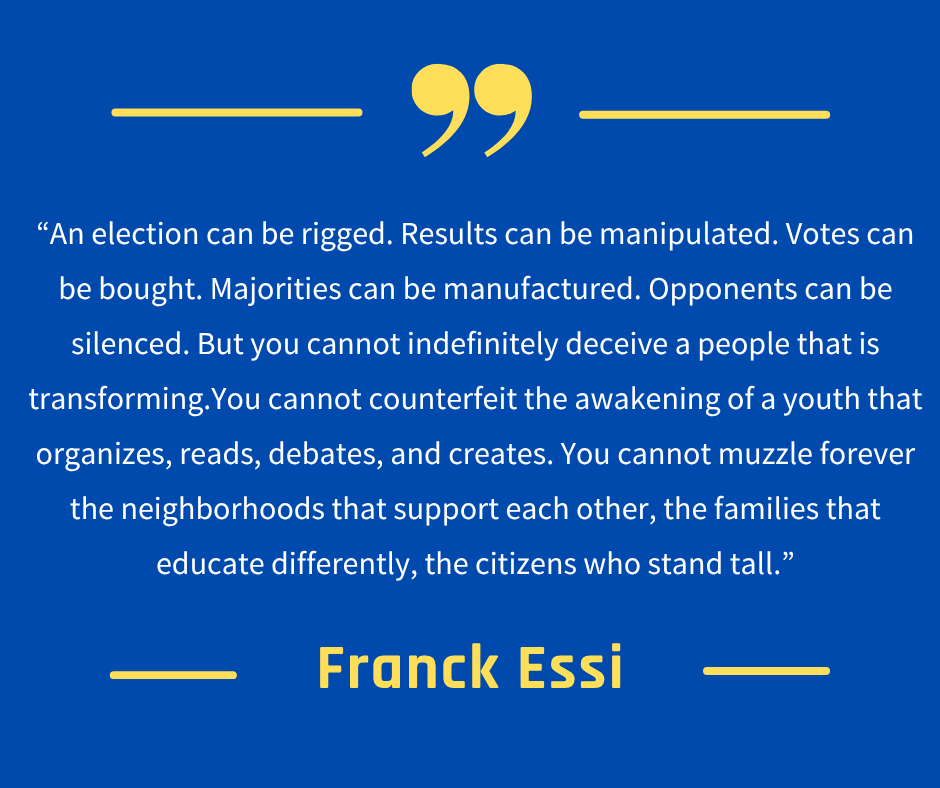
An election can be rigged. Results can be manipulated. Votes can be bought. Majorities can be manufactured. Opponents can be silenced.
But you cannot indefinitely deceive a people that is transforming.
You cannot counterfeit the awakening of a youth that organizes, reads, debates, and creates. You cannot muzzle forever the neighborhoods that support each other, the families that educate differently, the citizens who stand tall.
—
Transformation begins long before the ballot.
It starts in everyday conversations, in gestures of refusal against ordinary injustice, in the discreet but powerful gatherings of those who reject apathy.
In Cameroon, how many times have we hoped for change through the ballot box—only to see the same order, the same practices, the same impunity return?
But how many courageous initiatives also emerge from the margins—solidarity cooperatives, women’s movements, reading circles, popular education collectives—unseen and unheard? These are the true seeds of transformation.
—
Elections Are a Right. But Dignity Must Be Won Daily.
Participating in an election is legitimate. But believing that voting alone is enough to change the system is a sweet and dangerous illusion.
It is not the election alone that topples tyrannies or builds just societies. It is struggle. It is movements. It is conscious ruptures, nurtured solidarities, and constructed alternatives.
What good is voting if we do not fight lies every day?
If we turn a blind eye to corruption in our neighborhoods? If we tolerate contempt, violence, abuse—so long as it doesn’t affect us directly?
—
Transformation is first and foremost a culture.
A way of being in the world. A shared ethic.
What Y’en a Marre initiated in the streets of Dakar, what Le Balai Citoyen sowed in Ouagadougou, what LUCHA embodies in Goma—are examples of peoples who stood up outside the electoral cycle, choosing acts of dignity, justice, and reclaiming of power.
—
What Should Be Done? Reject the Illusion. Build Momentum.
Several imperatives emerge in this perspective:
1. Engage in Political Education
Anger is not enough. We need to understand. To read, to learn, to confront ideas. Ignorance is the breeding ground for all domination.
Let us begin here: by building a popular, accessible, vibrant, and critical political culture.
2. Reject Isolation
Alone, we burn out. Together, we rise. Commitment only gains strength when it is shared.
Let us form citizen circles, collectives, and associations. Let us dare to build unlikely alliances. Let us create bridges between neighborhoods, professions, and generations.
Change is always born in the social fabric.
3. Build Alternatives, Not Just Criticism
Let’s not settle for denunciation. Let’s propose. Let’s experiment.
In our villages, our universities, our businesses, our families—another way of producing, governing, resolving conflict is possible.
It won’t fall from the sky—it must be built here and now.
4. Practice Coherence
What good is demanding justice if we lie, cheat, or exploit ourselves?
What good is calling for ethical governance if we accept unfair favors or remain silent in the face of abuse?
The movement begins in the sincerity of our daily lives.
5. Learn Strategic Patience
Real change takes time. It collides with inertia, resistance, and fatigue. It requires collective endurance.
Transformation is not a sprint. It is a long walk—sometimes invisible, often thankless, but always fertile.
—
The Electoral Moment Is Strategic. The Transformational Movement Is Vital.
This is not about despising elections.
It’s about putting them in their rightful place.
In a truly democratic system, elections can be accelerators.
But in locked-down regimes, they are often traps.
And the most dangerous trap is passive waiting—waiting for a savior, a date, a miracle.
We don’t need fleeting moments of euphoria.
We need a slow but irreversible reclaiming of power by citizens.
And that power is not primarily about the vote.
It is about liberated speech, collective action, and dignity reclaimed.
—
What We Must Pass On
To our children, our students, our comrades, our neighbors, let us say this:
Change doesn’t come from a single election day, but from the patient repetition of courageous acts.
It is born of the awareness that we are not powerless, from the certainty that the future is not to be endured—it is to be built.
—
My Hope: To Move from the Moment to the Movement
An election is a moment we can prepare for.
But transformation is a movement we must embody.
And that movement—anyone can contribute to it, starting today, wherever they are.
By raising their heads. By saying no. By proposing better. By joining a collective. By speaking out. By rejecting injustice, even when it benefits them.
A people that stirs from within, that speaks to itself, listens, invents, and resists—is more powerful than any ballot box.
And that people is no longer waiting: it is rising.
We don’t just need ballots.
We need compasses.
Not just candidates, but consciences.
Not just electoral moments, but a civilizational movement.
—
Franck Essi

#WhatIBelieve
#WeHaveTheChoice
#WeHoldThePower
#LetUsIgniteOurMinds
#CivicEducation
 franckessi.com
[…] The Election Is a Moment — Transformation Is a Movement […]
J’aimeJ’aime