By Franck Essi
—
A pivotal year, a historic challenge
The year 2025 is not like any other year in Cameroon. It is a turning point. A year marked by crucial elections and increasingly obvious signs of the end of an era. The end of the reign of one man, Paul Biya, whose biological ageing is compounded by the political wear and tear of more than four decades in power. It is also the end of a regime weakened by internal wars, silent or noisy defections within the oligarchy, the widespread collapse of institutions and, above all, the growing exasperation of betrayed, impoverished and despised people.
In such a context, hoping for a simple change of government is naive or complicit. Cameroon can no longer afford the luxury of cosmetic changes. What we need is a systemic break. A complete overhaul. A genuine change of system.
But what exactly do we mean by that? What does this phrase, which is now on everyone’s lips, actually mean? What do we, as a citizens’ movement, as agents of change, as sincere patriots, mean by ‘systemic change’?
—
The system: a structure, a logic, a culture
In political science, the word ‘system’ refers to the set of structures, rules, actors and practices that organise the exercise of power in a given society. It is therefore at once an institutional architecture, a mode of governance and an ideological framework. In political economy, the system also refers to the logic of resource allocation, wealth distribution and production control.
In Cameroon, in everyday speech, the word ‘system’ is often synonymous with ‘the thing’, that opaque network of power, dishonest dealings, complicity, violence and lies that controls everything: elections, public procurement, careers, justice, freedoms and the future.
Paul Biya’s system today is not only the result of his choices. It is also the inheritor of a long line of succession: a perverse continuation of the French colonial system, passed down through the authoritarian regime of Ahmadou Ahidjo, then ‘renovated’ by Biya under the guise of pluralist democracy. This system is based on constants: excessive centralism, personalization of power, mistrust of civil society, selective use of violence, nepotism, economic predation and the staging of national unity as a cover for authoritarian uniformity.
This system has evolved, become more sophisticated and, in some cases, digitized, but it has remained the same in its fundamental logic: power for power’s sake, an elite for itself, a population left to survive on its own.
Above all, this system has contaminated the entire society. It is not limited to the highest echelons of the state. It has infiltrated everywhere, including certain so-called opposition political parties and so-called critical civil society organizations. It has shaped mindsets. It has produced a culture of falsehood, theft, contempt, short-termism and betrayal. It has made lying an art of government, failure a habit and resignation a virtue.
Contrary to certain discourse, what we call Biyaism, is not a political ideal. It is not an ideology. It is a way of being, a way of doing things, a national pathology. It is the reign of appearances, the valorisation of titles at the expense of merit, the flight from collective responsibility, the frantic quest for privileges, the instrumentalisation of traditions, the obsession with accumulation – of money, power, recognition – without any concern for the common good.
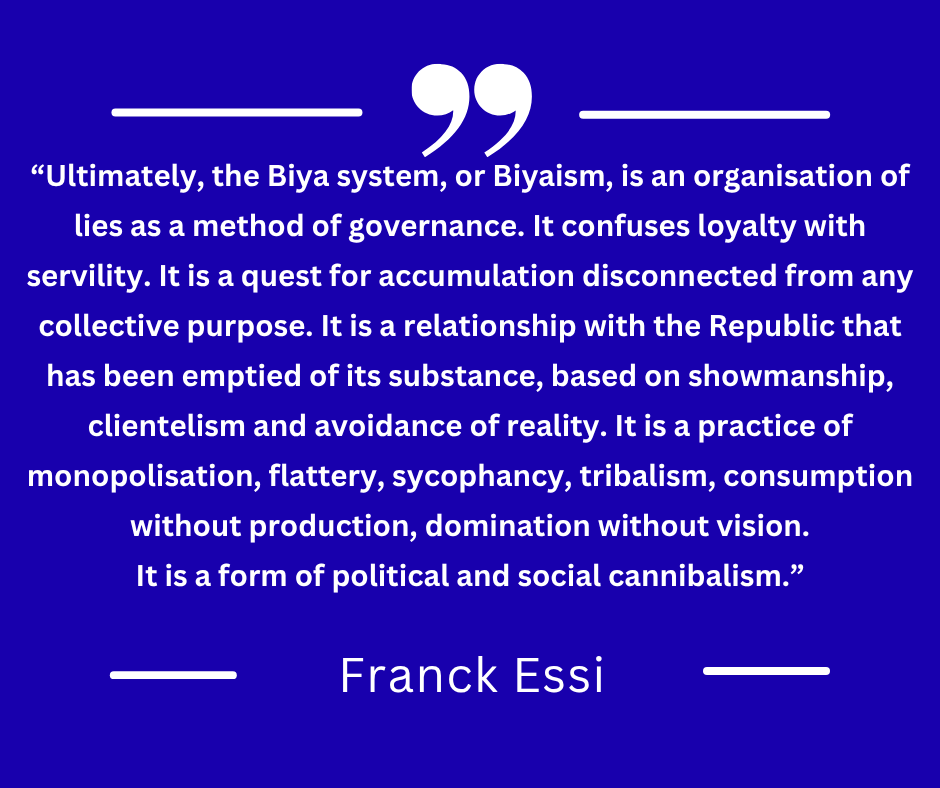
Ultimately, the Biya system, or Biyaism, is an organisation of lies as a method of governance. It confuses loyalty with servility. It is a quest for accumulation disconnected from any collective purpose. It is a relationship with the Republic that has been emptied of its substance, based on showmanship, clientelism and avoidance of reality. It is a practice of monopolisation, flattery, sycophancy, tribalism, consumption without production, domination without vision.
It is a form of political and social cannibalism.
—
What system change is not
In this context, it is important to clarify what system change does not mean.
Changing the system is not:
- Limiting oneself to a change of president, however long overdue;
- Replacing one ruling elite with another, without transforming the foundations of the exercise of power;
- Maintaining the same administrative, economic, social and cultural logic, while coating it with a veneer of reform or modernity;
- Reproducing the same structures of domination, predation and opacity under different guises or acronyms.
It would be a dangerous illusion to believe that a simple game of musical chairs, or minimal change, would be enough to respond to the depth of the current crisis. For the problem is not only one of who governs. It is about how we govern, the ends of power, and the relationship between the governed and the governing.
—
What systemic change implies
True systemic change must be a global overhaul, affecting all dimensions of national life. It is a radical transformation of the rules of the game, of the practices of power, of social imaginaries. It is a process of rebuilding that affects all aspects of our collective life.
It requires:
- An ethical transformation: Public action must be reoriented towards service, the common good, truth and justice. The notion of political and moral responsibility must be restored. The trivialisation of theft, lying, nepotism and abuse of power must no longer be tolerated or imitated.
- A cognitive and symbolic transformation: Systemic change requires a reconquest of intellectual autonomy. This means freeing thought, breaking mental conditioning, valuing endogenous and critical knowledge, and breaking with groupthink and the logic of depoliticisation.
- A democratic transformation: The logic of vertical domination must be replaced by a new balance based on citizen participation, deliberation, plurality of opinion and transparent regulation of power. This implies an end to impunity, the protection of fundamental freedoms and the consolidation of institutions capable of resisting arbitrariness.
- A transformation of governance: Governance can no longer be seen as a privilege but as a responsibility. It must be planned, evaluated, made transparent and based on clear criteria of performance, inclusion and proximity.
- A civilisational transformation: The country must move away from its obsession with survival and enter into a dynamic of collective elevation. It is a question of giving young people a new horizon, building a culture of excellence, restoring national self-esteem and nurturing a common ambition based on dignity, creativity and solidarity.
—
The conditions for systemic change
Such a shift cannot happen by decree. It requires historical, political and social conditions to be in place and actively constructed.
Without being exhaustive, we can mention at least the following:
- The formation of a critical mass of awakened and organised citizens: There can be no transformation without the conscious intervention of the people in history. Society must reclaim politics, take to the streets and reject fatalism. Counter-societies must multiply and organise themselves.
- The conquest of power as an act of rupture: It is not enough to wait for the regime to fall. A balance of power must be established that allows the forces of genuine change to come to power. Not to manage the status quo, but to usher in a new era. This requires strategy, unity, endurance and clarity of purpose.
- The exercise of power in the service of transformation: Action must be guided by fidelity to the mandate of rupture. It is necessary to resist the temptations of co-optation, compromise and forgetfulness. It is necessary to govern with rigour, audacity, truth and consistency.
- The dissemination of a new political culture: The current system will resist even after its formal fall. We must therefore spread new ethics, new practices and new standards in all areas: schools, government, political parties, families, businesses and places of worship. Transformation must become a profound cultural movement.
—
My conviction: Not changing the system means condemning Cameroon to collapse and certain chaos!
Cameroon is at a moment of truth. Faced with the failure of a model, history is giving us the opportunity to reinvent our collective destiny. But this challenge will not be won through improvisation or by settling for the ‘lesser evil.’ It requires thinking, acting and wanting a complete break with the current system, its actors, its logic and its illusions.
Changing the system means renouncing fear, cynicism and withdrawal. It means opening ourselves up to rigour, responsibility and greatness. It means rebuilding the nation on sound, solid and human foundations.
Failure to do so is to condemn ourselves to repeated agony.
Franck Essi
#WhatIBelieve
#WeHaveTheChoice
#WeHaveThePower
#Let’sTurnOnOurBrains
#CitizenEducation
#PoliticalTransition
#RebuildingCameroon
 franckessi.com