By Franck Essi
NB: Text for those Cameroonian citizens who still seem to believe that the current president, in one way or another, is a lesser evil, a player in the future. May this text contribute to an awareness or, at the very least, to some reflection.
—
Paul Biya for another seven years: A true historical imposture
It takes courage. It really takes courage, in 2025, after more than forty-two years of a reign marked by stagnation, repression and the gradual collapse of the state, to present Paul Biya as ‘the future of Cameroon’. It takes courage, even as the country sinks into a multidimensional crisis and a highly uncertain future, to hold up as a vision for society the biological longevity of a man who is visibly absent, clearly worn out and cruelly disconnected from reality.
This text is a cry. A cry against the absurd. A cry against manipulation. A cry against this tragic theatre where the old tricks of power are being used to recycle the unacceptable. Because this is no longer about politics. It is about ethics. It is about dignity. It is about collective memory and a shared future.
—
I. Paul Biya: the incarnation of a system on its last legs
At 92, Paul Biya is no longer a political force: he has become an alibi. A convenient pretext for the regime’s clans, which, unable to agree on a real transition, at least agree on a fiction: the myth of the ‘eternal father of the nation’.
This myth is an insult to the suffering of the Cameroonian people. It denies the millions of Cameroonians under the age of 40 who have never known any other head of state. It ignores hospitals without care, schools without teachers, villages without roads, regions at war. It buries the aspirations of a sacrificed youth, reduced to exodus or resourcefulness.
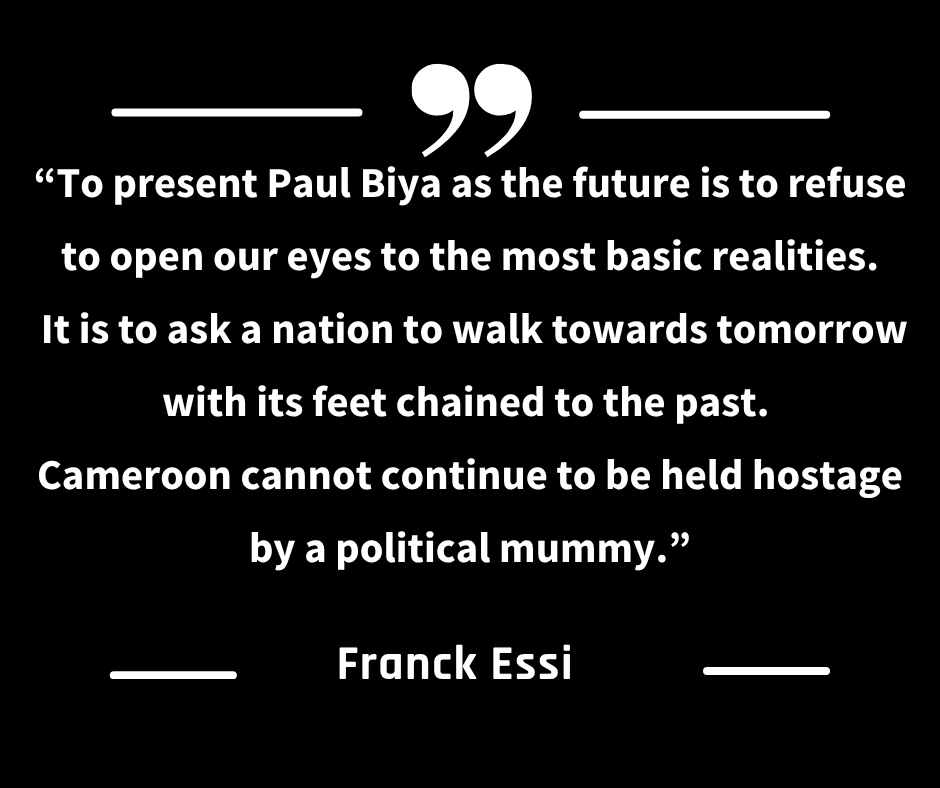
To present Paul Biya as the future is to refuse to open our eyes to the most basic realities. It is to ask a nation to walk towards tomorrow with its feet chained to the past.
—
II. A deliberate confusion between stability and paralysis
The regime’s acolytes talk about ‘stability’. They brandish it like a totem. As if we should thank heaven for having escaped chaos, even though chaos is here, creeping, creeping in the English-speaking regions, creeping in the Far North, creeping in the moral decay of institutions, creeping in the collapse of living conditions for the most disadvantaged, creeping in the brain drain to what are considered better horizons.
The truth is that the stability being touted is organised paralysis. A systemic lockdown. A refusal to prepare for the future.
For twenty years, there has been no serious debate on succession. Institutions have been stripped of their substance, countervailing powers have been crushed, and free voices have been hunted down.
Paul Biya’s longevity is not a political success. It is a symptom of an authoritarian system incapable of reform. And those who today dare to present him as the future know, deep down, that they are lying. That they are selling a rotten product to delay the inevitable.
—
III. A complicit elite, a people held hostage
The most tragic aspect of this charade is that it is supported by part of the country’s intellectual, political, religious and economic elite. This elite is resigned, fearful or opportunistic. It is a false elite that has stopped believing in change but wants to continue profiting from the established order.
This pseudo-elite is playing for time, speculating on a future biological transition, without ever daring to ask the real questions: how can political legitimacy be re-established? What is the vision for the post-Biya era? What social contract for a new Cameroon?
Meanwhile, the people wait. They watch. They suffer. And they doubt. Not because they still believe in Paul Biya, but because they see no organised, clear or credible alternative emerging.
This is the trap: keeping the country in a situation where the worst is presented as the lesser evil, where fear of the void becomes an argument for nothingness.
—
IV. Taking back the initiative: breaking the cycle of absurdity
Obviously, we must reject this imposture. We must fight it with clarity, courage and intelligence. This is not about attacking a man or showing disrespect. It is about putting an end to a state lie: Paul Biya is not the future of Cameroon. He cannot be. He has not been for a long time.
Breaking the cycle of absurdity means daring to ask the right questions:
- What kind of Cameroon do we want for 2030?
- What are the driving forces capable of carrying out this project?
- How can we organise a peaceful but genuine political transition?
- How can we give citizens back their voice and rebuild trust?
It is time for political parties, citizen movements, intellectuals, artists, entrepreneurs, believers, young people, women, diasporas… to take responsibility. Let them break their silence. Let them stop settling for small gains and temporary compromises.
And we rejoice with those who are already on the move. It is a happy sign of the times. It is up to all of us to amplify it collectively!
—
My conviction: We must reject humiliation and build an alternative
To accept that Paul Biya is still being presented as the future is to humiliate ourselves collectively. It is to accept that history will repeat itself as farce, after having been tragedy. It is to resign as a people.
But we are not doomed. There is still time. Time to organize, to think, to debate, to propose, to mobilise. Time to build a genuine political, social, economic and moral alternative.
An alternative carried not by a providential man, but by a collective surge. An alternative that breaks with the culture of cult, silence and clientelism.
Because the future of Cameroon can no longer be a name. The future of Cameroon must be a project.
And that project begins with a simple truth: Cameroon cannot continue to be held hostage by a political mummy.
Franck Essi
#WhatIBelieve
#WeHaveTheChoice
#WeHaveThePower
#Let’sTurnOnOurBrains
#CivicEducation
 franckessi.com