Ageing leadership, state capture and sham transition – Lessons from a case study to help us better understand our own situation
By Franck Essi
—

A sadly familiar scenario
On 13 July 2025, Paul Biya, aged 92, officially announced his candidacy for an eighth term as head of state of Cameroon. While this announcement came as no surprise to those who have long observed the logic of power confiscation in our country, it is nonetheless astonishing. Stunning, not because it is surprising, but because it confirms our country’s entrenchment in a cycle of blindness and endless political impunity.
This utterly grotesque situation is reminiscent of another emblematic case of the end of a reign in Africa: that of Abdelaziz Bouteflika in Algeria. Like Paul Biya today, Bouteflika, who was ill and weakened, had been kept in power despite his obvious inability to govern. And as in Cameroon, this was achieved through a game of shadows, institutional manipulation and a coalition of interests among an elite incapable of thinking beyond the present.
—
The driving forces behind a declining regime
When Bouteflika came to power in 1999, he did so with the direct support of the army and powerful security circles. He quickly consolidated his authority through an implicit pact: civil peace in exchange for absolute power. Oil revenues cemented this domination, which was based on the distribution of privileges, the co-opting of economic elites, and the manipulation of a historical legitimacy built around the war of independence.
This dysfunctional system was based on a simple principle: the figure of the president was less an actor than a symbol. Since his stroke in 2013, Bouteflika has no longer governed; he is governed in his name. His brother Saïd, the oligarchs of the oil era, and certain civilian and military officials ensure the regime’s continuity by exploiting him.
In Cameroon, this scenario is repeating itself almost identically. Paul Biya has not governed for a long time. His silence, his prolonged absences and his rare appearances in national affairs suggest that the continuity of his reign is mainly that of his entourage: a hard core of oligarchs, senior officials, members of his family and political operators whose aim is to preserve their acquired privileges.
—
The instrumentalisation of institutions
In Algeria, as in Cameroon, institutions have been stripped of their substance. They no longer play a regulatory role or represent the people. They have become cogs in an institutional theatre, where everything is staged to legitimise the unacceptable.
The Algerian Constitution was amended to allow Bouteflika to run for a third and then a fourth term. Despite his illness, elections were held, the results announced, and the fiction of power continues. In Cameroon, the scene is identical. The 2008 constitutional reform removed presidential term limits, paving the way for a lifetime presidency. The Constitutional Council, the electoral body, the Parliament… all participate in the illusion of the rule of law, when in fact they have become the pillars of a decaying authoritarian regime.
—
The Hirak: the awakening of a humiliated people
In February 2019, the announcement of a fifth term for Bouteflika was the last straw. A massive popular uprising, the Hirak (literally ‘movement’ in Arabic), engulfed Algeria. Every Friday for over a year, millions of citizens marched in cities across the country. They demanded not only the departure of Bouteflika, but of the entire system.
This popular uprising did not come out of nowhere. It was the result of a decade of frustration with:
- Opaque and authoritarian governance
- An economy based on oil revenues
- Endemic corruption
- A sacrificed youth
- A president who had become the living embodiment of absurdity
The strength of the Hirak lies in its social depth and national roots. It brings together students, teachers, the unemployed, trade unions, artists, women, young people from working-class neighbourhoods, pensioners, mujahideen (former independence fighters) and even some imams and magistrates. It is decentralised, peaceful, massive and tenacious.
The Hirak is therefore a revolution of dignity. Its slogan is: ‘Yetnahaw gaâ’ — they must all go. It embodies a desire to break with a form of governance based on humiliation, clientelism and contempt for citizens.
And yet, despite the scale of the mobilisation, the regime is reconfiguring itself. Bouteflika was forced to resign in April 2019 under pressure from the army. But his departure is only the tip of the iceberg. The ‘system’ remains in place: the December 2019 elections brought to power a former minister of the regime, Abdelmadjid Tebboune. The arrests of oligarchs and speeches about reform do little to mask the continuity.
—
A transition without rupture: when the army saves the system
In his book L’Afrique du Nord après les révoltes arabes (North Africa after the Arab revolts), political scientist Luis Martinez, director of research at the Centre for International Studies (CERI) at Sciences Po, analyses this sequence as an ‘impossible transition’.
According to him, several factors are preventing real change from emerging in Algeria:
- Real power belongs to the National People’s Army (ANP), not the civilian presidency. Since independence, the ANP has been the real arbiter of the political game.
- The regime functions as an oligarchy, based on opaque networks of interests involving high-ranking officials, technocrats, businessmen and former members of the National Liberation Front (FLN).
- Oil revenues (which account for 97% of Algeria’s foreign earnings) are used to buy social peace, fuel corruption and neutralise dissent.
- The traumatic memory of the civil war (1991–2002) is exploited to discourage any political radicalism.
- The political opposition is fragmented and discredited, unable to present itself as a serious alternative.
Faced with the Hirak, the army sacrificed Bouteflika as a scapegoat, while imposing a controlled electoral timetable, with a widely boycotted presidential election in December 2019 that brought to power Abdelmadjid Tebboune, a former prime minister of the regime.
It is a clever manoeuvre: change the face, keep the skeleton.
—
Cameroon: the risk of a false start
In many respects, the current situation in Cameroon is even more serious. Paul Biya has been in power for 42 years. Institutions are completely devitalised. The administration is in ruins. Social, political and ethnic tensions are at fever pitch. The country is engaged in an endless war in its English-speaking regions, plagued by resurgent terrorism in the Far North, and paralysed by an exhausted economic model.
If a peaceful uprising were to emerge, it could not, as in Algeria, be satisfied with demanding the departure of one man. What needs to be dismantled is the entire architecture of the regime: the confiscation of wealth, the lockdown of political life, the cult of personality, the impunity of the elites, the domestication of the media, and the collapse of education and justice.
—
Lessons from Algeria for a new start in Cameroon
The recent experience in Algeria, marked by the collapse of the Bouteflika regime under pressure from the Hirak movement, is a striking mirror for Cameroon today. It alerts us to the pitfalls of a false exit from crisis and the conditions necessary for genuine political renewal. It also reminds us that, when faced with the obvious end of a reign, the departure of one man is not enough to guarantee change in a system.
First lesson: the people are never eternally passive. Immobility is not the result of consent, but often of fear, resignation or a lack of credible prospects. In Algeria, the announcement of a fifth term for a weakened president was enough to catalyse a large-scale peaceful revolt. The Hirak movement demonstrated that a massive, disciplined and determined citizen movement could shake an apparently unshakeable regime. Cameroon must remember that a trigger event, even one that appears insignificant, can open up cracks in a system that has been locked down for decades.
Second lesson: the longevity of a regime does not guarantee its stability. The Bouteflika regime, presented as a bulwark of peace and continuity, was in fact concealing a deep crisis: weakened institutions, discredited elites, excluded youth and systemic corruption. Cameroon is living under a similar illusion. Paul Biya’s longevity is less a guarantee of stability than a factor blocking progress. It prevents change, fuels inertia and increases the risk of uncontrolled explosion.
Third lesson: without a structured alternative, any transition risks being hijacked. The Algerian Hirak did not bring about a real break with the past, due to a lack of coordinated leadership, a clear political project and institutional relays. The system adapted: a new president was elected, but the power structure remained unchanged. The same danger looms in Cameroon. If no structured force embodies a clear vision for the post-Biya era, the transition will be nothing more than a recycling of the regime.
Therefore, three strategic priorities are needed for real transformation.
1. Popular mobilisation alone is not enough; it must be rooted, structured and driven by a project.
In Cameroon, street protests, social media and spontaneous outrage will not be enough to shake up the system. What is needed is coherent, deep-rooted and sustainable mobilisation. This requires:
- The convergence of social, political and civic forces: opposition parties, trade unions, religious movements, diasporas, local collectives;
- The construction of a unifying narrative centred on justice, sovereignty, historical memory and a shared future;
- The establishment of an organised, patient and disciplined framework for action that is capable of withstanding the test of time and building lasting power relations.
2. A regime cannot be overthrown, it must be dismantled, piece by piece.
The Algerian regime has demonstrated its ability to reinvent itself in order to survive — what political scientist Luis Martinez calls authoritarian resilience. Bouteflika’s departure was not enough: the repressive apparatus, clientelist networks and routines of power have been preserved. In Cameroon, too, a real break will require much more than Biya’s departure. It will have to be backed by strong political action:
- The convening of an inclusive sovereign national conference to rebuild the institutions;
- The effective liberation of the judiciary, the media and trade unions in order to restore countervailing powers;
- The organisation of transitional justice to try economic and political crimes and state violence;
- The real decentralisation of power in the service of the territories;
- Radical electoral reform under the control of a truly independent body.
3. A credible alternative is a prerequisite, not a product of the transition.
In Algeria, the absence of a strong, coherent and unified opposition has left the field open to the manoeuvres of the system. Cameroon must avoid this mistake. It is imperative to prepare a clear, visible and unifying platform now. This alternative must be embodied in:
- A coherent political vision, offering concrete solutions in the areas of education, employment, governance, justice and institutions;
- Legitimate and new figures capable of uniting, engaging in dialogue, reassuring and inspiring collective hope;
- Solid alliances, both internal and external, to secure the process and guarantee the feasibility of change.
In short, Cameroon must not be content with learning lessons from the Algerian case — it must draw inspiration from it to anticipate, build and act. It is no longer enough to denounce the end of a reign: we must build the beginning of a new cycle, carried by the people, embodied by a vision and structured around a project of renewal. This is not a time for indignation, but for strategy.
—
We must rebuild, not recycle
In light of the above, the great danger facing Cameroon is that of ‘change within continuity’ — a Biya without Biya. In other words, a reorganisation of the same system with new faces, recycled, co-opted, legitimised by a formal transition, but without any profound transformation.
The only viable path is that of a democratic, social and institutional overhaul. An overhaul that requires a clean break with the Biya system. A rebuilding that involves rewriting a new constitution, cleaning up institutions, freeing political speech, and establishing a transitional justice mechanism.
—
My conviction: We must not wait for the ship to sink
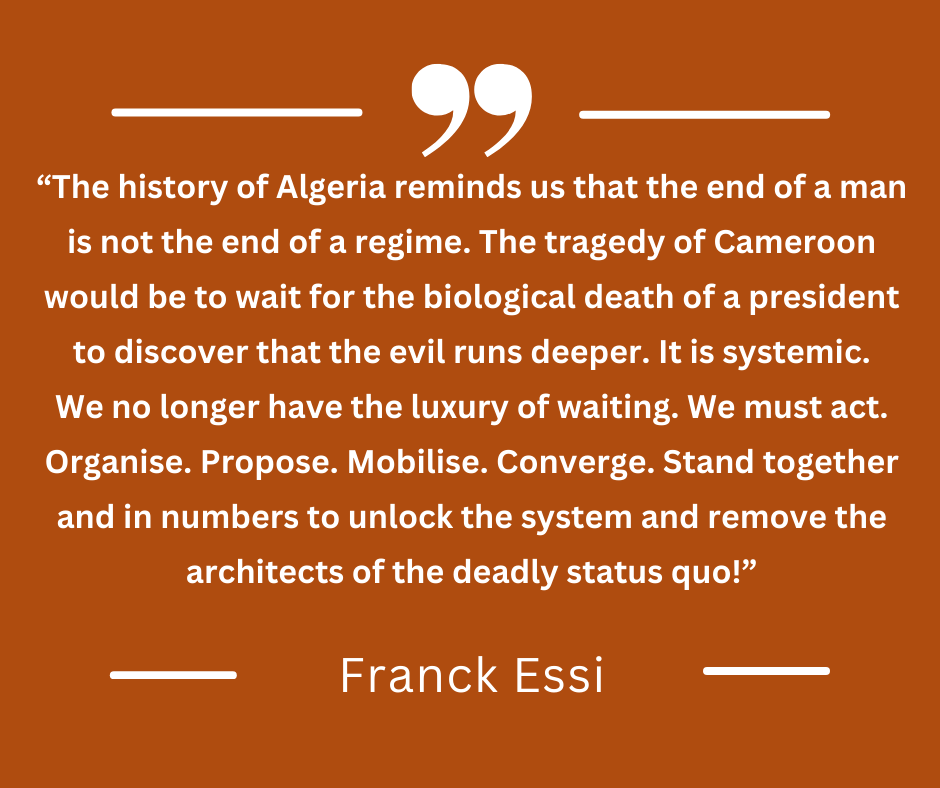
The history of Algeria reminds us that the end of a man is not the end of a regime. The tragedy of Cameroon would be to wait for the biological death of a president to discover that the evil runs deeper. It is systemic.
We no longer have the luxury of waiting. We must act. Organise. Propose. Mobilise. Converge. Stand together and in numbers to unlock the system and remove the architects of the deadly status quo!
The time for whispering is over. It is time for clarity.
And that clarity begins with a simple principle: the future of Cameroon cannot be written with the tools of the past.
Franck Essi
#WhatIBelieve
#WeHaveTheChoice
#WeHaveThePower
#Let’sTurnOnOurBrains
#CivicEducation
To go further:
Articles
Vidéos
Algérie – La contestation du #Hirak est-elle une révolution inachevée ? Analyse de José Garçon
Un an de Hirak en Algérie : et après ?
« Le monde en face, Algérie mon amour » Le documentaire sur le Hirak en Algérie
 franckessi.com