By Franck Essi
—
For many observers, citizens and leading ‘intellectuals’, the opposition is the main cause of the impasse we find ourselves in.
The opposition should do certain things: have a credible programme, unite, not allow itself to be bought, be present in all areas of protest and denunciation…
It should educate the people, be exemplary in every way, do better and more than those in power on all fronts.
For some, it must build bridges, schools, roads and houses. It must offer money to the poor, jobs to the unemployed, houses to the homeless, land to farmers…
In short, it is almost as if it must govern the country without being in power.
After losing 13 elections, it has even been called stupid or foolish.
Interesting…
But who is the opposition and what does it mean to oppose?
For many, the opposition simply boils down to political parties that want to oust those in power.
But let’s think about it for a moment.
—
1 – Let’s take a broader view of the opposition
Can we limit ourselves to such a restrictive description?
I am inclined to think not. Let’s just look at those who govern.
It is not just the party in power. It is also a network of associations, opinion leaders, grassroots activists, businesspeople, religious leaders, village chiefs, etc.
If the ruling camp is all these people, then the opposition camp cannot be limited to the political opposition alone.
The opposition must bring together all the political, economic, social and cultural forces that share a desire to end the current ruling order.
—
2 – Let us have a clear understanding of who the opponents are.
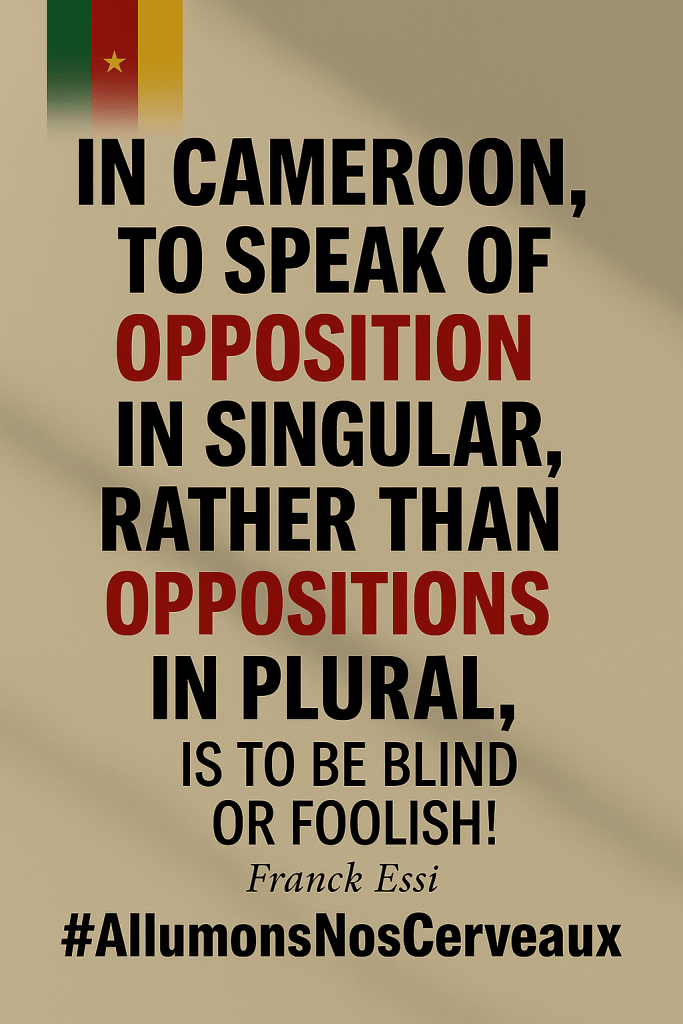
There is not just one opposition, but several oppositions.
There are several alternative concepts of how to run the country and solve people’s problems.
Some approaches overlap, which creates convergence and therefore facilitates possible short-term and/or long-term alliances.
This also means that certain political actors, due to the fundamentally divergent nature of their political visions and proposals, can never work together effectively or sustainably.
Hatred or rejection of the ruling party cannot be a solid foundation for moving forward together. Sometimes, opposition parties have less in common with each other than they do with the ruling camp.
A distinction must therefore be made between those who:
> Fundamentally criticize the nature of the dominant order and believe that nothing less than a revolution is needed as an alternative.
> Morally and technically criticize the system, denouncing the misdeeds of corrupt individuals, incompetence and poor public policy choices. They believe that with new, competent leaders who try out different approaches, without questioning the foundations of the system, they can solve the country’s key problems.
> Superficial criticism, driven solely by the desire to replace those in power. This is without any concrete, tangible and explicit evidence of a fundamental difference between themselves and those in power.
With these different political software packages, another parameter must also be added: the psychological parameter.
It is a question of distinguishing:
> Those who are sincere, committed and determined from those who are only so in appearance.
> Those who are aware of their real strengths and weaknesses from those who believe they can do anything and are in love with themselves.
This factor is not insignificant in analyzing the fortunes and misfortunes of a particular political opposition.
In the same vein, we must also consider other factors that can complicate alliances:
> Strategic differences. We may agree on the objective, but because of a difference of opinion on the path to take, we do not work together.
> Tactical differences. Our political opposition is such that sometimes, within a family that belongs to the same movement and agrees on the broad strategic lines, there are differences on tactical issues. Very often, and unfortunately, differences in the assessment of the specific action to be taken to deal with a specific situation put an end to nascent collaborations.
> The quarrel between the old and the new, the old and the young. Some believe that, because of their age and experience, they should impose their views on newcomers. The enthusiasm and modernity of newcomers and young people is welcome, provided they defer to the experience of their elders and older colleagues. This is often difficult because the young and the new believe, rightly or wrongly, that they understand the reasons for past failures and that they have miracle solutions to the political impasse in which we find ourselves. As a result, the generational divide is widening, fuelled by mistrust and a shared sense of superiority on both sides.
—
3- Let us have a clear idea of what opposition means.
Reflecting on this opposition camp, we come to realize other facts:
- ‘Intellectuals’ who are officially committed to the people, truth and justice are often very sterile when it comes to thinking about ways to overthrow the system. They shine for a moment with the quality and even radicalism of their criticism of the system. This leads us to believe that they are opposed to the system. But very often, when it comes to positively feeding the struggle of political opponents with ideas and strategies, there is a void. A ‘desert-like’ void, if we may be so bold with our language. Apart from general recommendations, such as ‘we must’ and ‘all we have to do is’, there is little that can grasp the concrete situation of concrete people engaged in a very concrete struggle. Sometimes, and this is the great paradox, they have to be paid so that they can rub shoulders with their fellow citizens who, on a political level, are trying to bring about the society they desire. And when they end up disappointed by these politicians, their criticism of them is sometimes fiercer than that levelled against the regime.
- Civil society, a veritable catch-all term encompassing NGOs, citizens’ associations (specialized or otherwise) and trade unions, is a true unidentified political object. It considers itself and sometimes wants to be apolitical, which is nonsense. Everything is political. While criticizing the government, public policies and public administrators, it does not want to rub shoulders with political opponents. They are not ‘pure’ enough to deserve to work with it. It believes it must teach them about human rights, democracy, mobilisation, communication, etc. Curiously, this civil society has become a refuge for people who do not have the courage to act directly in politics but use its cover to unfairly attack political entrepreneurs from behind.
And yet…
All these people say they want change. All these people are experts in the art of observation, debate for debate’s sake, denunciation, and suggestions to political opponents.
They say ‘unite,’ but they do not show us an example of their unity in their various fields of intervention.
They tell us to ‘fight’ and ‘sacrifice ourselves’, but most of them practice a policy of ‘no financial/material interest, no action’.
They say they want change but believe that electoral failures and the weakness of the ability to mobilize the masses are solely the responsibility of their political opponents.
They forget that it is all those who have an interest in reforms who must mobilize to implement them.
All those who have an interest.
We do not necessarily need opponents to:
– Demand water, electricity, healthcare, roads and the proper management of our public funds.
– Demand sanctions against unscrupulous managers. Every CFA misappropriated is a CFA lost to us and our children.
– Put pressure on the government to establish a fair electoral system. Such a system benefits citizens first and foremost, before benefiting political actors. A fair system ensures that citizens’ choices are respected and, at the same time, raises the level of political debate to the point where politicians are obliged to convince voters with clear arguments and commitments.
– Force worn-out, ageing and tired people who cling to power without any compensation in terms of economic or social performance to retire.
– Etc.
To do all this, we need informed citizens. With informed citizens, the political opposition supports the struggles and is obliged to outline what it could do differently, better and more to solve the country’s problems.
Ultimately, we simply want to say that anyone who ardently desires change in the current dominant order, whether political or not, is an opponent.
Opposing therefore means not supporting this regime. Not collaborating in such a way that it continues to maintain itself. It means taking action to hasten its downfall. It means being available to work with others, whether they are political actors or not.
Let us no longer ask ourselves what political opponents have done to bring down the current order.
Instead, let us ask ourselves what we can do to join forces with others.
And let’s do it!
— Franck Essi
#WhatIBelieve
#WeHaveTheChoice
#WeHaveThePower
#CitizenshipEducation
#Let’sTurnOnOurBrains
 franckessi.com