By Franck Essi

—
When Identity Becomes a Prison
In every society, collective tensions often crystallize around identity. In Rwanda yesterday, in Côte d’Ivoire at the turn of the 2000s, in the former Yugoslavia, in Lebanon or Syria: everywhere, ethnic, religious or linguistic affiliations have served as detonators for fratricidal wars.
In Cameroon, the question is persistent. In everyday conversations, in civil-service appointments, in electoral choices or political readings, the ethnic label imposes itself. It weighs like a mortgage on the nation’s future.
This is the trap that Amin Maalouf described with rare lucidity in his book In the name of violence (Identités meurtrières). He shows that human identity is plural—rich in multiple affiliations—but that this richness is often mutilated when a power or ideology reduces a person to a single dimension. That is when identity becomes exclusive, violent—deadly.
Cameroon tragically illustrates this drift. A mosaic of peoples, languages and cultures could form a tremendous civilizational wealth. Yet it has become a source of division, suspicion and instrumentalization.
—
Deadly Identities: Maalouf’s Lesson
Plural Identity as a Wealth
Maalouf insists on a fundamental point: no human being can be reduced to a single affiliation. We are all heirs to a plurality—our family, our language, our culture, our religion or non-belief, our profession, our life choices, our passions, our commitments.
This plurality is not a burden but wealth. It makes each of us unique. A Cameroonian can be at once of Bassa origin, a Cameroonian citizen, Christian or Muslim, Francophone, an engineer, a jazz lover and a community activist. Any attempt to reduce this complexity to a single label—“you’re Bassa,” “you’re Anglophone,” “you’re Beti”—is a mutilation.
“Reducing an individual to a single identity is to amputate them of what constitutes their richness and their freedom.”
— Amin Maalouf
When Plurality Turns into Exclusion
In times of crisis, this plurality is denied. The individual is reduced to a single belonging: he is seen only as an “Anglophone,” a “Bamileke,” a “Northerner.” From then on, any attack on that group becomes a vital threat to him. He is compelled to defend his camp—even against neighbors or compatriots.
It is this reduction that tips identity into violence. The civil wars in Lebanon, the massacres in Rwanda, the war in the former Yugoslavia all illustrate this process. Identity becomes “deadly” not by essence, but because it is mobilized as a weapon.
The Political Manufacture of Deadly Identities
For Maalouf, the danger does not lie in diversity itself, but in its instrumentalization. Exclusive identities are manufactured—by ideologies, by those in power, or by systems of domination that benefit from them. The history of colonialism in Africa has amply demonstrated this. Colonizers hardened ethnic categories to better administer, divide and rule.
In Cameroon, this colonial legacy has never been overcome. On the contrary, it has been recycled and amplified by successive regimes.
—
Cameroon, a Trapped Mosaic
A Diversity Full of Ambivalence
With more than 250 languages and cultural groups, Cameroon is sometimes called “Africa in miniature.” This diversity could be a strength—a soil for creativity and complementarity. But it is experienced as a threat. It yields not enrichment but a permanent competition.
Every Cameroonian learns very early to be identified by regional origin. In civil-service exams, appointments, hiring, marriage, the ethnic lens is omnipresent. It structures society in a subterranean and persistent way.
Tribalism as Daily Life
The examples abound:
- When a minister is appointed, the conversation focuses less on competence than on “their ethnicity.”
- When a corrupt official is exposed, supporters cry “an attack against our community.”
- When a citizen succeeds in business, people suspect the backing of “their group.
Cameroonians are constantly assigned to their ethnic belonging, reduced to a label that precedes and confines them.
The Anglophone Question: From Civic Claim to Identity Fracture
The crisis ravaging the North-West and South-West is emblematic. At the outset, Anglophone lawyers and teachers demanded respect for the Common Law and their specific education system. These claims were legitimate—civic and political.
But the regime chose to reduce these demands to an identity confrontation: “Anglophones versus Francophones.” This framing radicalized positions. Army violence, abuses by separatist groups and polarized opinion transformed a civic claim into an identity-based war.
—
Deadly Identities as an Instrument of Power
The Politics of “Divide and Rule”
Since Ahmadou Ahidjo, and then Paul Biya, Cameroonian power has made tribalism a tool of governance. National “geopolitics” rests on an implicit sharing-out: each region or group must have “its share” in the army, the administration, the ministries.
This system creates the illusion of balance while actually feeding rivalries and frustrations. Every appointment is scrutinized as a gain or loss for a community. National unity is constantly weakened by this balancing act.
Ethnicizing the State’s Failures
When the state fails to provide quality public services, responsibility is shifted to groups. Poor roads are “the fault of such-and-such minister from such-and-such region.” Hospital breakdowns are “because those in charge come from such-and-such community.”
This ethnicization of failure diverts citizens’ anger from its true target: poor governance, corruption and the capture of resources.
A Confiscated Democracy
Tribalism is also a poison for democracy. When people vote for “the man from their village” rather than for a program, politics is reduced to a bazaar of patronage. Elections cease to be a clash of ideas and become a zero-sum market-share war between groups.
Thus, tribalism locks in the existing system. Authoritarian regimes know they can always play on fear of the other to neutralize demands for change.
—
The Dangers of a Society Trapped by Tribalism
Generalized Suspicion
In a country undermined by deadly identities, distrust is everywhere. Every success is suspect; every failure is read as one group’s revenge on another. The other is no longer a compatriot but a rival.
Paralysis of the State
A state dominated by tribalism becomes inoperative. Appointments are not based on competence but on a fragile geopolitical balance. Administrative efficiency is sacrificed on the altar of clientelism.
The Specter of Civil War
African history is full of warnings: Rwanda in 1994, Côte d’Ivoire in the early 2000s, Liberia in the 1990s. In each of these countries, tribalism fueled deadly wars. If Cameroon does not move beyond this logic, it is not immune to a similar conflagration.
—
Moving Beyond Deadly Identities in Cameroon
Reassert Citizenship
The first step is to affirm that the fundamental identity of every Cameroonian is citizenship. Being Cameroonian must take precedence over all other affiliations. This requires an impartial state that guarantees equal rights for all—without favoritism.
Concretely, this means ending disguised ethnic quotas, guaranteeing equality before the law, and establishing true merit in exams, hiring and appointments.
Education for Plural Identities
Schools must teach children that each person carries multiple affiliations. Curricula should deconstruct stereotypes, value cultural diversity, and underscore citizenship as the common bedrock.
The media also have a crucial role: move beyond regional caricatures, avoid ethnic generalizations, and highlight narratives that unite rather than divide.
Expose Political Manipulation
Citizens must be trained to spot divide-and-rule tactics. Any time a leader instrumentalizes ethnicity to explain a problem, it should be denounced as a diversion.
Cameroon’s real fracture is not ethnic but social and political: between an elite that monopolizes power and resources, and a majority that endures poverty, exclusion and insecurity.
Build Cross-Community Solidarities
Associations, unions and citizen movements must bring people together across ethnic lines. Experiences of mobilization around common causes show that shared spaces can be created.
These concrete solidarities are the best antidote to tribalism.
Rebuild the National Narrative
Finally, we need a national story that brings people together—a shared memory that embraces diversity without turning it into a fracture. Culture, literature and history must be mobilized to write this shared memory.
Cameroon must reclaim and honor those who fought for freedom and unity, rather than feeding clan-based narratives.
Envision a Refounding Political Transition
The struggle against tribalism cannot be a mere moral exhortation. It demands a genuine refounding political transition.
This must tackle the structural roots of the problem:
- Establish independent and inclusive institutions,
- Guarantee transparent elections,
- End clientelism,
- Ensure social justice and a fair distribution of wealth.
As long as citizens feel their survival depends on ethnic belonging, they will remain trapped in this snare.
—
Remaking the Nation
Cameroon stands at a crossroads. Either it keeps sinking into deadly identities—at the risk of implosion—or it embraces the plurality of its citizens and refounds its common life.
As Maalouf reminds us, “each individual must assume their multiple affiliations. Only then will we escape deadly identities.”
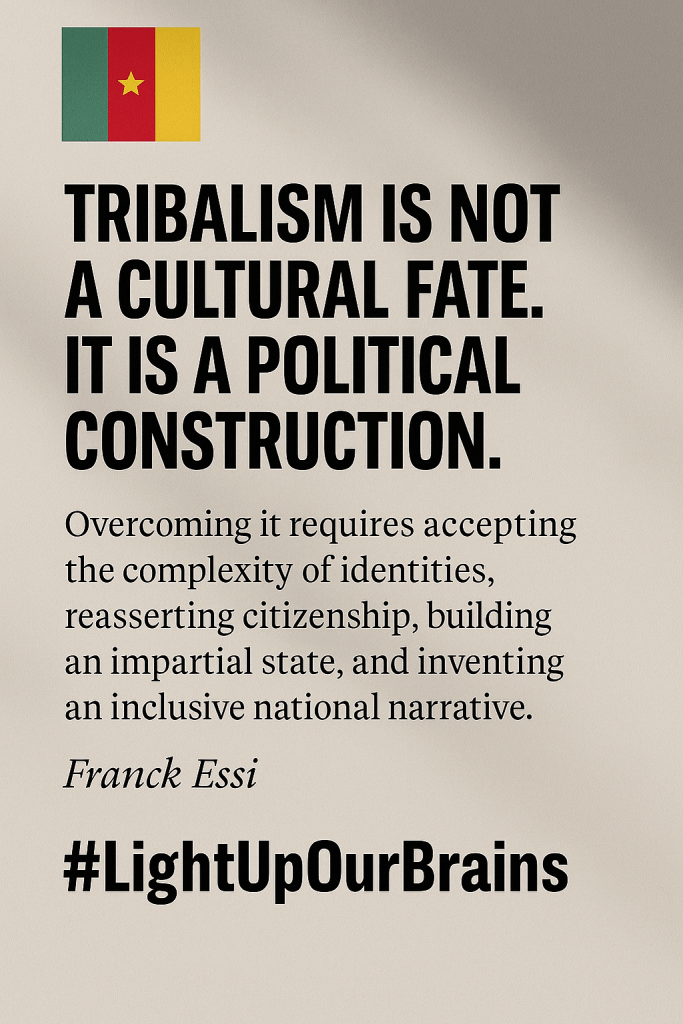
Tribalism is not a cultural fate. It is a political construction. Overcoming it requires accepting the complexity of identities, reasserting citizenship, building an impartial state and inventing an inclusive national narrative.
The choice is clear: remain prisoners of exclusive belongings and rush toward implosion—or embrace plurality to finally remake the Nation.
#IdeasMatter
#WeHaveAChoice
#WeHaveThePower
#LightUpOurBrains
#CivicEducation
 franckessi.com