By Franck Essi
—
An Invisible Yet Powerful Machine
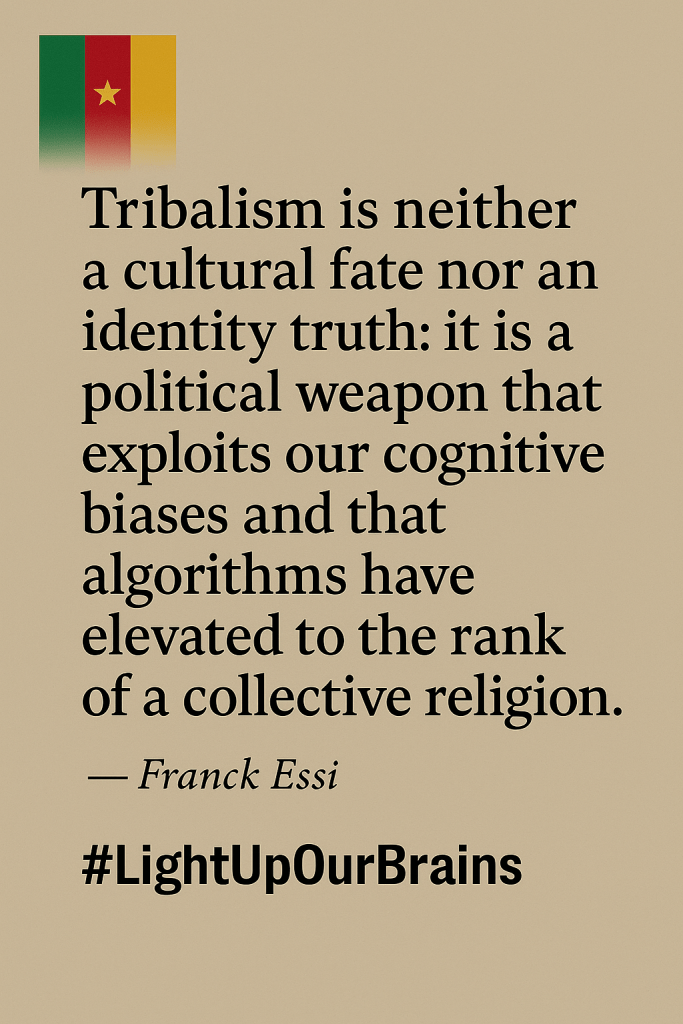
Tribalism is not only about identity-based rhetoric or community politics. It is, above all, a mental construction—a distorted way of perceiving reality—rooted in the natural flaws of our minds. In the era of social media and media overexposure, this psychological mechanism has been reinforced by a digital architecture designed to lock each of us into our own vision of the world.
Behind verbal clashes, identity retreats, and political divisions disguised as community tensions operate two silent yet devastating engines: cognitive biases and algorithmic bubbles. They feed, spread, and amplify contemporary tribalism.
—
What Cognitive Biases Are
Cognitive biases are mental shortcuts our brains use to make quick decisions. They simplify our relationship with the world but introduce systematic errors in reasoning. They are neither moral flaws nor pathologies: they are universal mechanisms, present in all of us. Yet in contexts of distrust, competition, or crisis, they become weapons of mass fragmentation.
Among the most influential in fueling tribalism:
- Confirmation bias: we select information that confirms what we already believe and ignore that which contradicts it.
- Outgroup homogeneity bias: we perceive members of an outside group as all alike, while we see our own group as diverse and nuanced.
- Attribution bias: we excuse the errors of our group by attributing them to circumstances, but interpret the faults of others as proof of their nature.
- Negativity bias: we retain negative facts more easily than positive ones, especially when they concern a group we perceive as threatening.
—
When Psychology Fuels Tribalism
Applied to identity, these biases become powerful catalysts of tribalism:
- An isolated incident involving one member of a community becomes collective proof of malice.
- The economic success of a minority group is interpreted as a plan for domination.
- A political appointment is not seen as the result of an individual career, but as the sign of tribal favoritism.
These mechanisms do not just produce misunderstandings: they structure narratives, forge convictions, justify exclusion. They transform complex situations into simplistic interpretative grids, where “we” are always victims or threatened, and “they” are always complicit or predatory.
Thus, tribalism thrives on an economy of suspicion, fueled by biased perceptions, reinforced through repetition, and frozen by emotion.
—
Social Media: Digital Catalysts of Biases
The arrival of social media has transformed this mechanism from an individual process into a collective self-reinforcing system. Platforms such as Facebook, X (formerly Twitter), TikTok, or WhatsApp operate on algorithms that privilege emotional engagement: what shocks, what divides, what confirms our beliefs.
In other words, social networks do not show us the world as it is, but the world as we want to see it. This phenomenon has a name: the algorithmic bubble.
Inside an algorithmic bubble:
- If you click on anti-Beti content, the algorithm will show you more.
- If you share messages denouncing a “Bamiléké hegemony,” similar posts will flood your feed.
- If you like identity-based discourses from the North, endless threads will appear to reinforce that perspective.
These bubbles create echo chambers where each person is trapped in their convictions, exposed only to messages that reinforce them, shielded from contradiction. Contradiction itself is no longer seen as an opportunity for debate but as an attack. Nuance becomes suspect. The enemy—always vague, always collective—becomes omnipresent.
—
The Combined Effect: Radicalized Minds, Normalized Tribalism
When personal cognitive biases meet algorithmic logic, tribalism goes viral.
- A baseless rumor is interpreted as truth, confirmed by other biased testimonies.
- A hate-filled speech trends, not because it is true, but because it provokes strong emotional reactions.
- A caricature shared a thousand times becomes a collective truth, resistant to any investigation.
Thus, a gentle radicalization process sets in. Tribal discourse becomes banal. Jokes turn into slogans. Insults transform into political positions. Soon, the very idea of equitable coexistence appears naïve, even dangerous.
—
In Cameroon, Elections as Accelerators
In Cameroon, this dynamic intensifies during every election cycle. The absence of an impartial state, the extreme personalization of power, the capture of political parties by clientelist logics, and the closure of institutional debate leave the field open to identity-based politics.
In this democratic vacuum, cognitive biases and digital bubbles replace debate with suspicion, argumentation with stigmatization. Every political speech is analyzed through the lens of the speaker’s supposed ethnicity. Every project is seen as a strategy of appropriation. Ethnicity becomes the only legible card.
In such conditions, elections cease to be the expression of collective will. They become rituals of retreat, competitions between imagined communities where the winner is perceived as the oppressor of the losers.
—
How to Resist?
Breaking this cycle requires deep effort, both individual and collective.
- Education on cognitive biases: learning to recognize our judgment errors, seeking contradictory evidence, cultivating intellectual humility.
- Diversifying sources of information: stepping out of digital bubbles, confronting different viewpoints, rejecting easy certainties.
- Regulating platforms: social media are not neutral. They must be subject to transparency, moderation, and protection against hate speech.
- Reconstructing politics: only a real, participatory democracy based on equal rights and opportunities can short-circuit the logics of fear and retreat.
—
My conviction: Thinking Against Oneself to Think Together
The greatest danger of contemporary tribalism is not only that it divides. It is that it creates the illusion of lucidity, while resting on distorted perceptions, reinforced by machines designed to exploit our cognitive weaknesses.
Resisting tribalism today is not only about proclaiming attachment to national unity. It is about making the painful effort to think against oneself, to question our reflexes, to dialogue with what unsettles us.
In an age where cognitive biases are industrialized by algorithms, where truth is transformed into a product of engagement, thinking for oneself has become a major political act.
It is through this critical vigilance that the deconstruction of tribalism begins—and the reconstruction of a shared future becomes possible.
#IdeasMatter
#WeHaveAChoice
#WeHaveThePower
#LightUpOurBrains
#CivicEducation
 franckessi.com