By Franck Essi
—
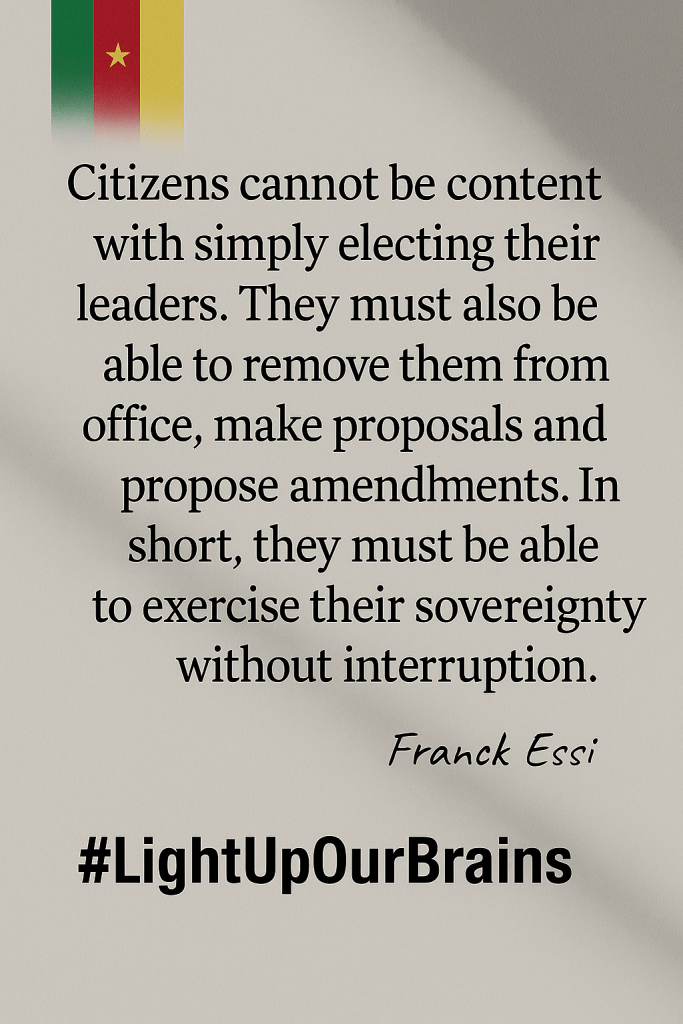
On the eve of a new electoral cycle in Cameroon, as the regime meticulously prepares to reproduce a discredited, locked-down and unproductive power structure, one idea is resurfacing with force: change will not come from a manufactured alternation, but from a profound overhaul.
It is in this context that the distinction between voting and election, proposed two decades ago by French thinker Étienne Chouard, takes on its full relevance. Behind what might seem like a semantic subtlety lies a fundamental issue: moving from a symbolic act to the real exercise of power, from a passive voter to an active citizen, from a captured state to a state rebuilt by and for the people.
—
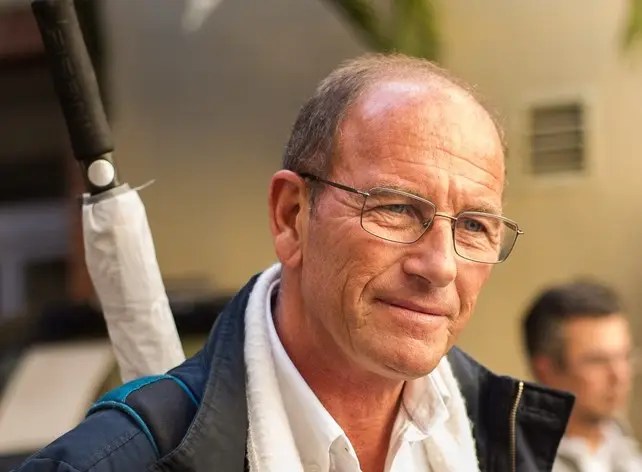
Who is Étienne Chouard?
Étienne Chouard is a retired French teacher who came to prominence in the public arena in 2005 during the referendum on the European Constitutional Treaty. Rejecting the formulaic discourse of the political elite, he advocates for real democracy, in which the people are not only consulted at regular intervals, but write the rules of power themselves.
Chouard defines himself as a ‘researcher of causes’. For him, political, economic and social injustices are not isolated accidents, but the logical consequences of institutions designed to organise popular powerlessness. He follows in the tradition of radical democratic thinkers who refuse to confuse electoral governance with popular sovereignty.
His central argument can be summed up in one sentence:
‘The problem is not the elected representatives. It is the process that appoints them.’
Hence his fundamental distinction between voting and election, and his call to completely overhaul the way we conceive and practise democracy.
—
Election is not voting
For Chouard, electing is not the same as voting. An election is a process of selecting from among candidates — often from the same social, economic and media circles. It encourages competition, showmanship and political marketing. It gives power to those who know how to win it — and often confiscate it.
Voting, on the other hand, refers to the act of directly participating in a decision. It assumes that everyone has equal power in defining laws, policies and common rules. It is the founding act of a sovereign people.
In representative democracy, elections appoint representatives. But when these representatives are neither accountable, nor removable, nor controlled, then the system ceases to be democratic and becomes aristocratic.
History reminds us that in Athens — often presented as the first democracy — magistrates were not elected but chosen by lot. Elections, said Aristotle, are characteristic of aristocracies; lotteries are characteristic of true democracies.
—
Why are elections not (or no longer) democratic?
In today’s representative systems — and even more so in disguised authoritarian regimes such as Cameroon’s — elections function as a decoy. Chouard demonstrates their limitations, which the Cameroonian experience sadly confirms:
- Power is delegated without any counterbalancing powers.
Once elected, representatives govern without oversight. They no longer consult, are not accountable, and enjoy almost absolute impunity.
- The choice is rigged from the outset.
Candidates are filtered, the dice are loaded. Independents are sidelined, opponents are silenced, and genuine debate is prohibited.
- Citizens become mere extras.
They vote, but they do not decide anything. They have no control over laws, the Constitution, or the rules of the game.
- The rules are written by those in power.
The Cameroonian Constitution, as in many authoritarian regimes, is a tool used by those in power to maintain their position. It is neither discussed nor validated by the people.
- Elections are communication operations.
They favour slogans, empty promises, clientelism and the buying of votes. The truth is marginalised.
In such a context, simply calling on people to ‘go out and vote’ is insufficient, even complicit with the status quo. We must reject the electoral trap and open up the democratic process.
—
Voting: an act of sovereignty, not an empty ritual
For Étienne Chouard, a true vote must be an act of collective decision-making. It is not a blank cheque given to representatives. In a real democracy, the people:
- Write the Constitution through a popular constituent assembly,
- Participate regularly in public deliberation,
- Has the right to recall elected officials,
- Can propose laws themselves (popular initiative),
- And decides on major policy directions through referendums.
In this model, citizens are not spectators. They are co-authors of the collective project.
This is the form of voting that Cameroon must now aim for.
—
Random selection: an additional way to break the oligarchy
The idea may seem strange: entrusting certain public functions to citizens selected at random. Yet it is an old idea — and a highly effective one for breaking the logic of political careers, avoiding the professionalisation of power, and reintroducing real equality.
Recent experiences in several countries (France, Ireland, Canada, Germany) have shown that it is possible to involve ordinary citizens in deliberation and democratic control, provided that they are trained, supervised and their terms of office are limited.
This model is not intended to replace everything. But it can provide a concrete response to the crisis of legitimacy in representative systems, including in Cameroon, by opening up democracy to those it systematically excludes.
—
And what about Cameroon? From election monitoring to rebuilding the state
Cameroon is once again preparing to hold elections in a locked political environment, with a subservient judiciary, a contested electoral commission, and a climate of indifference or resignation. But this time, the people must change their stance.
It is no longer enough to play the game. We must change the rules.
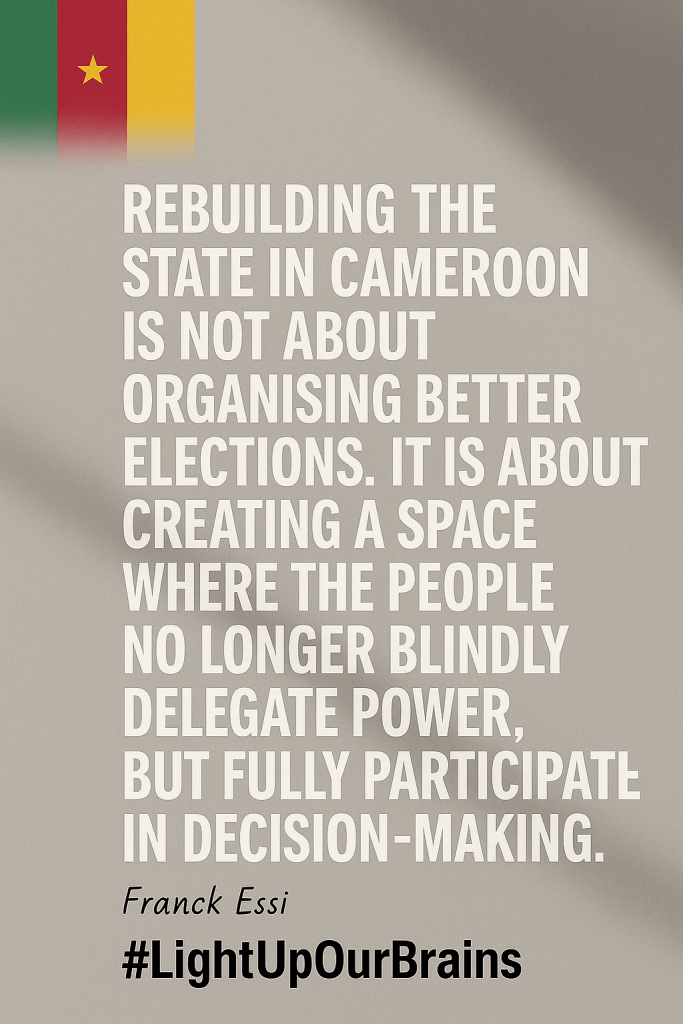
It is not just a matter of choosing another president. It is a matter of rebuilding the state.
Because beyond the elections, it is the entire institutional architecture that is ailing:
- A constitution written without people,
- Laws passed without debate,
- Institutions disconnected from real life,
- An administration that is being manipulated,
- A marginalised civil society.
Rebuilding the state begins with rebuilding democracy. And rebuilding democracy begins with taking back constituent power.
—
We must evolve from spectator-voters to standing-citizens-rebuilders.
The distinction between voting and election forces us to shake off our democratic apathy. It reminds us that power is not given. It is taken. It is built. It is wrested through collective action and political lucidity.
In today’s Cameroon, popular sovereignty must be reclaimed.
And this reconquest will not happen solely at the ballot box. It will happen:
- In neighbourhoods, through the creation of citizens’ assemblies,
- In minds, through popular education and awareness-raising,
- In struggles, through pressure on institutions, civil disobedience, and the occupation of symbolic spaces.
Voting is not electing. Electing is not deciding. Deciding is entering history through the front door, by once again becoming the authors of our collective destiny.
Cameroon does not need a new providential man. It needs people who will rebuild it. A people who stand tall!
To learn more about Etienne Chouard:
- https://www.chouard.org
- https://www.chouard.org/articles/
- https://www.chouard.org/videos/
- https://www.dailymotion.com/video/xslkxs
- https://www.thinkerview.com/etienne-chouard/
- https://www.librairie-gallimard.com/listeliv.php?form_recherche_avancee=ok&auteurs=Etienne+Chouard
#IdeasMatter
#WeHaveAChoice
#WeHaveThePower
#LightUpOurBrains
#CivicEducation
 franckessi.com