By Franck Essi
—
Tribalism as a Pollution of Our Common Life
Tribalism has become, in Cameroon, an underground language, a toxic lens, a thick fog that prevents society from seeing clearly and acting together.
By tribalism, we mean the tendency to overvalue one’s group of origin—ethnic, regional, or cultural—to the point of justifying preferential treatment, distrust, or exclusion of others. It is not the love of one’s roots that is the problem, but their use as a political weapon against the common good.
Like a slow-acting poison, tribalism seeps into political discussions, infects social media comments, taints hiring decisions, distorts collective mobilizations, and weakens institutions.
This form of tribalism has become one of the dominant pollutants in the public space. And as with any pollution, it is not enough to blame the visible factories or dominant currents—we all contribute, often unknowingly, to this collective contamination.
The first ecology to rebuild is internal. Detoxifying the public space from this identity-based poison begins with intimate, rigorous, and sustained work on our own biases, reflexes, language, silences, and invisible loyalties. This is a personal, ethical, and political undertaking.
—
Tribalism Is Not Just in Institutions: It Lives in Our Minds
We often think tribalism is the work of politicians, clan leaders, or corrupt elites. That is partially true. But what we often overlook is that tribalism is first and foremost a mental state, an implicit culture, a way of being in the world. It is what we think without saying, what we feel without admitting, what we transmit without realizing.
When a citizen evaluates a civil servant’s competence based on their surname,
When a student feels she must « hide her origins » to avoid being stigmatized,
When an ordinary Facebook comment turns into a community clash,
When a groundless rumor goes viral because it echoes old stereotypes…
This proves that tribalism is not merely an external event. It is a shared belief system—one that must be challenged within each of us.
—
The Inner Mirror: Detoxing from Our Own Biases
Cleansing begins with honest self-questioning:
• What fears do I have toward other communities?
• What stereotypes did I inherit from my family, surroundings, or school?
• Have I ever judged, excluded, or looked down on someone because of their origin?
• Do I allow myself to hear different stories without feeling personally attacked?
This introspection is not self-flagellation. It is an act of intellectual honesty and moral responsibility. It requires us to unlearn what society has sometimes taught us: suspicion, identity-based competition, reflexive distrust. This work is all the more urgent because, if neglected, our biases become time bombs. They sabotage alliances, fracture social movements, and shatter solidarities.
—
Learning Complexity Against Identity Reductionism
Tribalist thinking is rooted in reduction: it reduces others to a single dimension. He is “Bamileke,” “Bassa,” “from the North,” “Anglophone,” as if he could not simultaneously be a musician, a father, a scholar, a citizen of the world.
We must relearn how to see complexity. We must acknowledge that identity is never one-dimensional, but always hybrid, shifting, and multifaceted. As Amin Maalouf wrote, “murderous identities” are born from reduction, fear, and a refusal of otherness.
Detoxifying the public space also means campaigning for an education in plural identities—in schools, in the media, in families, in political parties. It means restoring to Cameroonians a taste for rooted universalism: an open, dignified, and active national citizenship.
—
From Symbolic Gestures to Transformative Practices
Self-work must not remain abstract. It is expressed through concrete actions:
• Naming and deconstructing tribalist discourse, even when disguised as humor or tradition.
• Rejecting ethnic-based coalitions, especially those claiming to represent a just cause.
• Creating intercommunity cooperation spaces around economic, social, or cultural projects.
• Promoting cross-community narratives, shared experiences, and stories of solidarity.
Each time we take a step toward others—without prejudice, without calculation—we neutralize a molecule of tribalist poison in the collective air.
—
A Commitment to Renew Every Day
This struggle is neither heroic nor glamorous. It is daily, quiet, and persistent. It requires patience, humility, and listening. It means accepting to be corrected, challenged, and even shaken. It demands that we question our communal reflexes—not to deny ourselves, but to expand the circle of belonging.
Because we do not fight tribalism by denying identities, but by inscribing them into a larger, fairer, more promising common project. A project for a Cameroon where merit outweighs names, where solidarity counts more than inherited boundaries, where the state protects instead of dividing, and where citizens feel responsible for the country’s moral atmosphere.
—
My personal conviction: The Change Begins Within
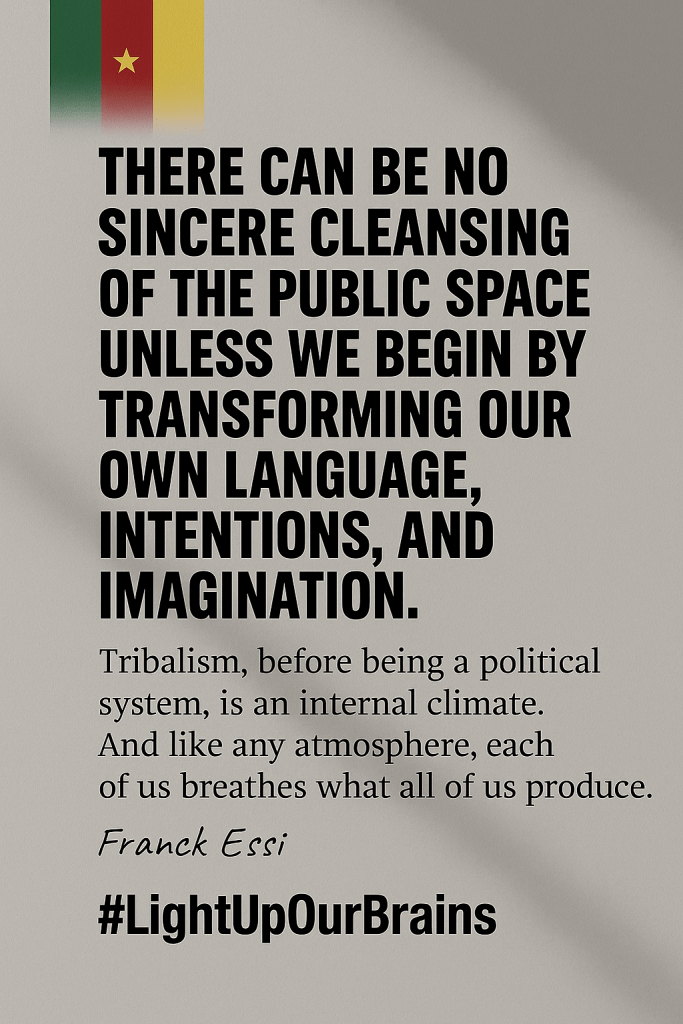
There can be no sincere cleansing of the public space unless we begin by transforming our own language, intentions, and imagination. Tribalism, before being a political system, is an internal climate. And like any atmosphere, each of us breathes what all of us produce.
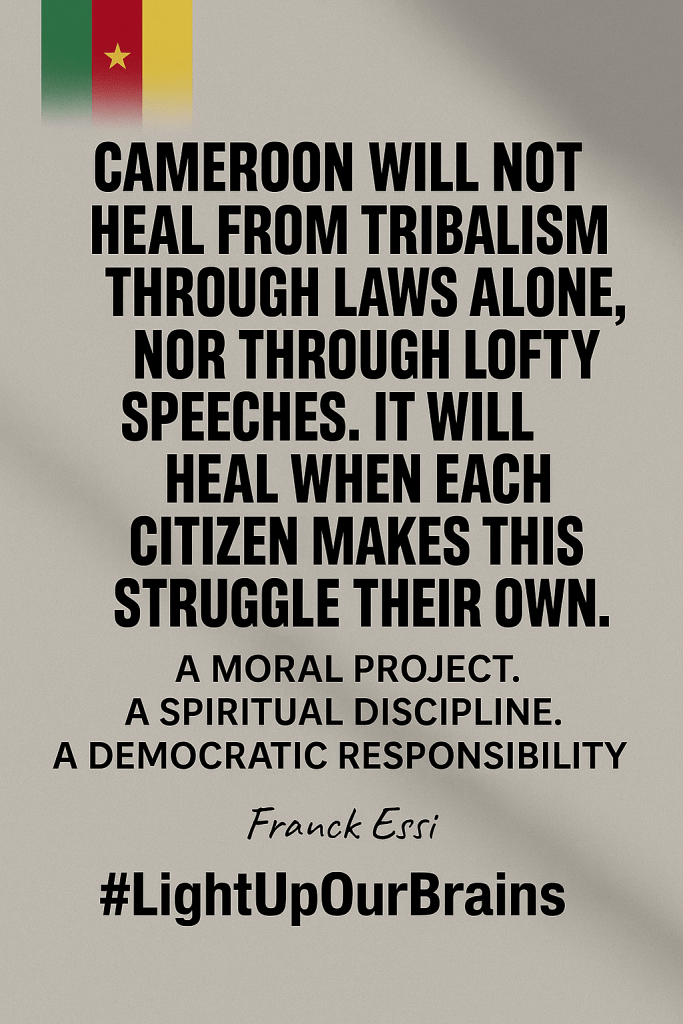
Cameroon will not heal from tribalism through laws alone, nor through lofty speeches. It will heal when each citizen makes this struggle their own. A moral project. A spiritual discipline. A democratic responsibility.
#IdeasMatter
#WeHaveAChoice
#WeHaveThePower
#LightUpOurBrains
#CivicEducation
 franckessi.com