Rebuilding the nation begins with rewriting the history that binds us together
By Franck Essi
—
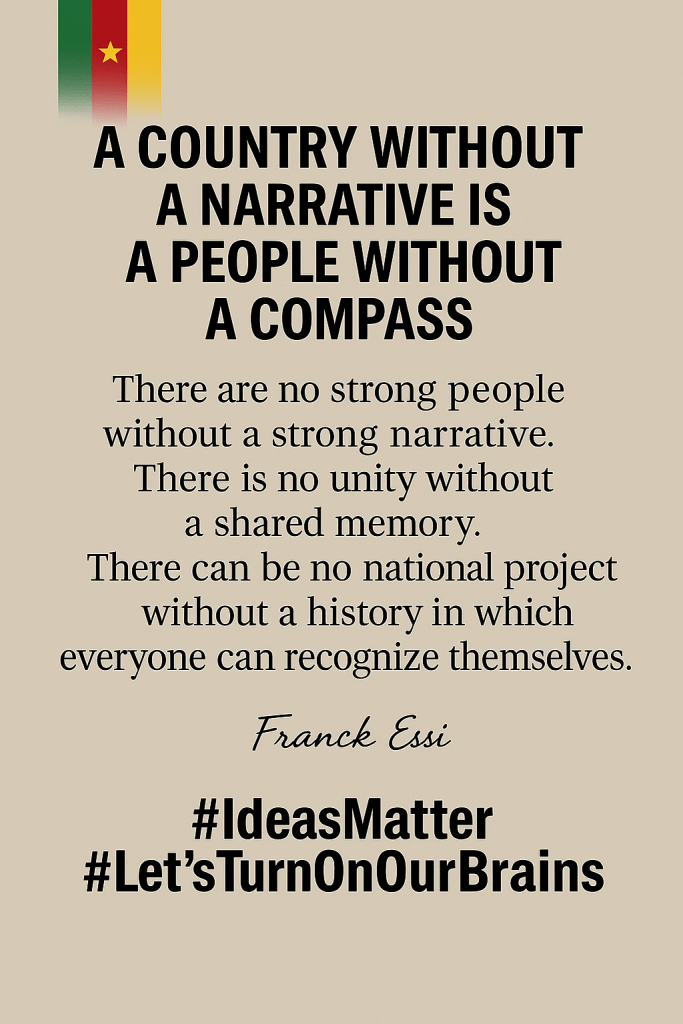
A country without a narrative is a people without a compass
There are no strong people without a strong narrative. There is no unity without a shared memory. There can be no national project without history in which everyone can recognize themselves.
A national narrative is not a luxury reserved for great powers or educated elites. It is the invisible but fundamental foundation of any stable, just and sustainable collective life. It gives people a sense of self, a sense of direction in time, a common language and a horizon for action. It enables us to answer collectively an essential question: ‘Who are we and where are we going together?’
Such a narrative cannot be reduced to dates, official heroes or institutional slogans. It includes the pains of the past, the struggles that have been ignored, the mistakes that have been acknowledged and the hopes that are shared. It is a living, evolving material that connects generations, clarifies responsibilities and engages everyone in a common adventure.
In all great nations, this narrative has played a decisive role.
- In the United States, the figure of Abraham Lincoln and the struggle for union and the abolition of slavery still shape the democratic imagination, despite persistent racial divisions.
- In South Africa, the Truth and Reconciliation Commission enabled post-apartheid society to name the crimes of the past, recognize the victims, and build a new moral contract through the mobilizing metaphor of the ‘Rainbow Nation’.
- In Rwanda, after the 1994 genocide, rigorous work to rebuild the narrative has made it possible to establish an official memory that avoids stories of revenge, empowers citizens, and refocuses the nation on unity, dignity, and resilience.
These narratives are not fixed myths. They are collective compasses, often contested, but always structuring. Without them, people wander, divide, and become vulnerable to identity manipulation, internal conflict, and political impotence.
—
Cameroon: a nation without an accepted narrative
Cameroon suffers from a profound narrative void. This country, rich in cultures, histories, resistance and encounters, has never developed an authentic, accepted and mobilizing national narrative.
Since independence, those in power have confiscated history to impose a narrow and selective official version. They have glorified national unity while ethicizing power, celebrated peace while organizing repression, and obscured the figures of struggle who could have embodied a common pride.
The heroes of anti-colonial emancipation have been erased or demonized. The massacres of unification, the tragedies of the West, the silent revolts of the Far North, and the frustrations of the English-speaking regions have never been integrated into an honest national memory.
As a result,
- schools teach a watered-down, biased, and sometimes misleading version of history.
- The public media sing the praises of the government, not those of the people.
- National holidays become staged events disconnected from the lived experience of the people.
In this void of meaning, fragmented narratives prevail : ethnic, religious, regional, community, diasporic narratives… Narratives of withdrawal, resentment or revenge, often exploited by the elites to consolidate their power or justify their privileges.
—
When slogans replace history
In the absence of a true collective narrative, slogans have filled the void. They are repeated like mantras:
‘Cameroon is Africa in miniature.’
‘We are the continent!’
‘Our diversity is our wealth.’
‘Cameroon is one and indivisible.’
‘United in peace and progress.’ «
But these phrases are only substitutes for a narrative, default narratives. They sound good, but they don’t tell us anything. They say nothing about the founding dramas, the unresolved conflicts, those excluded from the system, the buried pains. They coat reality without transforming it. They give the illusion of national cohesion, when in fact it is being undermined from within.
In truth, these slogans are collective anesthetics. They flatter the image we want to project of ourselves without forcing us to make the effort to build a true ‘living together’. They paralyze critical thinking and prevent us from inventing a more just future.
—
Why do we need a true national narrative?
Because a nation cannot be built on silence, oblivion and complacency.
A true national narrative is a work of truth, justice and collective projection. It serves to:
- Heal wounded memories by acknowledging injustices, state crimes, and past and present oppression.
- Build an inclusive sense of belonging, where everyone, regardless of their origin, finds their place in the shared narrative.
- Give meaning to civic engagement by linking rights, institutions and responsibilities to a living collective memory.
- Defuse identity tensions by replacing tribal opposition with recognition of interdependence.
The national narrative must not shy away from the pains of the past. It must confront them, integrate them, and use them as the foundation for a better future.
—
What a national narrative is not
A national narrative is not a communication campaign. It is not an advertisement for patriotism. It is not a fable where everyone is happy, united, and naturally supportive of one another.
It is not saying ‘We are the continent’ without questioning our dependencies, our contradictions, our organized powerlessness.
It is not repeating ‘Cameroon is Africa in miniature’ without recognizing that this ‘condensed version’ is also one of divisions, injustices and impunity.
It is not proclaiming ‘Our diversity is our wealth’ when that diversity is exploited to divide and dominate.
These superficial narratives prevent us from thinking about reality. They keep us in our comfort zone, in symbolic comfort, in sterile repetition. They must be replaced by a narrative that is lucid, courageous and transformative.
—
What a refounding national narrative should be
A refounding narrative is a plural narrative, born of the confrontation of memories, not their erasure. It does not seek to unify by force, but to connect through meaning. It does not simplify but brings complexities into dialogue.
It must integrate:
- National languages and oral tradition.
- Anti-colonial struggles and modern resistance movements.
- Female, diasporic, peasant and popular figures.
- Collective traumas and invisible victories.
This narrative is not nostalgia. It is a dynamic of renewal. It must be written in schools, streets, books, films, museums and social networks. It must be carried by all and for all.
—
A shared memory for a common future
To be fruitful, this narrative must be rooted in Cameroon’s plurality. It must reflect the reality of a country that is both richly diverse and dangerously fragmented.
This means :
- Moving from a nation-state imposed from above to a nation-state built from below.
- Making memory a lever for citizenship.
- Transforming diversity into real political strength, rather than a pretext for domination.
This project is also cultural: we must create new works, promote forgotten narratives, rebuild our common references and, above all, open up spaces for collective imagination.
—
How can we construct this narrative? Who should write it?
A national narrative cannot be dictated by a government. It must be co-constructed by the whole of society in a conscious process of rebuilding.
The actors :
- Historians, to document, restore the silences and restore a plural truth.
- Artists, filmmakers, musicians, writers, to embody memory in emotion and imagination.
- Teachers, to transmit history without betraying it.
- Citizen movements, to give voice to the forgotten and the buried.
- Institutions, once rebuilt, to inscribe this narrative in public practices and, in so doing, ritualize ‘the commons’.
- Young people, to be its co-authors, its living relays, and thus ensure its continuation into the future.
The key stages in the construction of this shared national narrative can be articulated around the following points:
- Establishing historical truth: on forgotten wars, repression and divisions, with the aim of recognizing what has been denied.
- Giving a place to every memory: from the North to the Far North, from Douala to Buea, from the South to the diasporas.
- Creating shared symbols: monuments, commemorations, collective works.
- Institutionalizing memory: in schools, in curricula, in civic rituals, in laws and national holidays.
—
What this would change in concrete terms
A true national narrative would make it possible to:
- Transform passive citizens into conscious historical actors.
- Rehabilitate institutions by reconnecting them to the people.
- Ease identity tensions by creating common ground.
- Inspire a desire to serve Cameroon, not just use it.
In short, it would enable us to move from being an administered population to a sovereign people, masters of our own destiny.
—
My personal conviction: We must move from slogans to narratives, from the comfort of a numbing status quo to the harsh truth that liberates!
We must shake off our narrative laziness.
‘We are the continent’ means nothing if we do not know where we are going.
‘Cameroon is one and indivisible’ is not enough if we refuse to listen to those who feel rejected.
‘Our diversity is our wealth’ is a lie if it continues to fuel injustice.
It is time to write a narrative that is stronger than our divisions.
A narrative that names the pain, recognizes the excluded, honours the righteous, unites the will, mobilizes the energies.
Rebuilding the nation means relearning how to tell the story of what it means to be Cameroonian. It is up to us to write that story. Now.
— Franck Essi
#IdeasMatter
#WeHaveChoices
#WeHavePower
#Let’sTurnOnOurBrains
#CivicEducation
 franckessi.com