By Franck Essi
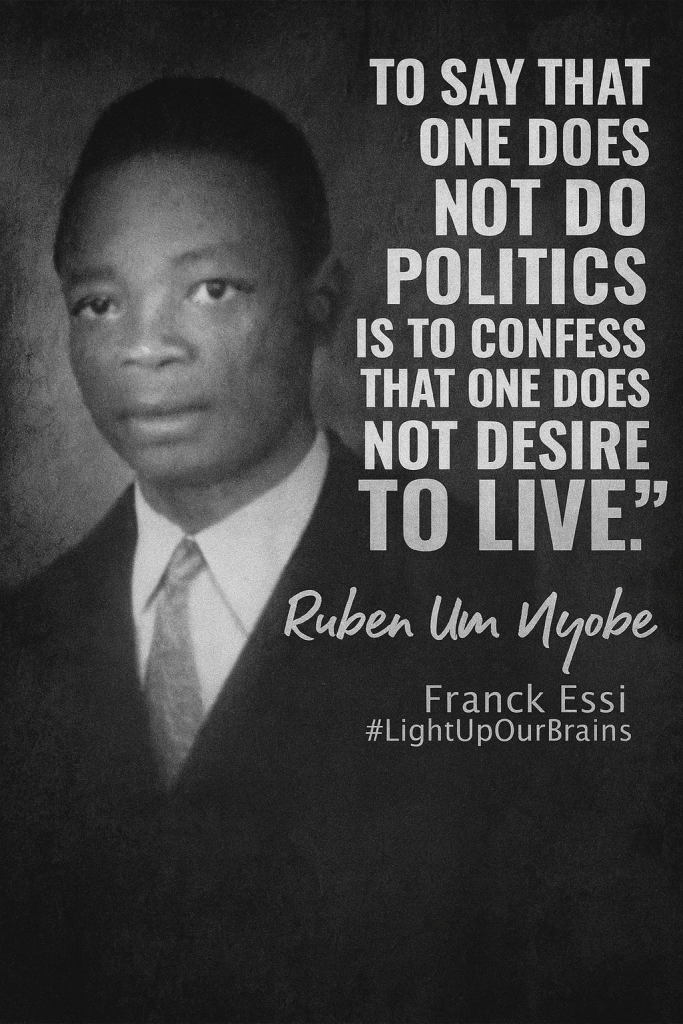
On 13 September 1958, Ruben Um Nyobe, Secretary General of the Union of the Peoples of Cameroon, was assassinated by « endogenous forces in incestuous collusion with exogenous forces ».
Because of the strength of his vision and the magnitude of his sacrifice, every 13 September has become an opportunity to reflect, learn lessons and draw inspiration from Um Nyobe and his comrades in order to complete the work of emancipating the people of Cameroon.
What can we learn from Um Nyobe and his illustrious comrades, the men and women of ’48?
—
1 – The audacity to hope and the courage to dare to invent a different future
The writer and Nobel Prize winner George Bernard Shaw used to say, « There are those who see things as they are and wonder why, and there are those who imagine things as they might be and say… why not? »
Ruben Um Nyobe and his peers, the men and women of ’48, were undoubtedly in the second category.
In the midst of the colonial period, when Cameroonians in particular and Africans in general were groaning under the yoke of the criminal and inhuman domination of the colonists, they rose up to say no. They rose up to say that as human beings, Cameroonians in particular and Africans in general could and should expect better from life. They founded the new hope of their era by proposing a new horizon of emancipation while, at the same time, forging the key elements of the new Cameroonian identity.
And because this was not without danger, they had to show courage. The courage to face repression and the courage to brave the thousand and one obstacles that internal and external opponents of the emancipation of the Cameroonian people placed in their path.
In their own way, as Thomas Sankara so aptly put it, they « dared to invent their future ».
—
2 – The refusal to resign oneself, a sense of commitment and a concern for consistency
Ruben Um Nyobe rightly said that there was no point in denouncing the injustice and arbitrariness of a system if no action was taken to put an end to it. This thought in itself is an anti-« how are we going to do it? » that characterises many of us.
Um Nyobe and his comrades were living embodiments of the refusal to resign oneself to one’s fate. They understood that resignation is nothing more than a construct of the dominant class to perpetuate the subjugation of the subjugated. Steve Biko, one of the South African leaders of the struggle against apartheid, later put it so well: « The most powerful weapon in the hands of the oppressor is the mind of the oppressed. » In the same vein, Bob Marley, the famous artist, never failed to emphasise the need to free ourselves from the slave mentality.
Ruben Um Nyobe also said that it is those who are likely to benefit from reforms who must mobilise to bring them about. « Reforms can only be effective when they are actively defended by those who benefit from them. » Um Nyobe, excerpt from the « Report presented to the first UPC congress », Dschang, 10 April 1950.
Today, we often witness paradoxes: the oppressed wait for the oppressors to reform themselves in order to change their conditions! It is incredible that we can expect the coloniser to decolonise, the thief of public funds to stop stealing, and the parasite to stop taking undue advantage of the labour of others.
As Sankara also said on this subject: « Only struggle liberates. » Um Nyobe and his peers were the first to put this common sense into practice through their full and complete commitment to liberating Cameroon from colonial rule.
And the consistency of this commitment stems from the fact that there was an indisputable alignment between his observations, his speeches and his actions. Neither time nor various trials and tribulations would cause him to deviate from this commitment. This undoubtedly makes him a benchmark and a role model for current and future generations of Cameroonians.
—
3 – A sense of organisation
« A people determined to fight for their freedom and independence is invincible. » Ruben Um Nyobe, in « How the massacre of the Kamerunais was prepared and carried out by the French government », Maquis, 3 January 1957.
No force can resist an organised people. For us, this means several things:
- When the people rise up, things change!
- There is no such thing as a spontaneous revolution, and change does not happen by chance.
- The vanguard, which is the progressive leadership in a society such as Cameroon, must establish and refine an organisation capable of mobilising the masses to achieve their own interests.
In this regard, the structuring of the UPC between 1948 and 1955, when it was banned, remains a model example. The training of its cadres remains a benchmark. The mobilisation of the masses remains an example. Work was carried out at the time in an environment in which not all the facilities that the modern world offers us were necessarily available. Increased facilities in terms of communication technology, means of transport, level of education, knowledge and know-how available in documentation.
Many of us today want to reap without having sown. Many of us do not take the time and care to patiently and solidly build the frameworks, structures, strategies and initiatives that, in the long term, in the interests of the masses, will make it possible to reverse the balance of power in favour of progressive forces.
It is in all our interests to continue to learn from these pioneers and to apply what, in their experience, has succeeded in raising the level of consciousness of the Cameroonian people.
—
4 – The spirit of unity, solidarity and fraternity
Um Nyobe and his peers, the men and women of 1948, also had other characteristics that contrasted sharply with contemporary political practices and positions: a spirit of unity, solidarity and fraternity. This spirit can be seen in three elements: the UPC’s statutes, its positions on tribalism and its discourse on racism.
a) The UPC’s statutes.
Article 1 of the statutes, as definitively established at the Eseka Congress of 1952, states: « A movement called the ‘Union of the Peoples of Cameroon’ (abbreviated to UPC) is hereby established in Cameroon, with the aim of bringing together and uniting the inhabitants of this territory in order to enable the more rapid development of the populations and the raising of their standard of living. »
This union was a means to achieve a goal more quickly: liberation. It was not based on philosophical, ideological or religious differences. Its main driving force was anti-imperialism and anti-colonialism. In other words, the vision was to create a Movement that would enable Cameroonians to regain control of their own destiny.
For Um Nyobe, « The independence of Cameroon means the government of Cameroon by Cameroonians, for the benefit of Cameroonians. » (Um Nyobe, Eseka Congress, 1952)
b) Positions on tribalism.
Um Nyobe and his peers, the men and women of 1948, were against tribalism. By way of illustration, the three quotes below give an idea of his analysis of the phenomenon of tribalism:
Tribalism as a weapon of division in the service of those in power
« They [the colonialists] pit tribe against tribe by making some believe that they are more intelligent and others that they are very rich and will dominate the country. Both sides naively believe this and engage in futile internal struggles that ultimately lead to the ruin of all, and the only one who benefits is the coloniser. […] They simply seek to exploit the hatred of the former to their own advantage and prolong the misery of all. » (In Ecrits Sous Maquis).
Today, we could easily replace the term coloniser with ruler, and this analysis would remain entirely relevant.
Tribalism as a weapon for opportunistic politicians
« Tribalism is one of the most fertile fields of African opposition. We are not ‘detribalizers’, as some claim. We recognise the historical value of our people’s ethnic groups. They are the very source from which the modernisation of national culture will spring. But we do not have the right to use the existence of ethnic groups as a means of political struggle or personal conflict. » (In Le Problème National Kamerunais).
Here too, we see the lucid, relevant and difficult choice that was made very early on: not to exploit ethnic groups for political gain. On the contrary, Um Nyobe constantly invited us to build a national culture based on the richness of our ethnic heritage.
The fight against tribalism as a means of strengthening national unity
« In order to bring together and unite the inhabitants of the Territory, we believe that the first step is to engage in a resolute struggle against tribalism and clanism, against everything that can fuel tribal hatred and clan divisions. Putting our words into action, we have set an example in the way we have distributed leadership positions within the U.P.C. » (In Le Problème National Kamerunais).
One cannot call oneself a patriot, nationalist and progressive while tolerating any form of tribalism or clanism. One cannot truly unite the people of the territory while giving primacy to one particular community over others.
c) Discourse on racism.
Finally, at a time when the awakening of African youth is growing everywhere, with its share of fervour and misunderstandings, it is worth recalling what Um Nyobe and his peers said on the issue of racism:
« We do not confuse the English people with English imperialism, which keeps peoples under its domination, nor the French people with French colonialism, which plunders and oppresses the peoples of our country. We must warn our brothers against the danger of anti-racist racism. We cannot, under the pretext of liberating Black people, pursue a policy of hatred against White people. Racial hatred is incompatible with any idea of progress » (Kumba Congress, 1951).
Racial hatred is incompatible with any idea of progress. That says it all. And Article 31 of the UPC’s statutes stated the following: « The UPC is not a movement that goes against the French nation, the interests of the French Union, or the current Constitution. »
Let us show lucidity and discernment in the legitimate struggle we must wage and complete against new forms of imperialism and colonisation. Showing discernment and lucidity leads us to introduce nuances in our view of the world, the causes of our misfortunes, and the allies and adversaries in the cause of our emancipation.
But let us be reassured: this nuance in our discourse in no way diminishes our denunciation of the oppressive system or our desire to build a new international order based on humanist values. The proof is in the statements below:
« We are therefore busy demanding the abolition of racial discrimination and are radically opposed to the system of forced labour, indigenous status and bloody provocations […]. We have repeatedly stated that we want a free Africa, but an Africa that is friendly to other free peoples. The colonialists know this very well, and the slanderous insinuation that we are in the pay of a foreign power can only serve to ridicule them. » Ruben Um Nyobe, excerpt from the « Report presented to the first UPC congress », Dschang, 10 April 1950.
« What we want to affirm once again is that we are against the colonialists and their henchmen, whether they be white, black or yellow, and we are allies of all those who support the right of peoples and nations to self-determination, regardless of colour. » Ruben Um Nyobe, Félix Roland Moumié, in « Religion or Colonialism? », Douala
« We must also combat the practice of our compatriots who, in police stations and public offices, often tend to serve Europeans first, even if they are the last to arrive. This also constitutes racial discrimination in its most reprehensible form. » Ruben Um Nyobe, excerpt from « Report presented to the first UPC congress, » Dschang, 10 April 1950.
« We must warn our brothers of the danger of anti-racist racism. We cannot, under the pretext of fighting for the liberation of Black people, pursue a policy of hatred against White people. Racial hatred is incompatible with any idea of progress. » Ruben Um Nyobe, excerpt from his speech at the Kumba Congress, 14-17 December 1951.
« We invite Mr André-Marie Mbida and his colleagues to understand that ‘tribalism’ has no place in politics and that Cameroon’s interests do not lie in corruption and African opposition politics. (…) We ask them to place the interests of Cameroon above power struggles and personal issues. » Ruben Um Nyobe, in « Franco-Cameroonian friendship in danger. Alert to Cameroonian and world opinion, » Maquis, 27 August 1957.
To summarise the thinking of Um Nyobe and his peers, Cameroon’s unity has both internal and external enemies. The latter come from all races and countries around the world. What they have in common is that they are agents of imperialism, colonialism and the impoverishment of the masses. The unity of the Cameroonian people and the continued improvement of their living conditions can only be achieved if these endogenous and exogenous forces are neutralised. And this can and must be done without racial, tribal or other amalgamation.
—
5 – Grassroots work alongside and within the masses
Um Nyobe said: « Cameroonian patriots have understood that the improvement of their material situation can only be guaranteed within a unified and independent Cameroon. It is therefore by organising and educating the masses, by linking our actions to our words, and by working together, regardless of colour, class or creed, that we will deserve to be the servants of our country and of history itself. »
It follows, first of all, that the role of the progressive vanguard is to bridge the gap between the socio-economic demands of the masses and the country’s system of governance. No lasting change in everyday life will occur without profound change in the country’s system of governance. Social, economic and cultural issues cannot be separated from politics. The role of progressive leaders is to raise the consciousness of the masses so that they gradually become acutely aware of the issues at stake and take action in relation to them.
The second thing that emerges is related to the nature of the work to be done with the masses. Communication through the media and social networks is good. Working within and alongside the masses is better, even essential. Working within the masses means informing, training, organising and mobilising them to defend their interests and continuously improve the system of governance. Working alongside the masses means supporting and accompanying the struggles initiated by the masses to break free from the various mechanisms of economic, social and political oppression.
This is the task of the progressive vanguard. In summary, from Um Nyobe and his peers, we learn that changing the balance of power in favour of the interests of the masses requires raising their understanding of the various issues at stake, organising them and mobilising them to ensure that the system of governance definitively and completely integrates their interests.
—
6 – Integrity and a sense of sacrifice
Um Nyobe and his comrades were undoubtedly Cameroonians who stood up for what they believed in. They were prepared to be called all sorts of names for a cause they believed in and which was beneficial to the vast majority of the Cameroonian people.
« Thus, the ‘rebellion’ of which we are guilty […] is nothing other than the rebellion of Cameroonian nationalism against national betrayal, and we can only congratulate ourselves on being at the forefront of such a rebellion, which is currently the most sacred duty that history has assigned to Cameroonian patriots. Ruben Um Nyobe, in « French resignation or complicity in the worsening of the situation in eastern Cameroon », Maquis, 2 December 1957.
He showed us that very often, refusing to get caught up in the petty game currently being played by ‘trapped’ institutions was the best way to preserve what was essential.
« Let it not be believed […] that we will allow ourselves to be intimidated by shootings, looting and torture into renouncing our noble mission, which is to continue the good fight for the immediate reunification and independence of our beautiful and rich Cameroon. » » Ruben Um Nyobe, in « Resignation or French complicity in the worsening situation in eastern Kamerun, » maquis, 2 December 1957.
Christians know that Jesus refused all the treasures of the earth in order to remain faithful to God. Um Nyobe refused honours and power in order to remain faithful to the ideal of emancipation of the Cameroonian people.
May the current generation produce people with the same characteristics to complete the work begun several decades ago.
—
7 – The meaning of true citizenship
Many of us Cameroonians are discouraged from entering politics. This situation is not new. Um Nyobe and his peers were already faced with this situation and warned their compatriots about the dangers of « apoliticism ».
Below is an overview of his views on the matter.
a) Everything is political
« We have insisted to our compatriots, who are given advice to warn them against politics – this ‘dangerous undertaking’ – and our compatriots, especially intellectuals, to say that they are not involved in politics because they are preparing for some unknown material situation. We have therefore insisted to them to show them the deception of such a campaign. Everything is political and everything is framed by politics. Religion has become political. Trade is political. Even sport is political. Politics affects everything and everything affects politics. To say that one is not involved in politics is to admit that one has no desire to live. That is why we believe that, above all, we must fight for fundamental freedoms , which are essential to material success. Ruben Um Nyobe, excerpt from the « Report presented to the 2nd Statutory Congress of the UPC », Eséka, 29 September 1952.
b) If you don’t engage in politics, politics will engage you
« Naive or disingenuous Africans, to justify their failure to defend our interests, claim not to be involved in politics because they have been told in administrative corridors that politics is a bad thing. […] For the colonialist administration and government in general, not being involved in politics simply means not defending your interests. This can also be translated as: ‘Only engage in my politics, which approve of my arbitrariness and my illegalities’. Ruben Um Nyobe, excerpt from the ‘Report presented to the first UPC congress’, Dschang, 10 April 1950.
« If you refuse to engage in politics that consists of fighting by all means and in all forms for the emancipation of our country, you leave the field open to the colonialists for their criminal policies of forced labour, indigenous status, shameless exploitation of our wealth, imprisonment and murder. » Ruben Um Nyobe, excerpt from the « Report presented to the first UPC congress, » Dschang, 10 April 1950.
—
In conclusion…
One thing is clear: we have indeed received a legacy from Um Nyobe and his comrades. This legacy includes achievements and a history of struggles of which we can rightly be proud. But it also includes unfinished projects and wounds that need to be healed.
Several questions are therefore being asked today:
- What is our historic mission today?
- How can we accomplish it?
- What will my particular contribution be?
To answer these questions, we must always remember some of the characteristics of those ancestors of the future, the men and women of 1948, namely:
- The audacity to hope and the courage to dare to invent a different future.
- Refusal to accept resignation, a sense of commitment and concern for consistency
- A sense of organisation
- A spirit of unity, solidarity and fraternity
- Working on the ground alongside and within the masses
- Integrity and a sense of sacrifice
- A sense of true citizenship
Glory to Mpodol and his comrades!
 franckessi.com