Personal reflection on the trap of false alternatives and the urgency of remaining true to our principles.
NB: Read slowly. Meditate on it. Otherwise, it will be useless.
—
The false dilemma: evil versus worse
In 2009, in a restaurant in the Bonapriso neighbourhood of Douala, an ordinary scene turned into a lesson in politics for me. We were gathered at the famous La Chaumière restaurant, a venue provided by Sam Mbaka, a well-known figure in Cameroonian public life, for the monthly Kièlè (‘Tomorrow’ in the Douala language) conferences of the Cameroon Ô’Bosso (Cameroon Forward) association, of which I am a member. This pioneering citizens’ association has set itself the task of mobilising Cameroonians around the positive transformation of our country’s governance.
On that day, in a debate on monetary reforms in Cameroon, particularly the exit from the CFA franc, the invited experts – as brilliant as they were technically knowledgeable – concluded that it was extremely difficult to carry out structural transformations in a country such as ours. The lack of room for manoeuvre, international power relations, internal inertia: according to them, everything conspired to reduce the scope of possibilities. One of them then uttered this chilling sentence:
« Sometimes, in public life, you only have a choice between bad and worse. »
But this statement provoked an immediate reaction. Mboua Massock, a central figure in the « dead cities » of the 1990s, stood up. With his deep voice, imposing stature and inimitable guerrilla appearance, he calmly but firmly declared:
« I want neither evil nor worse. I fight for good. »
His response was like a slap in the face to fatalism. It expressed something fundamental: rebellion against intellectual resignation, against the dictatorship of false evidence, against the cult of « no alternative ».
This response, both simple and incisive, broke a false dilemma. It highlighted a fundamental truth: behind technical discourse sometimes lies a renunciation of courage, imagination and audacity.
This retort opened up an essential discussion: should we accept the shackles of realism as inevitable, or should we reinvent our strategies based on our true values and needs?
For me, that day was much more than a debate. It was a turning point. It marked my deep and lasting refusal to give in to what some call realism but which is often just an elegant form of capitulation.
Since that day, one conviction has stayed with me: there can be no real transformation without the stubborn determination to pursue what is right, even when it seems unrealistic. Universal history confirms this:
- Gandhi and his peers refusing to accept colonial fate,
- Mandela and his comrades breaking apartheid,
- Martin Luther King and his fellow campaigners defying segregation,
- Um Nyobè and his peers championing the cause of independence,
- Sankara and the other revolutionary officers reinventing the African imagination, etc.
None of them accepted the dilemma of the « lesser evil ». Those who reject false dilemmas ultimately change the rules of the game.
—
Why am I talking about this today?
Because in September 2025, with a new presidential election approaching, Cameroon is once again playing out the same scenario: that of an election emptied of its democratic substance, reduced to a mere ritual to maintain the illusion of choice.
Twelve candidates are officially in the running. But behind this façade of pluralism lies a much darker reality:
- Important socio-political figures and groups do not consider it relevant to support this regime in this electoral masquerade.
- Major opposition figures were excluded from the selection phase.
- Entire regions, particularly the North-West and South-West, remain largely excluded from the electoral process due to the insecurity and violence that persist and are worsening during this period.
- Several candidates have neither a credible activist base nor popular legitimacy and have yet to provide any evidence of their ability to shake up the system’s foundations of fraud and restriction of freedoms.
- The game seems so rigged that the outgoing President of the Republic has not deigned to speak out once to announce his candidacy, explain why he is running, or present reasons to trust him. As the campaign officially kicks off, our local emperor is still on a private trip to Europe.
The logic remains unchanged: institutional lockdown, manipulation of the rules, marginalisation of dissenting voices and strict control of the deployment of opponents. And yet, part of the so-called progressive opinion seems ready to take the bait of easy, immediate change without demands.
In this climate of disillusionment, two former pillars of the Biya regime — Issa Tchiroma Bakary and Bello Bouba Maïgari — who recently resigned, are presenting themselves as credible alternatives.
And now, under the pretext of realism, some are calling for people to rally behind them, arguing that we must seize every opportunity, even if it comes from « the devil« . This expression was borrowed from the Bishop of Yagoua who, in a homily in 2024, argued that change was absolutely necessary, even if it meant dealing with the devil.
Hence the now commonplace idea of choosing ‘our favourite devil‘. This phrase crystallises a major trend of our time: the belief that any change, even the most suspect, is better than immobility — even if it means accepting all kinds of compromises.
But this strategy, which is dressed up as pragmatism, is in fact based on a dangerous resignation. For what we call realism here is often a code word for renunciation: renunciation of memory, ethical vigilance and political courage.
—
When memory fades, those in charge become saviours
This reasoning, seemingly pragmatic, is nevertheless based on a dangerous premise: voluntary amnesia. For who are these men whom we now want to transform into standard-bearers of renewal?
- Issa Tchiroma Bakary, long-time government spokesperson, has distinguished himself through his forceful interventions and his zeal in defending the indefensible, particularly during the violence of the Anglophone crisis and other major scandals that occurred while he was in office.
- Bello Bouba Maïgari, a minister for nearly 30 years, has been a pillar of the system of confiscation of freedoms and institutional inertia.
These two men have been, at the heart of the Biya regime, the driving forces behind repression, stagnation and the stifling of political debate. To present them as solutions, simply because they have jumped ship, is a historical misinterpretation.
It overlooks the fact that those who were yesterday’s guardians of the system can hardly be its gravediggers today. It confuses a change of personnel with real transformation.
—
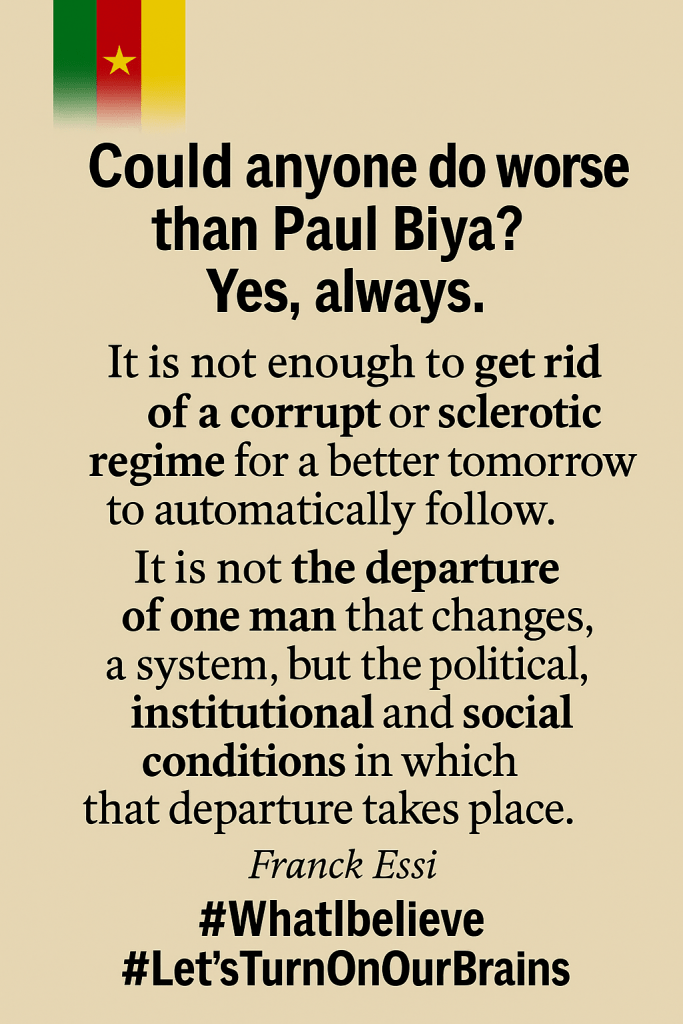
Could anyone do worse than Paul Biya? Yes, always.
« Even the devil couldn’t do worse, » we sometimes hear, as if despair had been transformed into strategy. This phrase, which is meant to be pragmatic, is in fact a dangerous rhetorical trap.
It is based on the illusion that any change, by its very nature, is progress. But the recent history of Africa, with its revolts and transitions, proves the opposite.
It is not enough to get rid of a corrupt or sclerotic regime for a better tomorrow to automatically follow. It is not the departure of one man that changes a system, but the political, institutional and social conditions in which that departure takes place.
The mirage of a salutary break
Take Libya, where the fall of Muammar Gaddafi in 2011 was hailed as a victory for the people and the international community. However, in the months that followed, the country sank into a multifaceted civil war, ravaged by militias, tribal rivalries and foreign powers. Even today, Libya remains divided, without a unified state, with a collapsed economy and a fragmented society. The armed change of power supported by foreign powers has been synonymous with prolonged chaos.
In Mali, change has come about by force: successive coups d’état, rejection of civilian authorities, and the sidelining of regional partners. The result has been a loss of sovereignty over several territories, the militarisation of political life, a decline in freedoms, and populations plunged into fear and precariousness.
In the Central African Republic, the history of electoral change, often imposed under international pressure, has been marked by broken promises, weak presidencies and captured states. Lacking vision and popular support, change has given rise to chronic instability.
Even in countries that are, in principle, better structured, political transitions can lead to new deadlocks. In Tunisia, despite a transition that was hailed for its peaceful nature, the failure to respond to the social demands of the revolution has led to deep disillusionment. Formal democracy has crumbled under the pressure of creeping authoritarianism.
Transitions that exacerbate poverty and authoritarianism
When poorly prepared, regime change can even worsen living conditions:
- Economic shocks (collapse of investment, institutional disorder);
- Reconfiguration of the predatory system instead of its dismantling;
- Exploitation of republican institutions by new elites more concerned with revenge than reconstruction.
The example of Sudan, where Omar al-Bashir’s fall was followed by a power struggle between the military and civilians, illustrates this phenomenon: a transition that collapsed in bloodshed, civilians sidelined, political violence and economic collapse.
In reality, Africa is experiencing four main types of post-transition situations:
- Post-revolutionary chaos: the state dissolves due to a lack of credible alternatives (Libya, Sudan).
- Authoritarian transitions: a new regime reproduces the same practices (Guinea, Mali, Chad).
- Trapped transitions: power remains in the hands of the old networks despite a change in appearance (Gabon, DRC).
- Stalled democracies: institutions that survive without improving the lives of the people (Tunisia, Niger before the coup).
Yes, things could be worse than Paul Biya. Not that his record is defensible—it is catastrophic. But precisely because the damage has been so profound, it requires more than just a change of actors: it requires a systemic break.
There are only a few countries where we see democratic consolidation and significant progress in governance and development. Hence the importance of not assuming that the post-Biya era will be a blank slate.
—
The post-Biya era will not be a blank page
Faced with the regime’s decline, a frequent refrain can be heard in activist discourse:
« First we get rid of Biya. Then we’ll see. »
This slogan, often brandished as a salutary urgency, reflects legitimate anger. But it also conveys a dangerous illusion: the belief that the fall of one man would be enough to break with a system that has been entrenched for several decades.
Change does not begin once the page has been turned. It begins in the way we prepare for the aftermath: clarity of vision, structuring of social forces, building a foundation for reconstruction.
Yet Africa is full of examples where the departure of a dictator has led not to freedom, but to a cycle of disillusionment, confusion and even regression:
- Egypt: after Mubarak (2011), a poorly prepared transition, a lack of guarantees, and a return to a more authoritarian military regime.
- Burkina Faso: after 2014, due to a lack of democratic and security consolidation, the military regained power and insecurity grew.
In these and other cases, change without direction paved the way for the reproduction and even worsening of old patterns. The aftermath always belongs to those who prepare for it, even in the shadows.
—
Change does not necessarily herald transformation
One of the great confusions of the moment is the belief that changing the president is enough to change the country. However, change can be deceptive.
Changing faces does not mean changing the system.
Changing the regime does not mean rebuilding the state.
A change of government only leads to transformation if it is accompanied by:
- Profoundly revised rules of the game,
- Effective counterbalancing powers,
- A renewed political culture,
- And demanding and continuous citizen participation.
Democracy is not limited to elections. It is based on:
- Strong and independent institutions capable of resisting pressure from the executive branch;
- A real balance of powers, ensuring that no one person holds all the levers of power;
- Citizen oversight mechanisms to monitor, challenge, correct and demand accountability;
- Free and responsible media;
- A political culture of responsibility, not allegiance or resignation.
Otherwise, alternation becomes a simple game of musical chairs among elites: we change the faces, not the practices; we reshuffle alliances without redefining priorities. The people remain spectators, frustrated and betrayed.
—
What does ‘rebuilding the state’ mean?
Rebuilding the Cameroonian state is not just about changing the president or amending a few laws. It means returning to the roots of the political contract: what establishes authority, legitimises power, structures community life and guarantees the dignity of every citizen.
Rebuilding the state means above all:
• Redefining the nature of power, breaking with an omnipotent presidential system that concentrates decision-making, paralyses institutions and infantilises society; building a decentralised, shared and accountable system of power.
• Rehabilitating sovereignty — economic (control of resources), monetary (breaking free from dependencies), political (deciding according to our priorities).
• Transforming the economy so that it serves the essential needs of the greatest number: breaking with extractive accumulation for the benefit of a minority; promoting social justice and territorial resilience.
• Guarantee fundamental rights and freedoms as enforceable and protected rights (expression, security, education, health, mobility).
• Rebuild the nation, not through superficial nationalism, but through the recognition of wounded memories, the redress of injustices, the promotion of diversity and the construction of a common narrative based on truth, justice and solidarity.
Rebuilding the state means changing the content, method and purpose of public action: a cultural as well as institutional break with the past.
—
A transformation that goes beyond the electoral moment
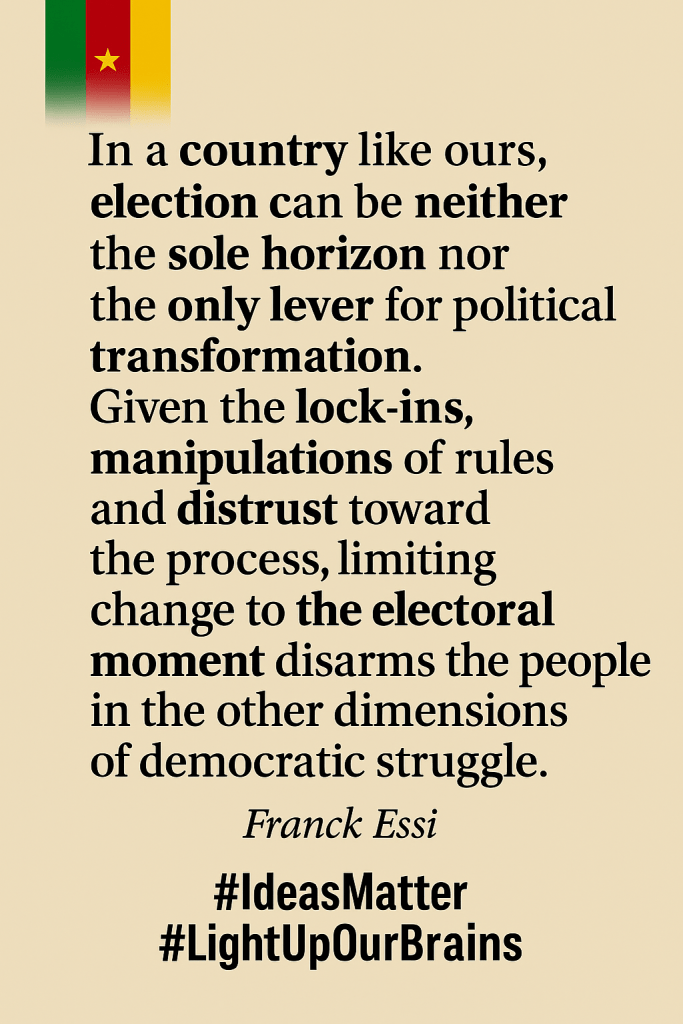
In a country like ours, elections cannot be the only horizon or the only lever for political transformation. Given the deadlocks, the manipulation of rules and the mistrust of the process, limiting change to the electoral moment amounts to disarming the people in other dimensions of the democratic struggle.
True transformation is rooted in the social fabric, organised on the margins, takes shape in collective practices, and is imposed over time: pressure, proposals, citizen presence.
Among the dynamics to be consolidated and generalised:
• Citizen control of local budgets: monitoring committees, publication, monitoring of implementation, questioning of elected officials → accountability and sense of decentralisation.
• Trade union and sectoral mobilisation (teachers, doctors, lawyers, transport workers, etc.): alliances, pooling of demands, coordination → structural transformation of public services.
• Citizen documentation of abuses and malfunctions: local platforms, social networks, exposure of fraud, violence, rigged markets, abuse of authority → transparency as a weapon of mass action.
• Community initiatives for autonomous management: cooperatives, community schools, mutual health insurance schemes, reforestation, solidarity funds → concrete alternatives to a predatory and failing state.
• Cultural and memorial resistance: rehabilitating Ruben Um Nyobè, Félix Moumié, Ernest Ouandié and anonymous figures → nurturing an imagination of justice and sovereignty.
Combined and united, these dynamics can shift the centre of gravity of power: from the elites to the people, from closed institutions to living spaces, from electoral rituals to active democracy.
This is where Cameroon’s future lies: in the people’s ability not to wait passively for the « right candidate », but to leverage the contradictions of the system, invest in the gaps, invent, build, challenge and transform — day after day, territory after territory.
—
The duty not to give in to cynicism
In a weary country, it is easy to give in to weariness. It is easy to take refuge in irony, sarcasm or fatalism. But this cynicism, disguised as realism, is the most treacherous form of capitulation: it neutralises willpower, erodes hope and destroys clarity of reference points.
The moment we are living through is a test — for our institutions and for our collective moral and political intelligence. To hold fast is to refuse to lower our standards, to refuse to compromise our principles, to refuse to confuse urgency with panic, compromise with compromise.
As Aimé Césaire wrote:
« A civilization that plays fast and loose with its principles is a moribund civilization. »
in Discourse on Colonialism (1950).
It is not a sign of maturity to give up on ideals; it is not adult behavior to walk alongside the gravediggers, telling ourselves that we will stop them later. The role of committed women and men is not to accompany the fall, but to chart the course for recovery.
Even in the shadows.
Even against the tide.
Even without the certainty of immediate success.
Even alone.
—
My conviction: always choose the right thing
Refusing to choose ‘our favorite devil’ is not naivety. It is a strategic, ethical and historical choice. It means understanding that:
- You cannot build a sound house on rotten foundations.
- People should never be condemned to the lesser evil but called to the greatest good possible.
- A change of façade without a break in logic is merely an illusion.
- Ethics, memory and consistency are political weapons, not ornaments.
Yes, the current regime is exhausted. Yes, anger is legitimate. But the future cannot be entrusted to those recycled from the system, to the managers of the old disorder, to the architects of stagnation.
The future belongs to those who, without posturing or populism, but with consistency and integrity, hold the line.
And that line is the Good. Not the Good as an unattainable perfection, but as a direction, a requirement, a collective compass. Choosing the Good means betting on integrity in action, consistency in commitment, clarity in trajectory.
It is not about fleeing reality: it is about confronting it with lucidity, without denying oneself.
An election is a moment. Transformation is a movement.
Let us not sacrifice this movement on the altar of a deceptive moment.
Let us not betray the memory of our struggles for the illusion of change.
Let us reject our favorite devils. Let us choose the Good.
— Franck Essi, 30 September 2025
#WhatIbelieve
#WeHaveTheChoice
#WeHaveThePower
#IdeasMatter
#Let’sTurnOnOurBrains
In the same vein:
The Election Is a Moment — Transformation Is a Movement
Let’s not mistake our horizon.
Do not confuse a change in posture with a change in nature
Cameroon 2025: Change, yes. But what kind of change?
Upcoming elections in Cameroon: how to analyse the candidates and their political platforms?
 franckessi.com