By Franck Essi
—
Cameroon is in crisis. In multiple crises.
Our country is in a critical situation. And this is not a passing storm or a temporary hardship. It is a polycrisis: an accumulation of blockages, contradictions, violence, and dysfunctions that feed one another.
A political crisis, with an illegitimate power that refuses to leave. An economic crisis, marked by skyrocketing debt, chronic poverty, and massive youth unemployment. A social crisis, with collapsing public services and multi-tiered access to health and education. A security crisis, with ongoing wars in the Far North, North-West, and South-West regions. And finally, a moral crisis, defined by the normalization of lies, corruption, and betrayal.
Cameroon has become a planetary curiosity: forty-three years in power, ninety-two years of age, an eighth presidential term nonetheless underway. A country where elderly rulers, disconnected from reality, hold on to the levers of power, while a young population — more than 75% under 35 — watches helplessly as stagnation deepens.
We are a people known to be brilliant, educated, and lucid, able to analyze with great precision what happens elsewhere — in Senegal, the DRC, Gabon, or France — but unable to organize ourselves collectively to end our own paralysis.
Why? How can we explain this resignation, this collective paralysis in the face of a visibly worn-out and harmful regime?
Perhaps one of the keys lies in the notion of voluntary servitude.
—
Voluntary servitude: what does it mean?
The concept of voluntary servitude was forged in the 16th century by Étienne de La Boétie in his visionary essay The Discourse on Voluntary Servitude.
To the question, “How can a minority dominate a majority?”, La Boétie offers a striking answer: tyrants are powerful only because people agree to serve them.
They survive through our obedience, our submission, and our passivity.
Despots hold powerless by sheer force than by the implicit or explicit consent of those they dominate.
The tyrant reigns because he is served, applauded, justified — often by his own victims.
Servitude is therefore often voluntary: a chain we accept, and sometimes even desire — out of habit, fear, interest, or moral laziness.
—
How does it manifest in Cameroon, past and present?
Historically
Colonization was an imposed servitude — but one that was sustained by the collaboration of local chiefs and African auxiliaries who found their advantage in the colonial system.
Then came formal independence, but without real rupture: the colonial order merely changed faces.
The “colonial administrators” of yesterday were replaced by “native heads of state,” often more concerned with pleasing former masters and preserving their positions than transforming their societies.
The majority chose survival over resistance, apparent stability over real freedom.
In recent decades
Voluntary servitude now manifests through:
• The cult of personality surrounding the head of state, even among educated elites;
• The constant justification for inaction: “Nothing can be done,” “Power is too strong,” “This is not the right time,” “We must be cautious…”;
• Loyalty purchased through petty privileges: appointments, per diems, contracts, fictitious posts;
• The obsession with personal comfort at the expense of the common good;
• Indifference toward injustice: “It’s not my problem,” “He should’ve kept quiet”;
• The endless wait for a ‘savior’ from elsewhere: the international community, a providential opposition figure, the army, and so on.
This mindset fuels a vicious cycle: the more citizens remain silent, the more the regime feels entitled to trample freedoms; the more injustices pile up, the deeper fear takes root.
Today, voluntary servitude takes new forms:
• Intellectuals who justify the unjustifiable to keep their privileges;
• Journalists who remain silent or distract the public with trivialities;
• Security agents who beat and arrest those fighting for their own future;
• Youth who prefer selfies with the oppressors of the Republic instead of organizing collective liberation;
• Civil servants who denounce the system at the bar but execute its absurd orders at the office;
• Citizens who complain about the regime yet refuse to act: to march, vote differently, or support those who do.
This modern servitude is not always visible, but it is real. It is a quiet acceptance of disorder, an adaptation to the abnormal — a routine of powerlessness.
—
The mechanisms of voluntary servitude
- Fear: of losing one’s job, of exclusion, arrest, torture, exile, or death. The regime has built a subtle climate of fear, where caution is valued over dignity.
- Habit: after long years under dictatorship, people grow used to it. Resignation becomes culture.
- Division: the regime exploits ethnic, linguistic, and social fractures to prevent unity among the people.
- Rewards: a small elite benefits from the system — scholarships, contracts, decorations. Servitude that is rewarded often lasts longer than domination by force.
- Disinformation: state propaganda and media control ensure that a misinformed population becomes easily manipulated.
- Distraction: football, gossip, scandals, and social media “infotainment” keep people busy while the state collapses in silence.
- Fatalism: believing that “God will decide” or that “Africans are not made for democracy.”
These mechanisms form a spider’s web in which citizens trap themselves, forgetting they hold the power to break free.
—
Ending voluntary servitude: how?
There is no magic wand. But there is a path. And that path begins with awareness.
Voluntary servitude is not destiny. It can be unlearned, confronted, and overcome.
The struggle requires no miracle — only consciousness, courage, and organization.
It is a demanding journey, but one within everyone’s reach — a journey that begins in lucidity and matures through collective action.
1. Awaken critical consciousness
The first liberation is internal. As long as people fail to understand the mechanisms of their own domination, they remain imprisoned by it.
To read, to understand, to analyze society — to move beyond magical thinking, resignation, and learned fear. To name things is already to resist.
This awareness grows in popular education circles, universities, places of worship, and civic networks where people debate, learn, and awaken together.
2. Know the system to fight it
You cannot overthrow what you do not understand.
Study power — its institutions, networks, and methods of manipulation — to uncover the mechanics of servitude.
Knowledge is a weapon, and truth an act of resistance.
3. Break mental chains
The strongest domination is not physical but psychological.
As long as citizens believe nothing can change, the tyrant needs no soldiers.
Each time we say “nothing can be done,” we reinforce his power.
Breaking these chains means daring to believe in the possibility of change and reclaiming confidence in ourselves, in others, and in the collective.
4. Practice lucid disobedience
Resistance doesn’t necessarily mean taking up arms.
It means refusing to obey injustice, to lie, to collaborate, to corrupt or be corrupted.
It means saying no to fear, to propaganda, to manipulation.
It means resisting peacefully — through words, silence, humor, art, and example.
Every gesture of dignity is an act of liberation.
5. Build active solidarities
No individual can liberate themselves alone.
Servitude is collective; freedom must be collective too.
Mutual aid, support for the persecuted, and networks of solidarity are the backbone of a free people.
Solidarity transforms fear into shared courage.
6. Unite and organize
No lasting change is born from chaos.
Freedom demands discipline, strategy, and unity.
It is through organization that anger becomes political force, and dreams become achievable projects.
7. Expose false prophets and impostors
The struggle for freedom is often hijacked by those who claim to speak for the people while secretly serving the regime.
Political vigilance is itself an act of resistance against manipulation.
8. Support the resisters
Those who take risks for truth and freedom must never stand alone.
To defend them is to defend our shared humanity.
Dictatorships crumble when fear changes sides.
9. Build an alternative
Resistance is not enough; we must also propose.
To craft and embody a clear vision based on justice, dignity, and popular sovereignty — that is the true antidote to servitude.
We must live today the values of the world we wish to build.
—
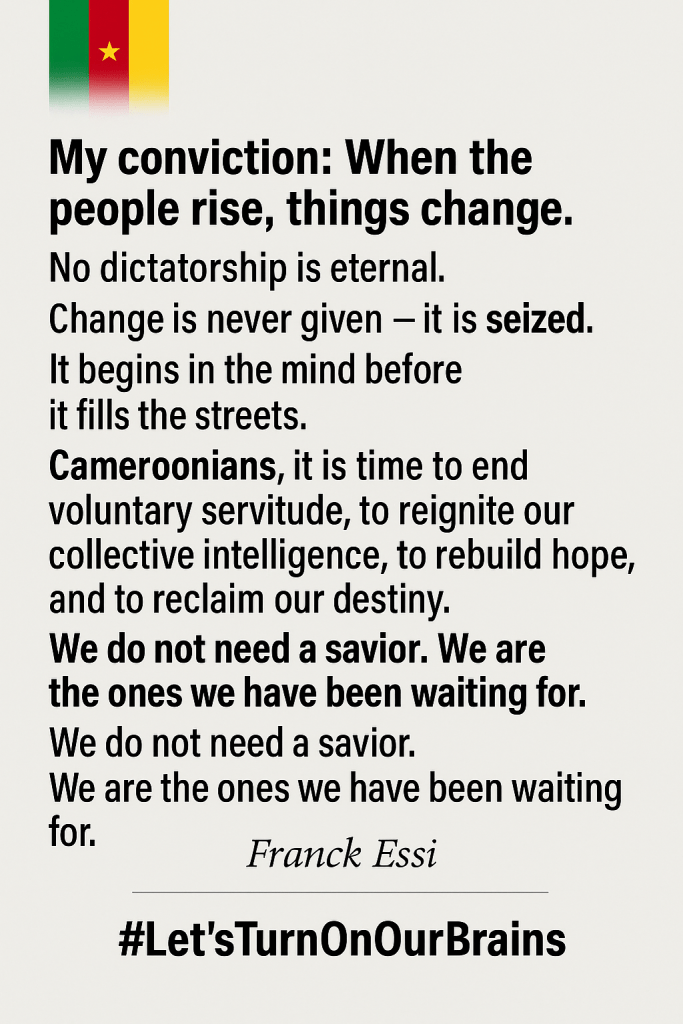
My conviction: When the people rise, things change.
No dictatorship is eternal.
Change is never given — it is seized.
It begins in the mind before it fills the streets.
Cameroonians, it is time to end voluntary servitude, to reignite our collective intelligence, to rebuild hope, and to reclaim our destiny.
We do not need a savior. We are the ones we have been waiting for.
— Franck Essi
#WhatIBelieve
#WeHaveAChoice
#WeHaveThePower
#IdeasMatter
#LightUpOurBrains
 franckessi.com