By Franck Essi
—
In Cameroonian political life, as in so many other places, there exists a strange and devastating phenomenon: the blind faith of the activist.
A faith that goes beyond reason, defies facts, and ends up devouring all critical thinking.
It transforms political engagement—noble and full of hope at the start—into a form of servile devotion to men and structures that often deserve neither trust nor admiration.
This blind faith is not merely an excess of enthusiasm; it is one of the invisible pillars upholding the most unjust political order.
—
1. When Politics Becomes Religion
The Cameroonian political activist often slides into a form of religiosity.
He no longer believes only in ideas, but in a “leader,” a “messiah,” a “mission.”
The party becomes the Church, the leader becomes the prophet, and the party line becomes the Gospel.
In this closed universe, to think is to betray. To ask questions becomes a crime of heresy.
Engagement turns into an empty liturgy: people gather, applaud, and believe—but they no longer understand.
They no longer seek to transform reality; they simply endure it.
—
2. The Fear of Thinking Differently
At the heart of the activist’s blind faith lies fear—fear of being excluded, fear of losing belonging, fear of being accused of betrayal.
In a society where loyalty is too often confused with submission, the activist prefers silence to banishment.
He accepts the arbitrariness of his leaders, the blatant contradictions, the shameful alliances, the unspoken compromises.
Thus, we reproduce the very pattern we claim to fight: the infantilization of the people and the disempowerment of the citizen.
The activist ceases to be an actor and becomes a passionate spectator of a play in which he only hopes for a happy ending.
—
3. The Comfort of Voluntary Servitude
Blind faith is comfortable. It spares one the burden of thinking, doubting, or choosing.
It soothes. In a society marked by uncertainty and fear, believing blindly in a leader or party provides a feeling of belonging and safety.
This is what La Boétie called voluntary servitude—a phenomenon where people participate in their own domination.
Tyranny endures not only by force, but by the enthusiastic consent of those who submit to it.
Blind faith thus becomes another name for intellectual laziness and moral comfort.
—
4. The Betrayal of Ideals
The tragedy of blind faith is that it always ends up betraying the very ideals that once inspired activism.
One enters politics to defend truth, justice, and freedom.
But in defending a leader, one ends up defending his mistakes, his lies, his failures.
One becomes complicit in the very system one sought to destroy.
In many movements in Cameroon, this drift is evident.
People no longer belong to a cause—they belong to a camp.
And in this logic of camps, truth loses all value; only loyalty remains.
—
5. Lucid Faith: Another Kind of Activism
Political engagement only makes sense when it rests on lucid faith—a faith that questions, doubts, and seeks to understand.
To be loyal does not mean to be submissive.
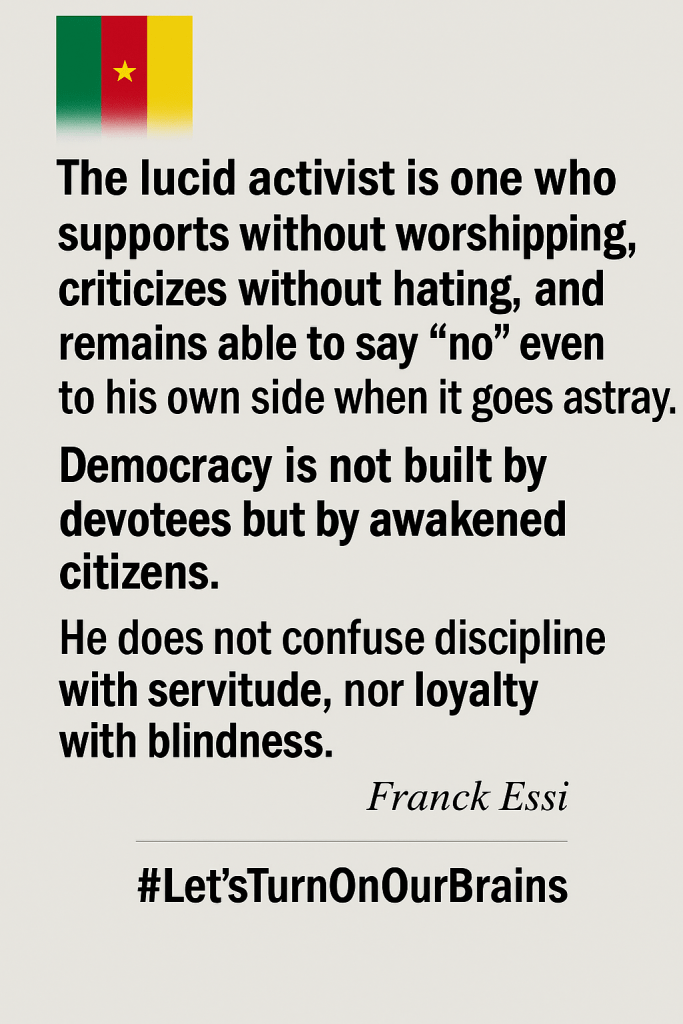
The lucid activist is one who supports without worshipping, criticizes without hating, and remains able to say “no” even to his own side when it goes astray.
Democracy is not built by devotees but by awakened citizens.
He does not confuse discipline with servitude, nor loyalty with blindness.
That courage—to think for oneself and to stand by one’s convictions—is the foundation of a people’s political maturity.
Without it, we merely reproduce the very chains we claim to break.
—
6. Rebuilding the Cameroonian Activist
Rebuilding the Cameroonian activist may well be the most urgent political task of our time.
For without free activists, there can be no free leaders.
The country’s transformation will not come only from a change of head, but from a change of mindset.
We must rehabilitate critical thinking in political movements, encourage internal debate, and value fraternal contradiction.
An activist who never questions his own camp becomes a danger to his cause.
There can be no lasting liberation without inner liberation.
And the first liberation of all is that of the mind.
—
My Deep Conviction: To Believe Without Blinding Oneself
The activist’s faith is not a weakness; it is a strength when illuminated by conscience, nourished by reflection, and guided by truth.
But when it becomes blind, it turns against itself.
Cameroon, like many African countries, does not need political believers but awakened citizens.
Men and women capable of following an ideal without submitting to an idol. Of believing without idolizing. Of hoping without lying to themselves.
For a faith that does not doubt is no longer faith—it is servitude. And a revolution without lucidity is but a mirage.
— Franck Essi
#WhatIBelieve
#WeHaveAChoice
#WeHaveThePower
#IdeasMatter
#LightUpOurBrains
 franckessi.com