By Franck Essi, Senior Consultant, STRATEGIES!
A Silent Hemorrhage
Each year, Africa loses between USD 60 and 90 billion through illicit financial flows (IFFs), representing about 3.7% of the continent’s GDP¹. These losses exceed the official development assistance (ODA) received by Africa and also surpass the annual inflow of foreign direct investment (FDI)². Paradoxically, Africa has become a “net creditor” to the rest of the world, while remaining heavily dependent on external aid and financing³.
This hemorrhage is not merely a matter of accounting. It deprives African countries of vital resources needed for education, healthcare, infrastructure, and ultimately undermines economic sovereignty while jeopardizing the achievement of the Sustainable Development Goals (SDGs).
1. Defining Illicit Financial Flows: A Plural Notion
Illicit financial flows are defined as the movement of funds that are earned, transferred, or used illegally. According to the African Union and UNCTAD, this phenomenon encompasses three main dimensions⁴:
- Illicit origin: proceeds of corruption, organized crime, and embezzlement.
- Illicit transfer: fraudulent trade misinvoicing, tax evasion, and abusive transfer pricing.
- Illicit use: money laundering, terrorist financing, and other criminal activities.
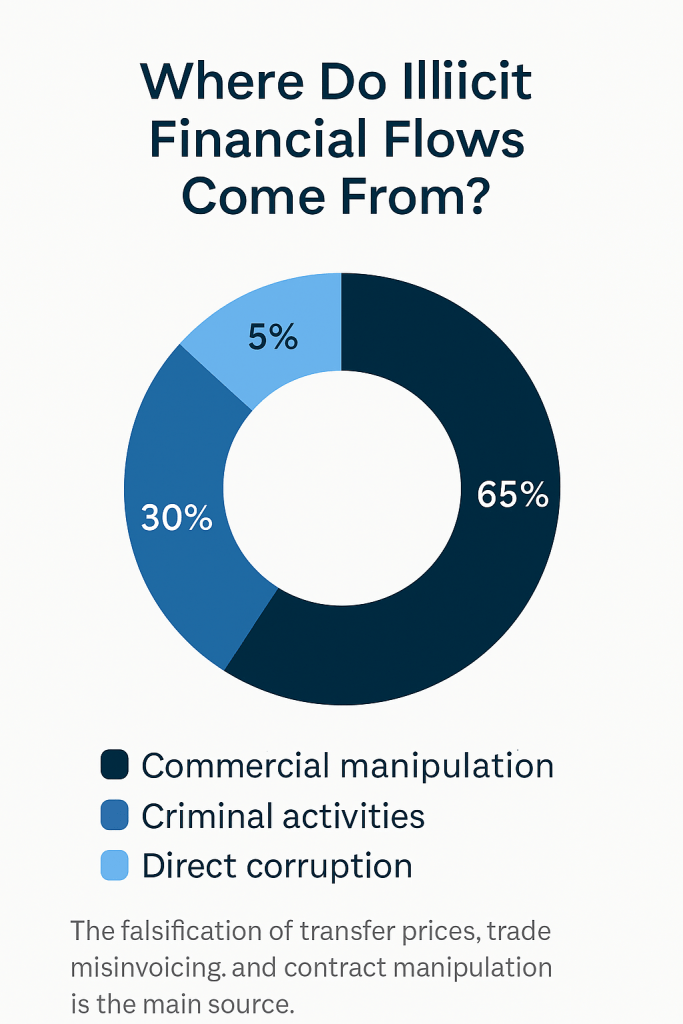
A study by the African Union indicates that 65% of Africa’s losses stem from commercial practices (misinvoicing, contract manipulation), 30% from criminal activities (trafficking, laundering), and 5% directly from corruption⁵.

2. Measuring the Invisible: The Scale of Illicit Flows
IFFs are by nature hidden, but economists and statisticians use different methods to estimate their scale.
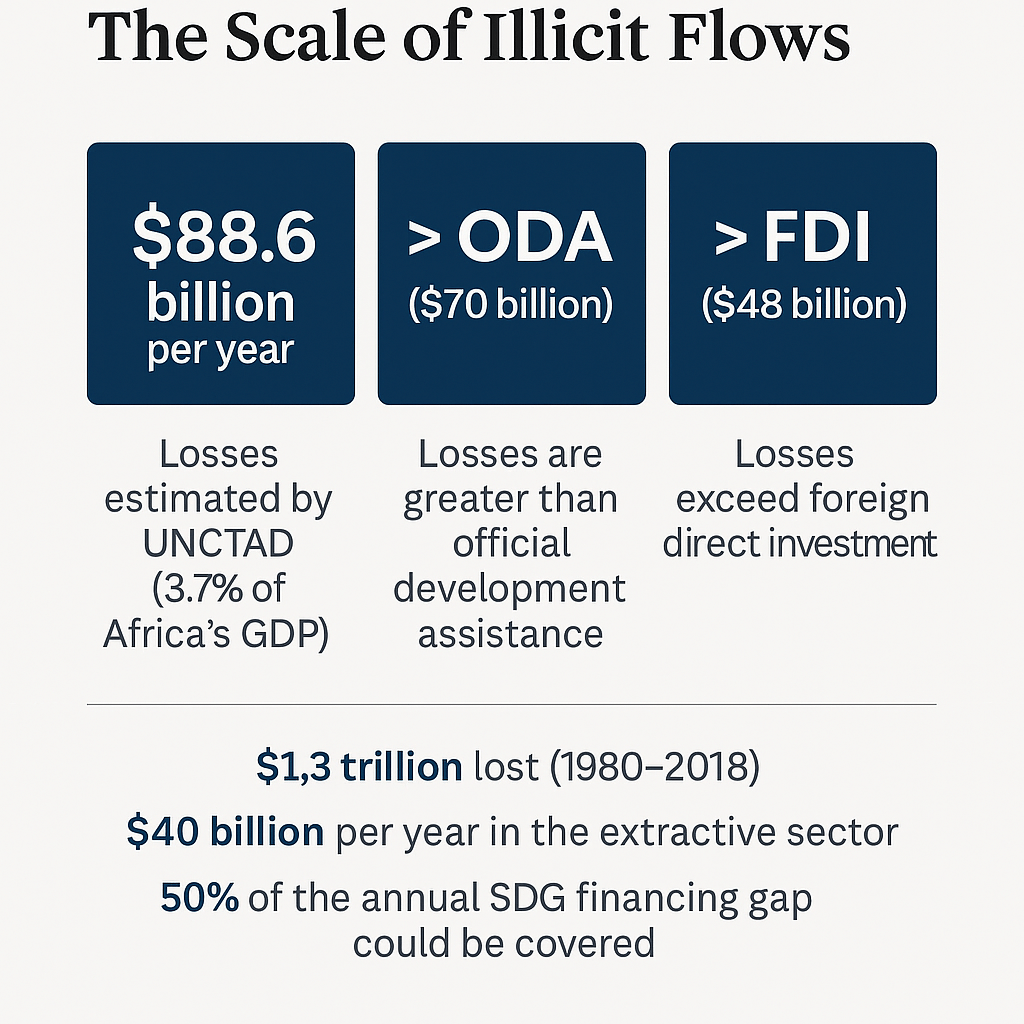
- UNCTAD estimates Africa’s annual losses at USD 88.6 billion, equivalent to 3.7% of continental GDP⁶.
- Between 1980 and 2018, cumulative losses exceeded USD 1.3 trillion⁷.
- These losses are greater than the USD 70 billion in annual ODA and USD 48 billion in FDI received by Africa⁸.
If curbed, illicit financial flows could cover almost 50% of Africa’s annual SDG financing gap, currently estimated at USD 200 billion⁹.
3. Structural Causes: Internal Fragilities and an Unequal Global System
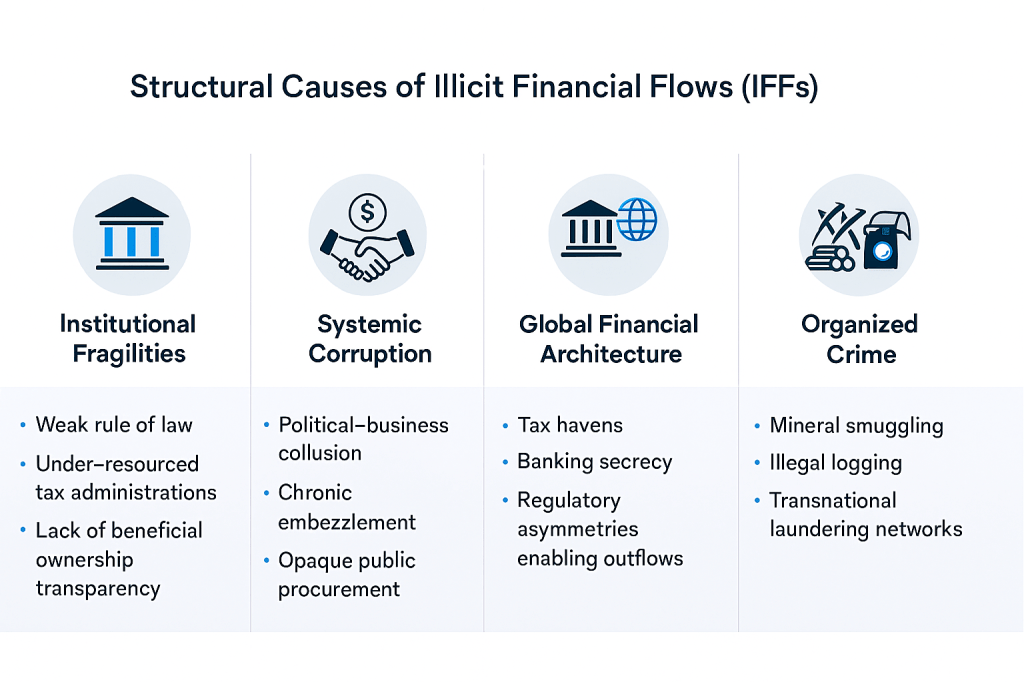
The causes of IFFs are manifold:
- Institutional fragilities: weak rule of law, under-resourced tax administrations, absence of beneficial ownership registries¹⁰.
- Systemic corruption: collusion between local elites and multinational corporations, bribes, and embezzlement¹¹.
- Global financial architecture: designed to benefit tax havens and secrecy jurisdictions, facilitating capital flight¹².
- Organized crime: smuggling of minerals, illegal logging, human trafficking, and laundering of illicit gains¹³.
- Professional enablers: lawyers, accountants, and bankers creating opaque and complex financial structures¹⁴.
4. The Ecosystem of Actors: An Interconnected System
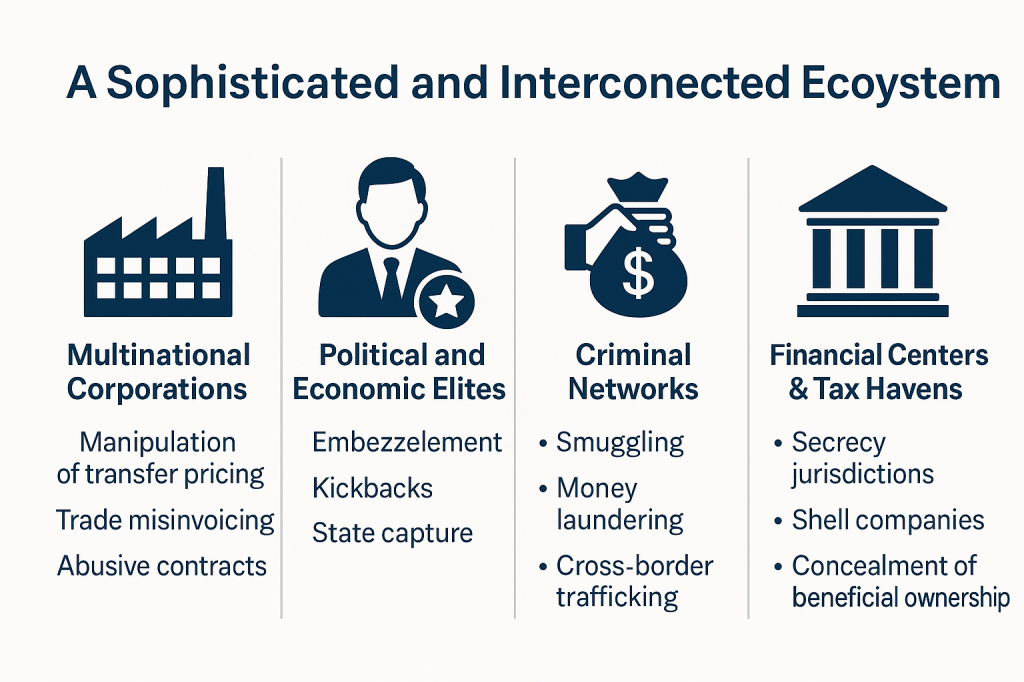
IFFs involve a wide range of actors working in synergy:
- Multinational corporations, through aggressive tax avoidance and abusive transfer pricing¹⁵.
- Local political elites, implicated in embezzlement of public funds¹⁶.
- Criminal networks, generating and laundering illegal revenues¹⁷.
- Financial institutions and tax havens, providing protection and secrecy for illicit capital¹⁸.
5. Consequences: A Systemic Drain
The impacts of IFFs are multidimensional:
- Macroeconomic: loss of fiscal revenues, weakened national currencies, increased external debt¹⁹.
- Social: reduced public budgets – up to 58% less for education and 25% less for healthcare in the most affected countries²⁰. As a result, over 282 million Africans suffer from undernourishment²¹.
- Political: weakened state institutions, loss of public trust, aggravated inequalities²².
- Sectoral: the extractive industries alone account for USD 40 billion in annual losses, followed by international trade and fishing²³.

6. Countries and Regions Most Affected
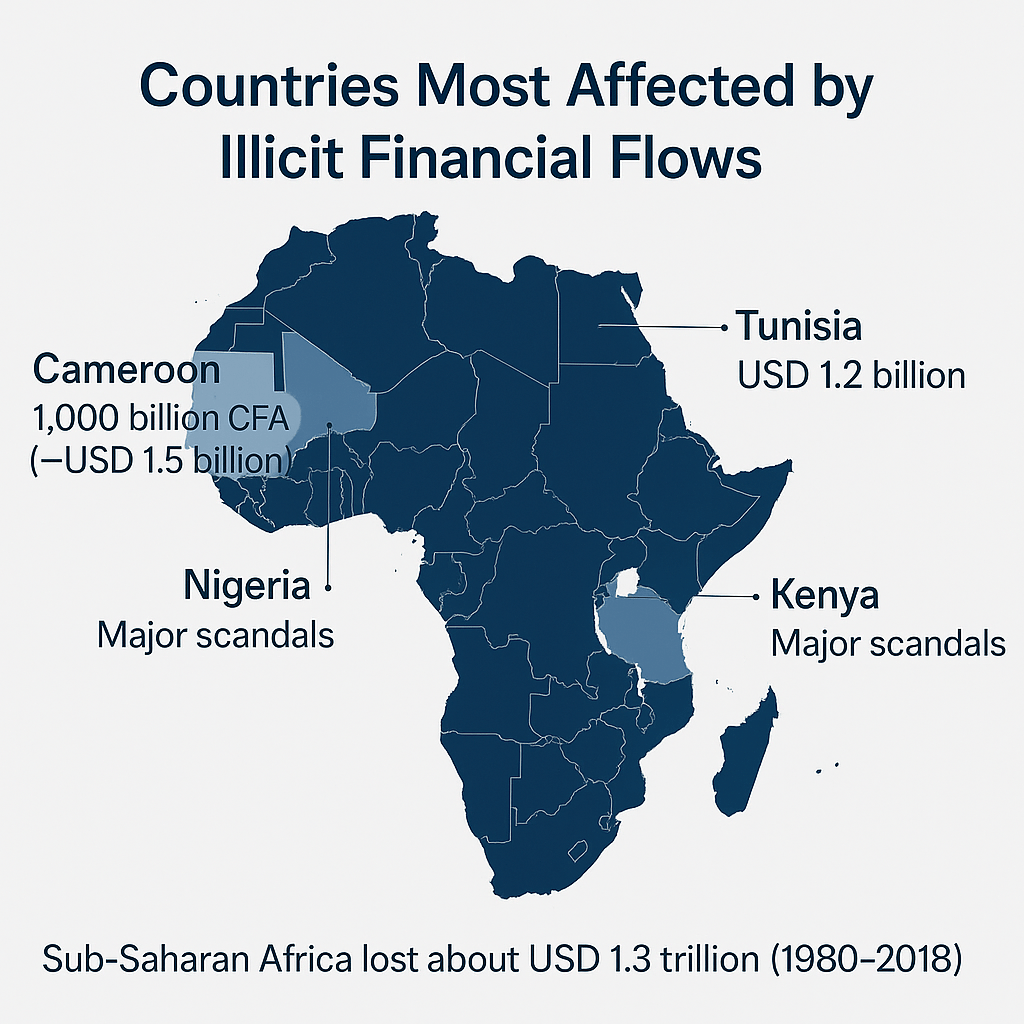
- Sub-Saharan Africa lost about USD 1.3 trillion between 1980 and 2018²⁴.
- Tunisia loses about USD 1.2 billion annually²⁵.
- Cameroon loses nearly XAF 1,000 billion per year (≈USD 1.5 billion)²⁶.
- Nigeria and Kenya have been rocked by high-profile scandals, including Kenya’s “Goldenberg Affair”²⁷.
Towards Restored Sovereignty
Illicit financial flows are not just abstract statistics. They translate into unfinished schools, under-equipped hospitals, and unbuilt roads. They perpetuate dependence, undermine governance, and rob Africa of its future.
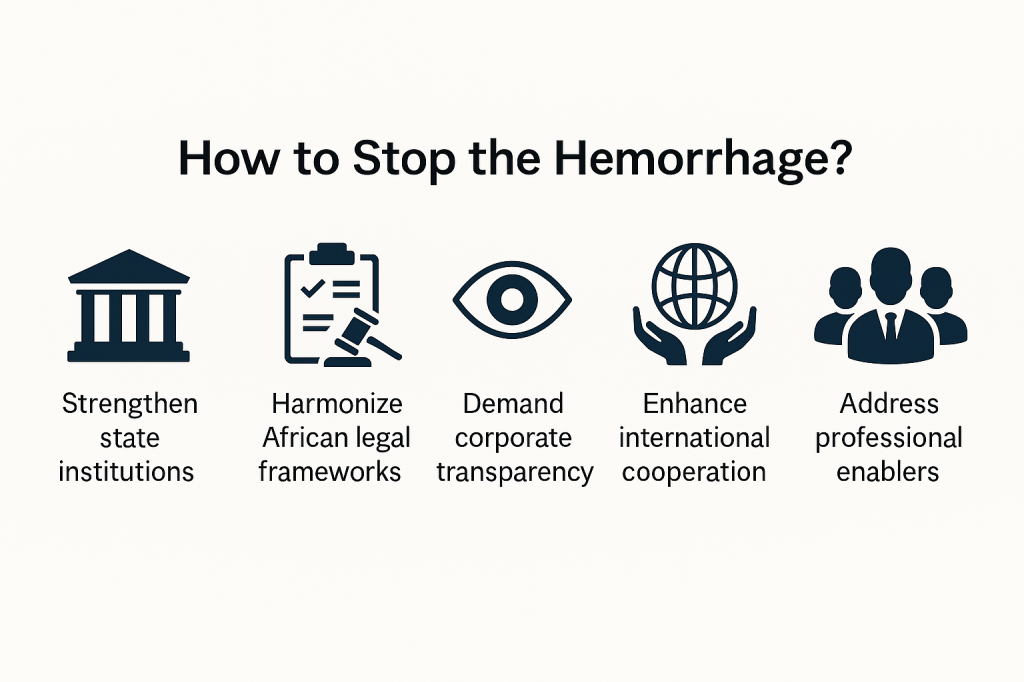
The fight against IFFs requires a multidimensional approach:
- Strengthening state institutions.
- Harmonizing African legal frameworks.
- Demanding greater transparency from multinationals.
- Reinforcing effective international cooperation.
This article is the first in a series dedicated to illicit financial flows in Africa. The next articles will explore the mechanisms fueling IFFs, the institutional responses already in place, and the strategies required to curb them and unlock Africa’s full economic potential.
NB: This article was originally published here: https://strategiesconsultingfirm.com/illicit-financial-flows-in-africa-anatomy-of-a-silent-hemorrhage/
References
- Africa24TV – Illicit financial flows in Africa: over USD 60 billion lost annually (2025)
- UNCTAD – Economic Development in Africa Report (2020)
- ECA – Illicit Financial Flows: Report of the High Level Panel (2015)
- African Union & UNCTAD – Definitions of Illicit Financial Flows (2020)
- Tax Justice Network Africa – Policy Priorities on Illicit Financial Flows (2024)
- UNCTAD – Trade Misinvoicing in Africa (2020)
- Brookings Institution – Africa Growth Initiative Report (2019)
- Jeune Afrique – USD 88 billion evaporates from Africa every year (2025)
- UNCTAD – Financing for Development and the SDGs (2024)
- APA News – Africa struggling with illicit financial flows (2024)
- Transparency International – Risks of Illicit Financial Flows in Africa (2025)
- African Business – Africa’s Vulnerability to Criminals Spurs Illicit Financial Flows (2025)
- UNODC – Organised Crime and Illicit Flows in Africa (2023)
- Carnegie Endowment – Illicit Financial Flows in Africa: Tax and Governance (2024)
- OECD – Tax Transparency in Africa (2025)
- Agence Ecofin – Africa loses CFA 587 billion annually to illicit flows (2025)
- Interpol & AfDB – Cooperation to combat financial crime (2025)
- CodAfrica – High Level Panel on Illicit Financial Flows (2024)
- Equal Times – Illicit financial flows: a brake on Africa’s development (2023)
- African Development Bank – Impact of Illicit Flows on Education and Health in Africa (2024)
- FAO – State of Food Security and Nutrition in Africa (2024)
- Transparency International – op. cit.
- UNECA – Tackling Illicit Financial Flows: Africa’s Path to Reparatory Justice (2023)
- Brookings Institution – op. cit.
- Ecomatin – Tunisia loses USD 1.2 billion annually (2025)
- AfDB – Cameroon loses an average of XAF 1,000 billion annually (2025)
- Ecomatin – Scandals linked to IFFs in Kenya and Nigeria (2024)
 franckessi.com