By Franck Essi, Senior Consultant, STRATEGIES !
Illicit Financial Flows (IFFs) deprive Africa of resources estimated at USD 60 to 90 billion annually, more than the official development assistance received by the continent¹. Existing initiatives have shown their limits, mainly due to poor implementation and lack of coordination. It is therefore urgent to build an integrated strategy based on five essential pillars, capable of transforming the fight against IFFs into a true lever of economic sovereignty.
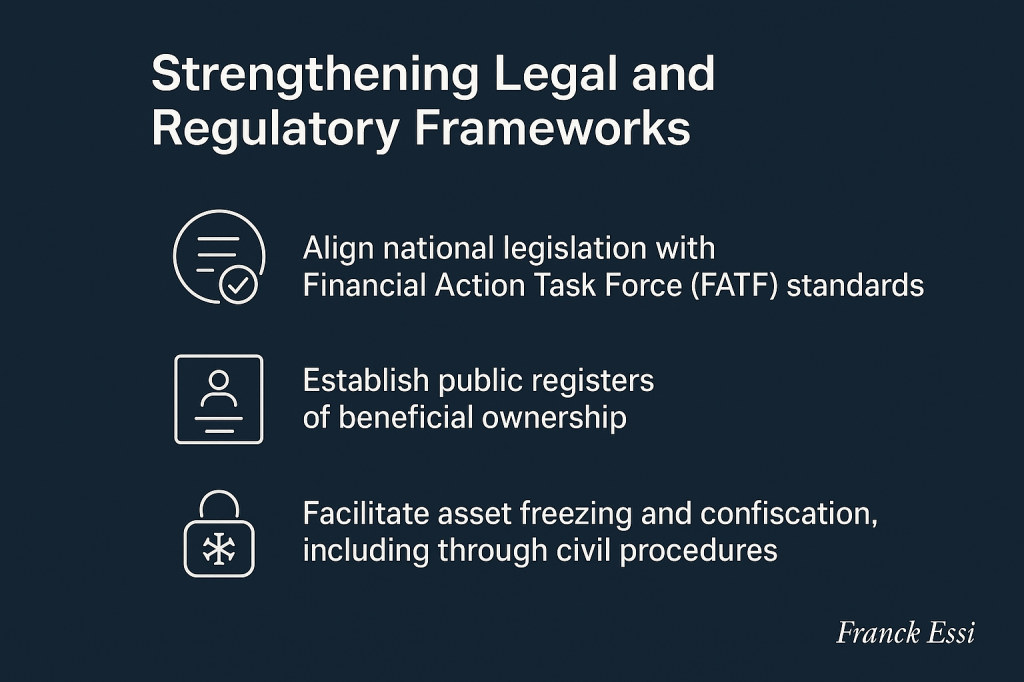
I. Pillar 1 – Strengthening Legal and Regulatory Frameworks
A solid legal arsenal is the first barrier against illicit flows. In the absence of clear and harmonized laws, multinationals, criminal networks, and corrupt elites exploit loopholes to transfer capital illicitly. Three priority measures stand out:
- Align national legislation with Financial Action Task Force (FATF) standards. Morocco, by adapting its laws to the FATF’s 40 recommendations, improved its evaluation and reduced suspicious transactions by 25% between 2020 and 2022².
- Establish public registers of beneficial ownership. Nigeria introduced such a register in 2023, revealing more than 500 companies involved in fraudulent public contracts³.
- Facilitate asset freezing and confiscation, including through civil procedures. Mauritius recovered nearly USD 50 million between 2016 and 2020 thanks to civil confiscation mechanisms⁴.
These legal adjustments are indispensable: without a robust normative basis, the other pillars of the fight remain ineffective.
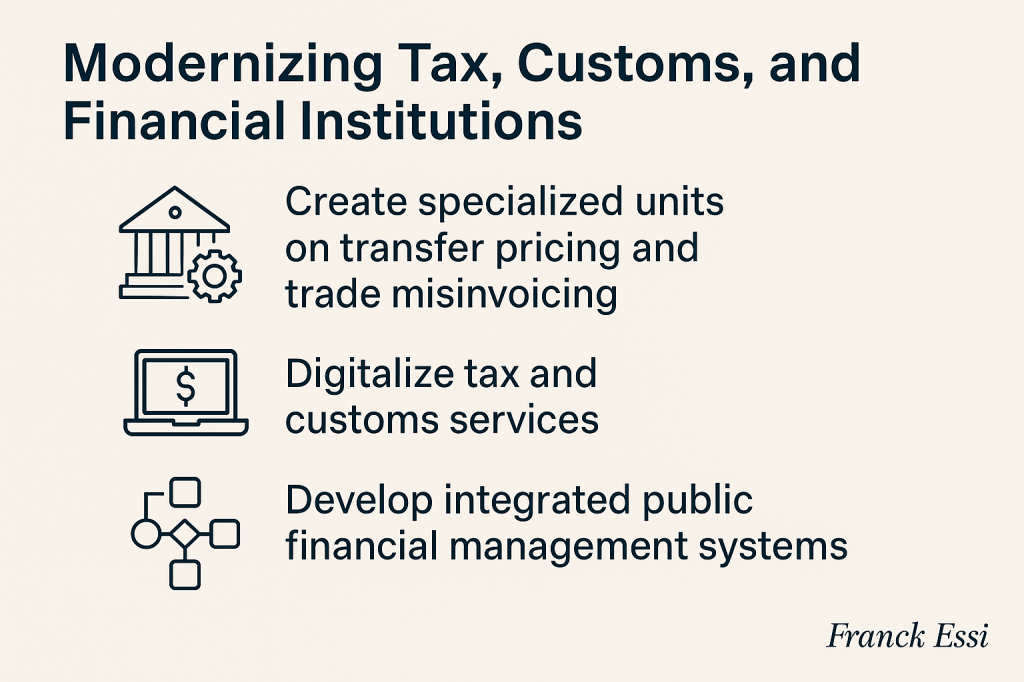
II. Pillar 2 – Modernizing Tax, Customs, and Financial Institutions
Even the best laws are insufficient without institutions capable of enforcing them. Administrative capacity deficits remain a major obstacle to combating IFFs. Three levers of action stand out:
- Create specialized units on transfer pricing and trade misinvoicing. South Africa recovered nearly USD 500 million between 2018 and 2022 thanks to this targeted approach⁵.
- Digitalize tax and customs services. Rwanda, through its e-Tax system, increased tax revenues by 68% in ten years⁶.
- Develop integrated public financial management systems. Ghana, through GIFMIS (Ghana Integrated Financial Management Information System), reduced budgetary leakages by 20%⁷.
By strengthening administrative capacity, states equip themselves with the tools to detect, control, and sanction illicit flows.
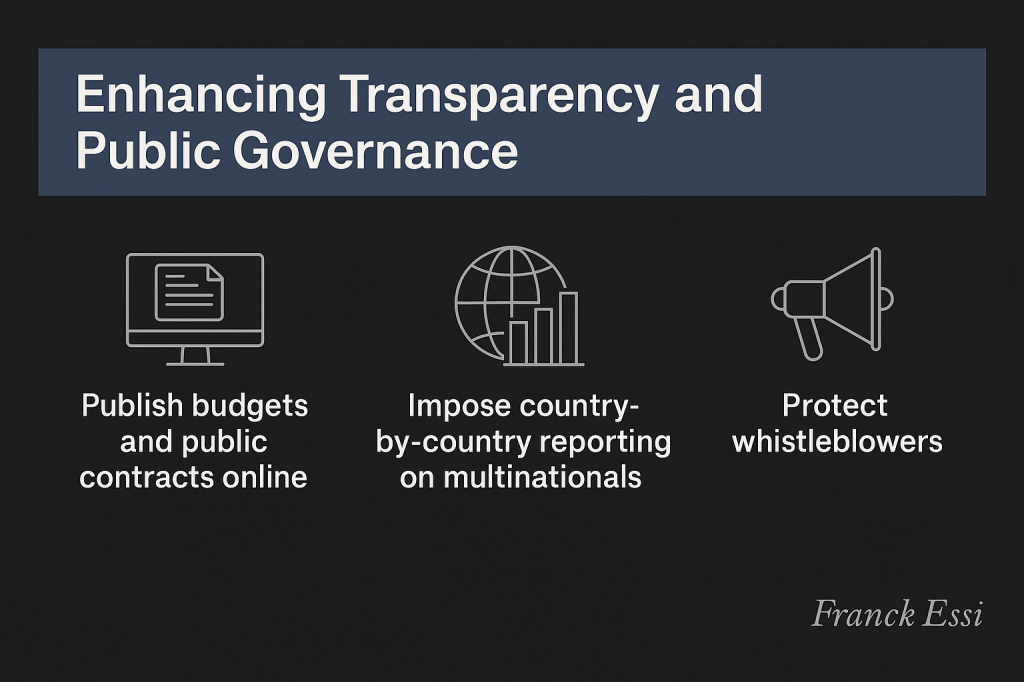
III. Pillar 3 – Enhancing Transparency and Public Governance
Transparency breaks the opacity that feeds corruption and undermines governance. It is one of the most effective pillars to prevent illicit flows. Three measures are particularly relevant:
- Publish budgets and public contracts online. In Kenya, the Open Contracting portal uncovered 12% irregularities in 2021, saving around USD 200 million⁸.
- Impose country-by-country reporting on multinationals. In South Africa, this measure exposed significant discrepancies between locally declared profits and offshore transfers⁹.
- Protect whistleblowers. In Senegal, the 2022 law led to more than 300 official reports filed with OFNAC (National Office for the Fight against Fraud and Corruption)¹⁰.
Strengthened transparency fosters public accountability and cultivates a culture of responsibility.
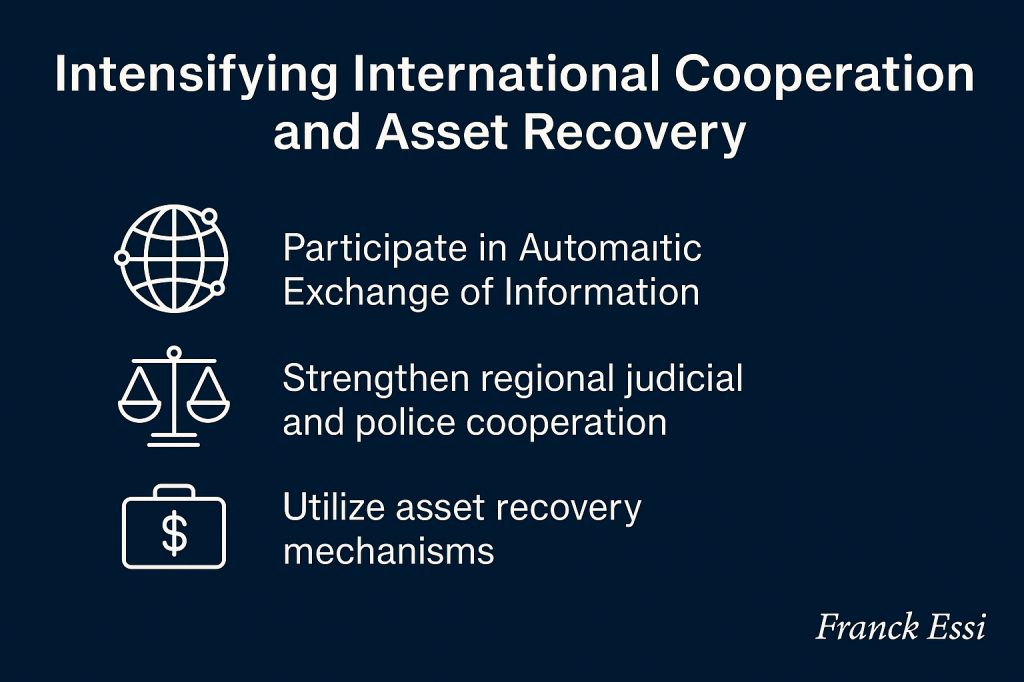
IV. Pillar 4 – Intensifying International Cooperation and Asset Recovery
IFFs are by nature transnational: no African state can fight them alone. International cooperation is thus essential, with three key components:
- Active participation in the Automatic Exchange of Information (AEOI). Ghana has identified USD 1.2 billion in undeclared offshore assets since joining in 2019¹¹.
- Strengthening regional judicial and police cooperation. The GIABA (Inter-Governmental Action Group against Money Laundering in West Africa) coordinated 42 cross-border investigations between 2020 and 2023¹².
- Using asset recovery mechanisms such as the Stolen Asset Recovery Initiative (StAR). Nigeria repatriated USD 311 million in 2020 through the Abacha fund restitution¹³.
International cooperation is thus indispensable to curtail capital flight and restore economic sovereignty.
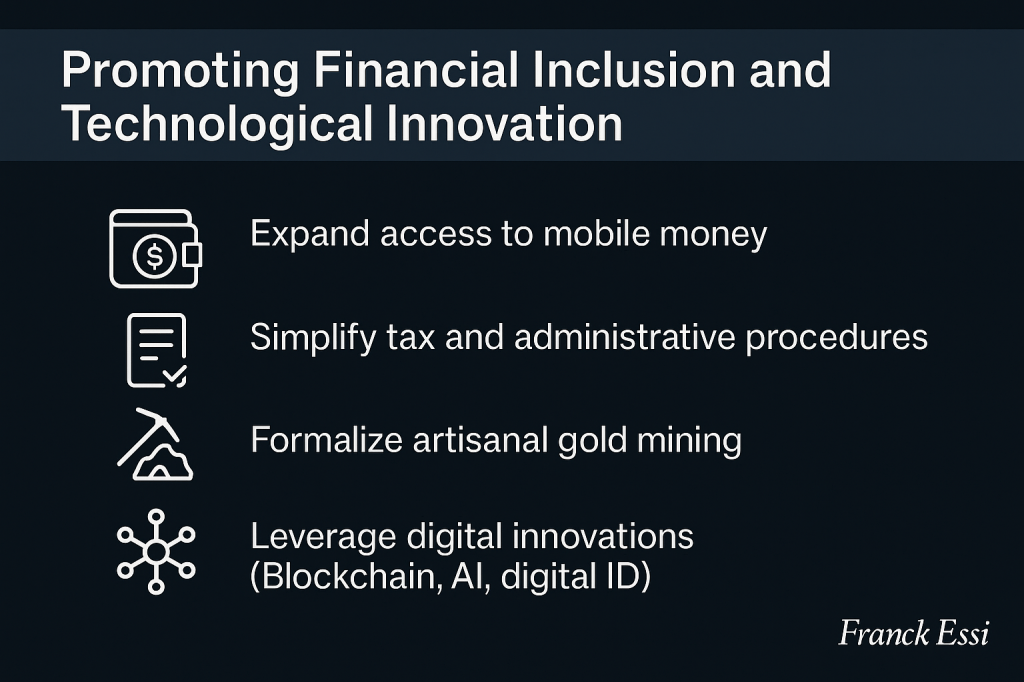
V. Pillar 5 – Promoting Financial Inclusion and Technological Innovation
The last pillar addresses the structural roots of the problem: informality and the lack of modern monitoring mechanisms. Several reforms are required:
- Expand access to mobile money. In Kenya, the expansion of M-Pesa reduced informal payments by 30% in local transactions¹⁴.
- Simplify tax and administrative procedures. In Benin, the e-Impôt platform enabled 100,000 small businesses to join the formal sector since 2018¹⁵.
- Formalize artisanal gold mining. In Ghana, the Responsible Mining certification increased fiscal revenues from artisanal gold by 20%¹⁶.
- Leverage digital innovations (Blockchain, AI, digital ID). In Sierra Leone, a blockchain project reduced fraudulent diamond sales by 15% in 2021; in Ethiopia, the Fayda digital ID system aims to register 70 million citizens by 2025¹⁷.
Financial inclusion and technology form a dual lever: broadening the tax base while improving monitoring of flows.
An Agenda for Sovereignty
The fight against IFFs must be seen as an agenda of sovereignty. The five pillars — law, institutions, transparency, international cooperation, and technological inclusion — are not optional, but essential. Their progressive and coordinated implementation will allow Africa to turn a historic vulnerability into a lever for development.
The next and final article in this series will be dedicated to the concept of a functional state, directly linked to the need for an effective and sustainable fight against illicit financial flows.
NB: This article was originally published here: https://strategiesconsultingfirm.com/combating-illicit-financial-flows-in-africa-strategies-and-recommendations-for-effective-action/
References
- IMF, Fighting Illicit Financial Flows, 2023
- FATF, Mutual Evaluation Report – Morocco, 2022
- Open Ownership, Beneficial Ownership Transparency in Nigeria, 2023
- Transparency International, Asset Recovery Practices in Mauritius, 2021
- ATAF, Transfer Pricing Audits in Africa, 2022
- World Bank, Rwanda Revenue Authority Digital Reforms, 2021
- IMF, Public Financial Management Reforms in Ghana (GIFMIS), 2022
- Open Contracting Partnership, Kenya Case Study, 2021
- Tax Justice Network Africa, Country-by-Country Reporting in South Africa, 2023
- OFNAC Senegal, Annual Report 2023
- OECD, Automatic Exchange of Information: Ghana Report, 2020
- GIABA, Annual Report 2023
- World Bank & UNODC, StAR Initiative, 2020
- GSMA, Mobile Money and Financial Inclusion in Kenya, 2022
- Government of Benin, e-Impôt Platform: Report 2021
- UNCTAD, Formalizing Artisanal Gold Mining in Ghana, 2022
- Chainalysis, Crypto and Blockchain in Africa, 2022 ; World Bank, Digital ID in Ethiopia (Fayda), 2023
 franckessi.com