By Franck Essi, Senior Consultant, STRATEGIES !
The urgency of a paradigm shift
For decades, Africa has been losing between USD 60 and 90 billion every year through illicit financial flows (IFFs). This economic hemorrhage undermines the achievement of the Sustainable Development Goals (SDGs), weakens institutions, and increases dependency on external aid. Despite numerous initiatives, the results remain insufficient: structural causes persist, and anti-IFF mechanisms remain fragmented.
Throughout this series of articles, we have examined:
- the scale and causes of IFFs;
- the circuits and mechanisms that feed them;
- the initiatives already underway and their persistent limitations;
- the strategic priorities to reverse the trend.
Yet a fundamental question arises: can these reforms succeed sustainably without a robust and functional state as their foundation? The answer is no. This is where the concept of the Functional State, advanced by STRATEGIES!, comes into play — a strategic horizon and cornerstone of Africa’s sovereign and sustainable development.
What is a Functional State?
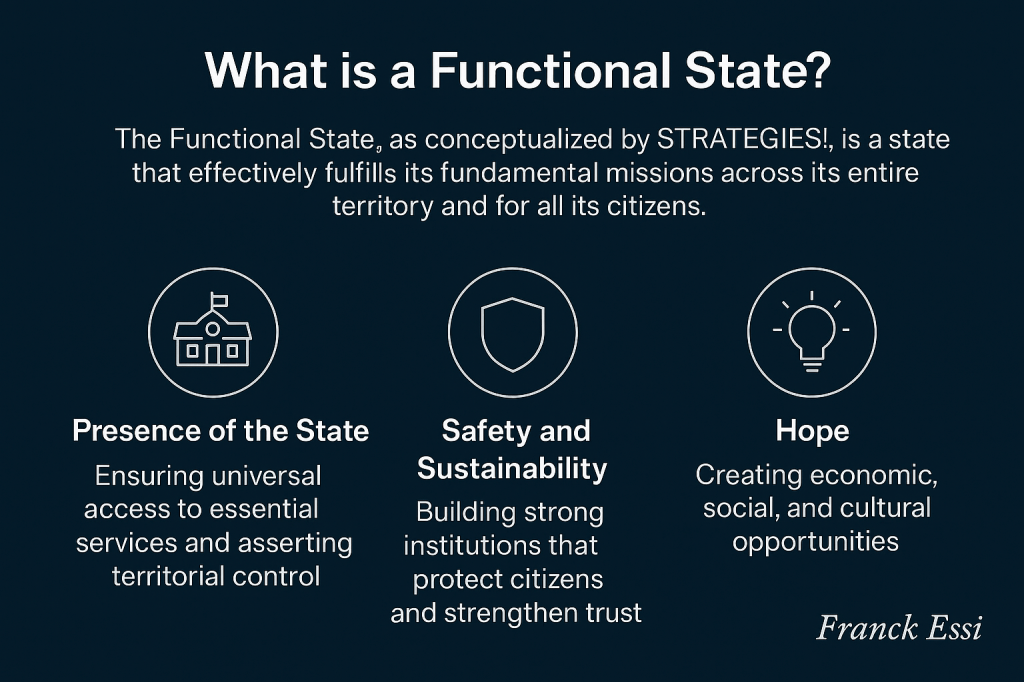
The Functional State, as conceptualized by STRATEGIES!, is a state that effectively fulfills its fundamental missions across its entire territory and for all its citizens. It rests on three key pillars:
- Presence of the State: ensuring universal access to essential services (education, health, energy, security, infrastructure) and asserting territorial control, including in peripheral zones.
- Safety and Sustainability: building strong institutions that protect citizens, uphold the rule of law, guarantee stability, and strengthen trust between governments and citizens.
- Hope: creating economic, social, and cultural opportunities that encourage innovation, decent employment, and youth empowerment.
A Functional State is, in essence, a state that truly works for its citizens — and, by doing so, becomes the most effective shield against IFFs.
Linking the Functional State to IFFs
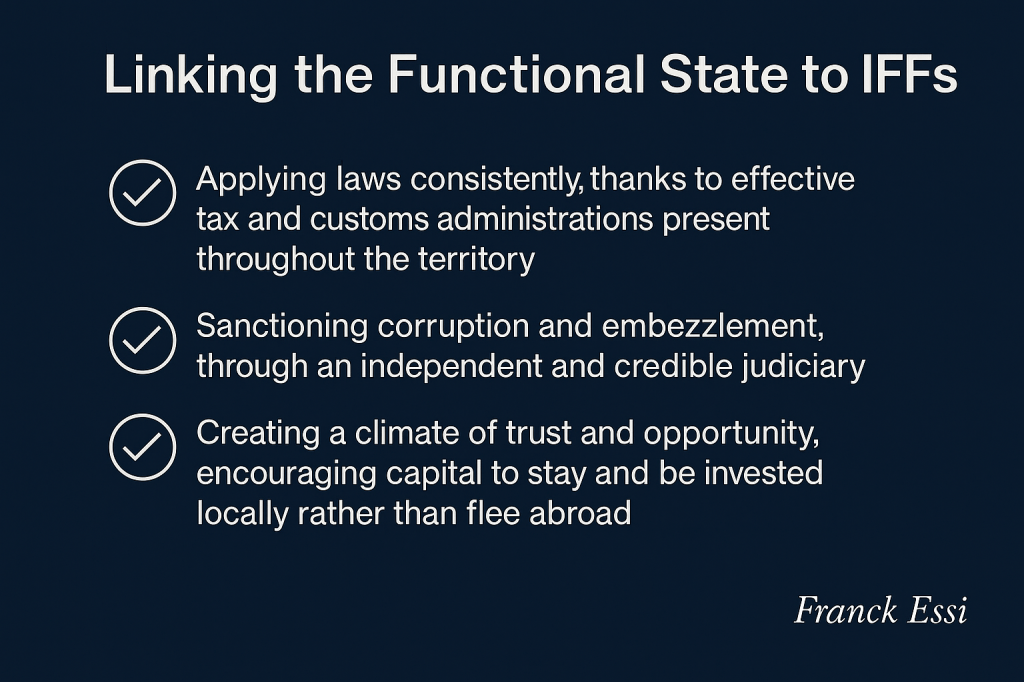
The fight against illicit financial flows cannot be won through isolated laws or fragmented projects. It requires a state capable of:
- Applying laws consistently, thanks to effective tax and customs administrations present throughout the territory;
- Sanctioning corruption and embezzlement, through an independent and credible judiciary;
- Creating a climate of trust and opportunity, encouraging capital to stay and be invested locally rather than flee abroad.
Thus, each of the five strategic pillars of the fight against IFFs — legal frameworks, institutions, transparency, international cooperation, and technological inclusion — only reaches its full effectiveness and sustainability within the framework of a Functional State.
What conditions are needed to build Functional States?
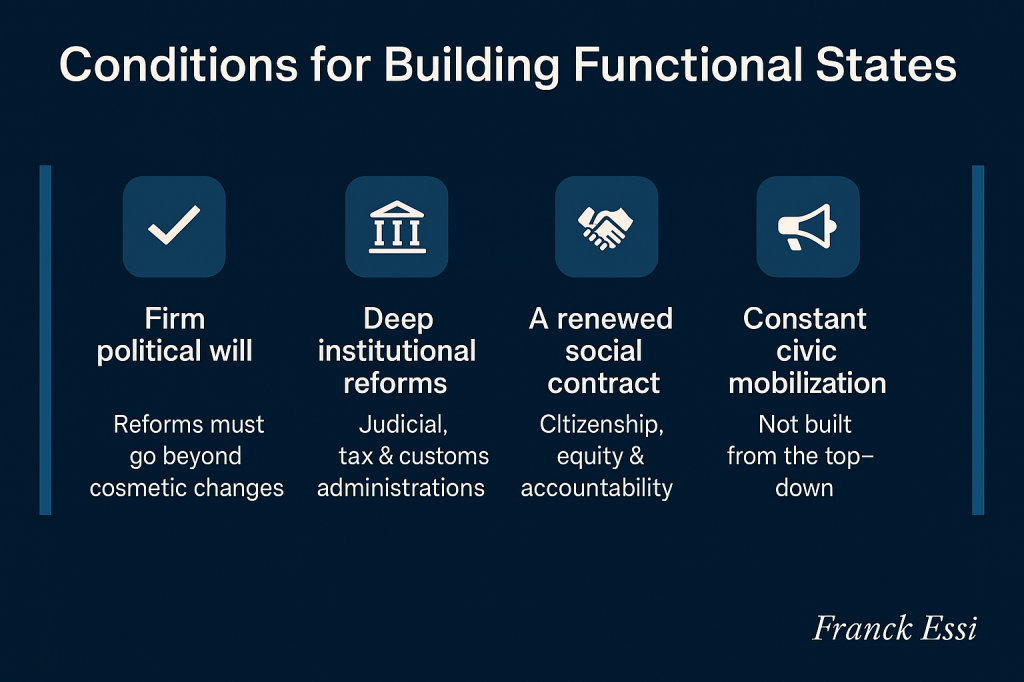
Building Functional States is not a slogan; it requires the convergence of political, institutional, and societal conditions:
- Firm political will: without committed and coherent leadership, reforms remain cosmetic.
- Deep institutional reforms: judicial independence, professionalization of tax and customs administrations, and an uncompromising fight against impunity.
- A renewed social contract: placing citizenship, equity, and accountability at the core of governance.
- Constant civic mobilization: a Functional State is not built only from the top; it is demanded, monitored, and co-constructed from below.
- Aligned international partnerships: donors and partners must end complacency with predatory regimes and condition their support on the construction of genuinely functional states.
How should this concept change the approaches of all actors?
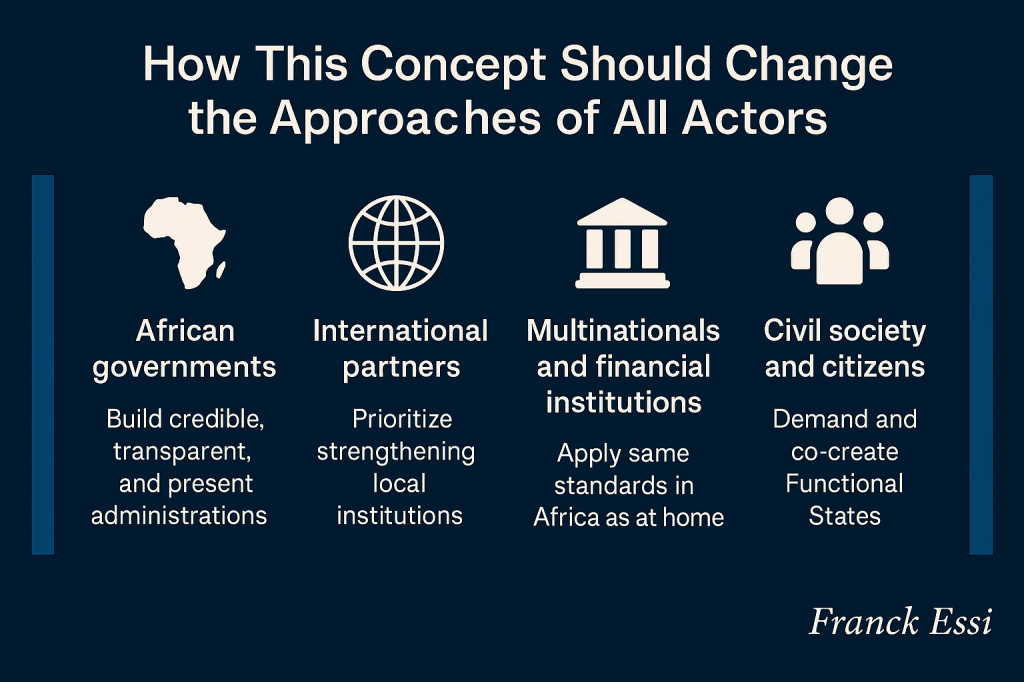
Adopting the Functional State as a horizon requires every actor to rethink their approach:
- African governments: passing laws or signing conventions is no longer enough; they must build credible, transparent, and present administrations. The fight against IFFs thus becomes inseparable from state-building.
- International partners: they must move beyond fragmented project logic. Priority should be given to strengthening local institutions — justice systems, tax administrations, anti-corruption bodies — rather than creating parallel mechanisms.
- Multinationals and financial institutions: they must apply the same standards of transparency and accountability in African countries as in their home countries.
- Civil society and citizens: the Functional State will not be handed down from above. It must be demanded, enforced, and co-created through persistent civic and democratic engagement.
The Functional State as a common horizon
Illicit financial flows are merely a symptom of a deeper problem: the insufficient functionality of African states. As long as these states remain partially present, weakly regulatory, and unable to inspire trust, IFFs will continue to thrive.
The lasting solution is not simply to refine technical mechanisms but to build Functional States: states that are present, secure, and sources of hope. This structural transformation is what will allow Africa not only to stop the hemorrhage of IFFs but also to build a sovereign, prosperous, and inclusive future.
This fifth article closes our series on illicit financial flows in Africa. But it opens a much broader strategic reflection: making the Functional State the shared horizon of governments, citizens, companies, and international partners who aspire to an Africa free from IFFs and in control of its destiny.
NB: This article was originally published here: https://strategiesconsultingfirm.com/what-if-the-functional-state-were-the-lasting-solution-to-illicit-financial-flows-in-africa/
 franckessi.com