—
Cameroon does not lack intelligence, nor does it lack rhetoric about change.
What it lacks, more deeply—and more uncomfortably to admit—is a genuine sense of the common good, and the willingness to submit to it when it conflicts with our immediate personal interests.
Let us be honest.
Most of us are perfectly capable of denouncing injustice, corruption, or selfishness—so long as they concern others.
But when a rule constrains our own advantage, when a shortcut presents itself, when the system can be bypassed without immediate risk, our indignation often falls silent.
In its simplest sense, the common good is what sustainably improves the lives of the greatest number—even when it requires individual sacrifice.
It means accepting that not everything that is possible is necessarily legitimate.
It means understanding that a country is not built by “clever” citizens, but by responsible ones.
Yet in our collective imagination, intelligence is still too often associated with cunning, with trickery, with the ability to look after oneself at all costs.
Those who respect the rules are sometimes seen as naïve.
Those who circumvent them are admired.
This confusion is one of the most silent—and most destructive—poisons undermining our development.
—
What the Data Show
Development research, however, is unambiguous.
Countries that achieve sustainable progress are those where shared rules are broadly respected, public resources are directed toward the common good, and private interests do not capture the state.
The World Bank’s Worldwide Governance Indicators have shown this consistently for decades: countries that score highest in government effectiveness, rule of law, and control of corruption are also those with the highest per capita incomes and the most significant reductions in poverty.
Conversely, where the common good is disregarded, the same patterns recur everywhere:
degraded public services, systemic corruption, widening inequalities, latent conflict, and generalized mistrust.
In Cameroon, this capture of the common good by private interests is not an abstraction.
In 2024, the country scored 26 out of 100 on Transparency International’s Corruption Perceptions Index, ranking 140th out of 180 countries, after nearly three decades spent in the 20–27/100 range.
This stagnation points to structural corruption, not a temporary anomaly.
This is not an opinion.
It is a finding supported by decades of empirical research in institutional economics and governance studies.
—
Silent Complicity
But the most unsettling aspect lies elsewhere.
The system does not persist only because of those at the top.
It also endures through millions of small, everyday accommodations.
Through repeated individual choices.
Through quiet renunciations of collective standards.
Economists use the term state capture to describe situations in which public power is systematically used for private interests—from minor administrative favors to large-scale political rents. International governance indicators explicitly account for this dynamic when measuring corruption control and the quality of the rule of law.
We denounce the inefficiency of the state, yet we accept bypassing it whenever it suits us.
We demand justice, yet seek personal intervention when a case concerns us directly.
We praise merit, yet applaud the successful scheme.
Under such conditions, what common good are we really talking about?
—
Fragmentation as a Strategy of Evasion
Contempt for the common good also manifests itself in the permanent fragmentation of public debate.
Structural issues—poverty, education, health, social justice—are reduced to regional, communal, or identity-based logics.
What should unite is instrumentalized to divide.
What could ground a shared national project is dissolved in competition among particular interests.
UNDP analyses show that societies with open and inclusive public spheres manage social tensions far better than those where debate is fragmented into identity-based and communal bubbles. Where everyone defends only “their group,” the common good becomes elusive.
No country has achieved sustainable development on such a basis.
None.
—
The Question That Tests Our Maturity
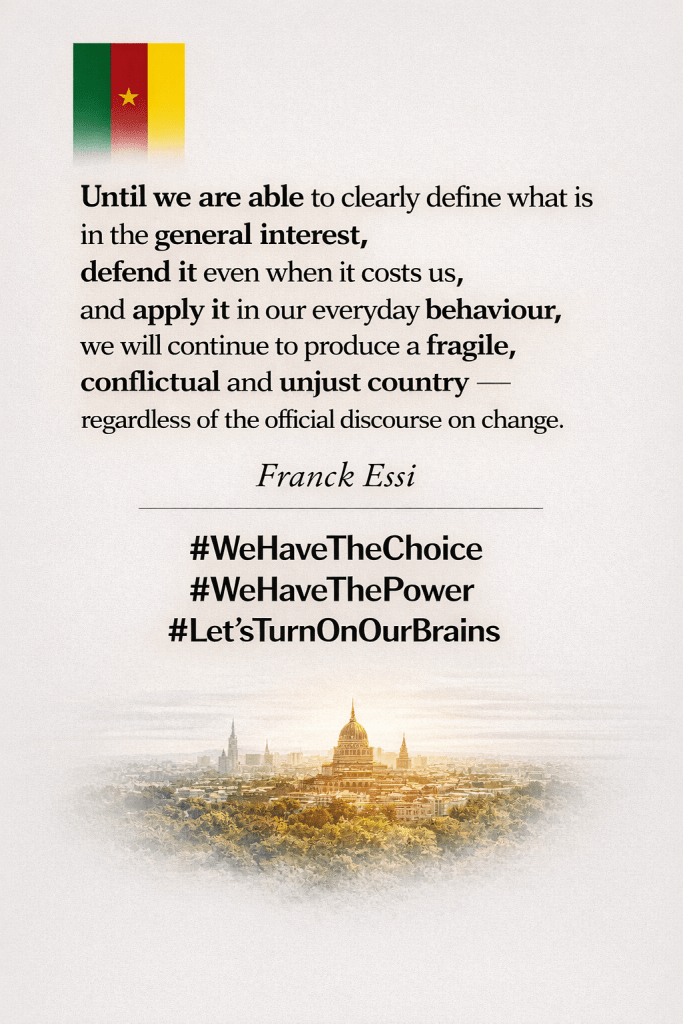
As long as we are unable to clearly define what belongs to the common good, to defend it even when it costs us personally, and to apply it in our everyday behavior, we will continue to produce a fragile, conflict-ridden, and unjust country—regardless of official discourse about change.
The real question, therefore, is not:
What do I gain?
Nor even:
What does my group gain?
The only question that truly matters is this:
What would be acceptable if everyone acted the way I do?
That question is the measure of civic maturity.
And it is that collective maturity that determines the very possibility of development.
Development does not begin with grand projects.
It begins with a shared moral discipline.
Everything else is merely rhetoric.
Franck Essi
#WeHaveAChoice
#WeHavePower
#CivicEducation
#LetsTurnOnOurBrains
 franckessi.com