—
Across every field — politics, business, sports, media, trade unions, associations, and civic initiatives — the same troubling pattern emerges: Cameroonians struggle to unite and act collectively over time in defense of shared interests.
Talent exists. Ideas abound. Initiatives proliferate.
Yet most of them move forward in isolation, as if fragmentation were the default mode of organization.
—
The Paradox of Individual Control
Many appear to prefer being the sole owner of a small enterprise earning 100 CFA francs rather than a shareholder in a collective venture capable of generating ten times more value for each participant. Individual control, however modest, feels safer than collective success — even when the latter promises far greater returns.
This logic is not merely a personal preference. It is deeply rooted in historical experience and social structures.
Colonial rule institutionalized division — geographic and political — as a method of domination. After independence, centralized and highly concentrated power reinforced distrust toward autonomous collective structures, often perceived as potential threats. Even within traditional social organization — kinship networks, lineage hierarchies, systems of notability — there remains a long-standing tension between collective interest and personal prestige.
The result is predictable: instead of convergence, mergers, and the patient construction of strong, credible organizations, there is chronic fragmentation. Projects split, leaderships compete, structures multiply — all of them too weak, too isolated, too vulnerable to confront the scale of contemporary challenges.
—
The Illusion of Solitary Excellence
The paradox is stark: individual brilliance often coexists with collective inefficiency.
We produce leaders, but rarely durable teams.
Projects, but few solid institutions.
Moments of mobilization, but almost never long-term dynamics.
This is why building large, deeply rooted political parties, strong companies capable of structuring entire sectors, influential media institutions, or internationally significant cultural and sporting events remains so difficult. And when such initiatives do emerge — in civil society, entrepreneurship, or culture — they almost always suffer from the same weakness: their fragility over time.
Internal disagreements, ego conflicts, mutual distrust, and an inability to manage the long term gradually overpower the original vision. What was meant to endure dissolves. What was meant to grow fades. Even the rare success stories remain exceptions, often exposed to internal fractures or external pressures.
—
The Mechanisms That Sustain Fragmentation
Understanding this pattern requires looking beyond surface observation. Several mechanisms perpetuate it.
Institutionalized distrust, shaped by decades of political manipulation, produces a visceral reflex: surrendering control means risking dispossession. Memories of past betrayals — failed coalitions, broken alliances, unkept promises — push individuals to build personal spaces rather than invest in collective structures where marginalization or instrumentalization is feared.
Rational calculation in insecure environments reinforces this behavior. In contexts marked by political repression, economic volatility, and weak institutions, collective gains appear uncertain. Securing a small personal domain seems safer than risking engagement in an unpredictable collective project.
Finally, the psychology of personal domination transforms leadership into a quest for recognition and exclusive authority. For many, leading means controlling, deciding alone, being the singular reference point. Power-sharing is experienced not as institutional strengthening, but as a loss of status.
—
The Contrast With Other Contexts
The contrast becomes striking when observing other African countries — or Cameroonian diasporas abroad.
Elsewhere, more durable political institutions, consolidated social organizations, and formalized conflict-management mechanisms can be found. In Cameroonian diasporas in France, the United States, or Canada, associations, businesses, and cultural structures often last longer and function more effectively than similar initiatives at home.
Why? Because conditions differ: lower political risk, more predictable institutions, clearer rules — or simply geographic distance that increases mutual dependence. Above all, some groups deliberately cultivate a culture of cooperation: explicit rules, respected procedures, transparent conflict resolution, and ritualized leadership transitions.
In other words, durable cooperation is not a miracle. It is a discipline.
—
The Strategic Imperative
History — economic, political, and social — leaves little room for doubt:
no major transformation has ever occurred without sustained cooperation.
Unity is not a naïve slogan; it is a strategic lever of power. Commercial empires are built through the accumulation of capital — not only financial, but human and institutional. Political movements that change history do so through rooted structures, generational continuity, and the patient construction of collective legitimacy.
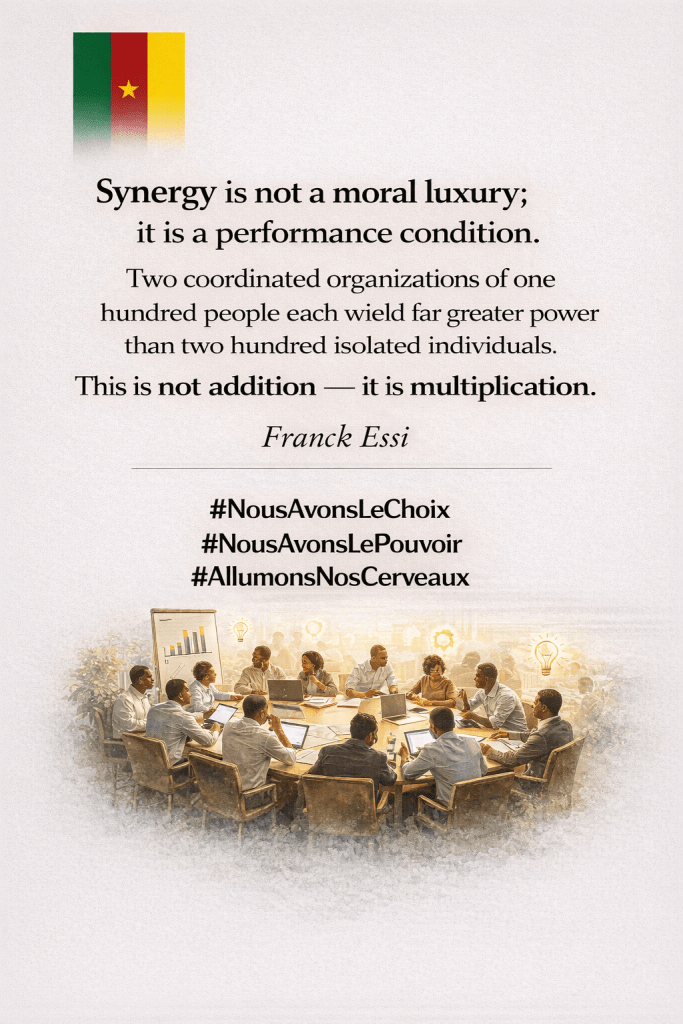
Synergy is not a moral luxury; it is a performance condition. Two coordinated organizations of one hundred people each wield far greater power than two hundred isolated individuals. This is not addition — it is multiplication.
Long-term collaboration is not optional. It is the only way to confront systems that are powerful, organized, and persistent — whether states, economic monopolies, or global structures that shape national trajectories.
—
Beyond Leadership Myths
Development — like political and social change — is rarely the work of solitary geniuses. It is produced by collectives capable of transcending egos, sharing power, managing conflict, and enduring over time.
As long as leadership is confused with personal domination, autonomy with isolation, plurality with dispersion, societies remain trapped in sterile cycles of reinvention. As long as charismatic tribunes are valued over patient builders, spectacular initiatives over sustained accumulation, seeds will be planted without harvest.
—
The Real Challenge
The real challenge, therefore, is not generating more initiatives.
It is learning to connect them, strengthen them, and make them last.
It is building spaces where disagreement does not mean rupture, where power rotation is anticipated and accepted, where common interest prevails without erasing differences. It is cultivating a culture of institution-building — not as bureaucratic constraint, but as a foundation that allows everyone to contribute without fear of absorption, humiliation, or erasure.
This collaboration is not a prayer. It is a skill to be learned, a discipline to be practiced, a daily struggle against our instinct toward isolation.
It begins when we accept that what we lose in control, we gain in power.
It takes root when we recognize that the other is not primarily a rival, but a multiplier of capacity.
It succeeds when we build together — slowly, painstakingly, courageously — the durable institutions capable of transforming a nation.
Franck Essi
#WeHaveAChoice
#WeHavePower
#CivicEducation
#LetsTurnOnOurBrains
 franckessi.com