—
Across many areas of social life, a shared assumption quietly shapes behavior: the belief that there is never enough to go around.
Not enough money.
Not enough opportunities.
Not enough respectable positions.
Not enough recognition.
Not enough future — for everyone.
This assumption is rarely stated openly, yet it structures a large part of individual and collective behavior. Success is perceived as threatening. Access to resources is treated as permanent competition. Society is imagined as a closed space, incapable of producing more than what already exists.
This mindset did not emerge by accident. It was forged through lived experience — in environments where scarcity was real, distribution unequal, and institutions unreliable. In contexts marked by chronic shortages, broken promises, and weak guarantees, fear of lack stops being an abstract belief. It becomes a survival reflex.
—
From Creation to Capture
Within such a mental framework, the central question is no longer how to create value, but how to secure one’s share.
The focus shifts from expanding what exists to appropriating what is available before it disappears.
Instead of asking:
“How can we add value?”
the prevailing question becomes:
“How do I take what I can — and protect it before things collapse?”
This logic fuels defensive accumulation, precautionary corruption, aggressive competition for positions, and constant fear of decline. Behaviors known to be harmful to the collective are morally rationalized by the expectation of a deteriorating future.
In this worldview, tomorrow will almost certainly be worse than today.
Thinking in terms of the common good appears naïve.
Sharing seems imprudent.
Trust feels dangerous.
—
Historical and Institutional Foundations
The scarcity mindset is deeply rooted in history. Colonial economies were systems of organized scarcity: maximum extraction, minimal redistribution. Access to education, status, and authority was rationed and dispensed as privilege. The idea that “there will never be enough for everyone” was not psychological — it was structural.
Post-independence trajectories often reinforced this logic. Economic crises, structural adjustment programs, currency devaluations, unpaid wages, and shrinking public opportunities extended the experience of scarcity. Where social mobility was promised, stagnation followed. Competitive exams became existential lotteries. Public positions turned into fortresses to be defended at all costs.
Under such conditions, the scarcity mindset is not simply a cultural weakness. It is a rational response to institutions perceived as unjust, unpredictable, and incapable of ensuring that effort today will generate rights tomorrow. Where rules are opaque and cheating is rarely sanctioned, mistrust is not paranoia — it is prudence.
—
A Paralyzing Social Logic
With this psychological background, large-scale, durable construction becomes nearly impossible.
Why invest in collective projects if outcomes are likely to be confiscated?
Why transmit knowledge or mentor others if one risks creating an additional competitor?
Why accept fair rules if the system is assumed incapable of producing enough for all?
Social life is thus reduced to a zero-sum — or even negative-sum — game:
For me to win, someone else must lose.
For me to rise, someone else must be excluded.
For me to be secure, others must remain vulnerable.
This logic produces mistrust, social jealousy, sterile competition, and fragmented solidarity. Cooperation does not disappear — it retreats into narrow circles: family, community, personal networks. Solidarity survives, but it cannot scale to the level of shared institutions.
—
A Self-Reinforcing Trap
The most damaging aspect of the scarcity mindset is that it creates the very scarcity it seeks to avoid.
Refusing cooperation limits value creation.
Blocking others reduces collective capacity.
Prioritizing capture weakens institutions, discourages investment, and dries up future opportunities.
Fear becomes reality.
When public officials extract “their share” out of fear of future deprivation, they destroy trust in public administration — reducing tax compliance, weakening state capacity, and undermining public services. When entrepreneurs refuse to grow, formalize, or share for fear of being plundered, they reinforce the belief that there is space only for a few small actors — never for multiple strong ones.
—
From Endured Scarcity to Constructed Abundance
History, however, offers a different lesson.
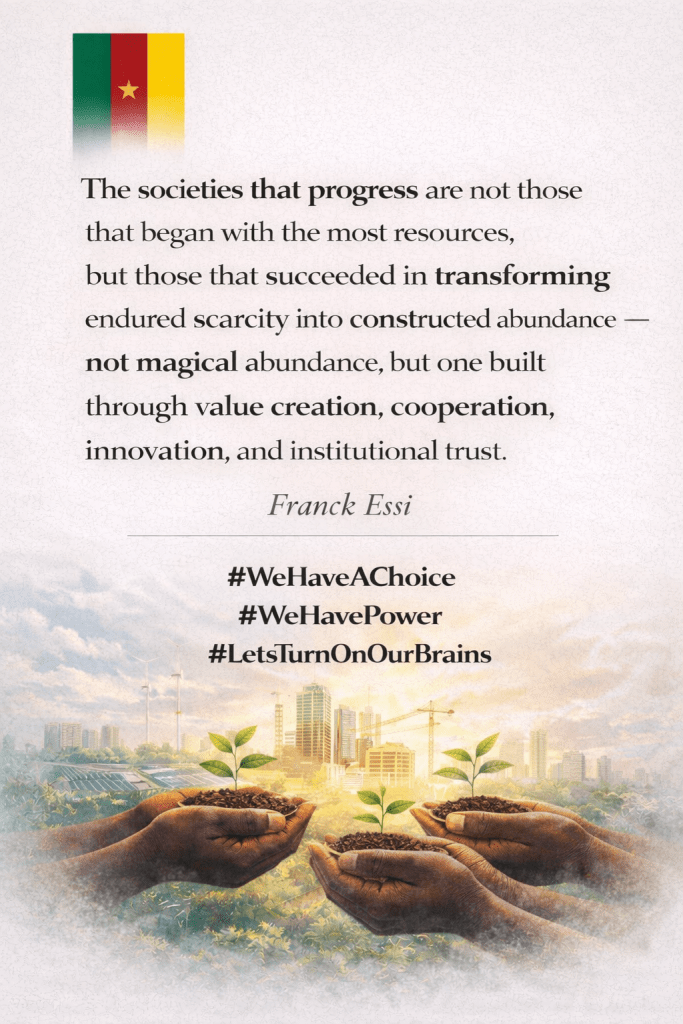
The societies that progress are not those that began with the most resources, but those that succeeded in transforming endured scarcity into constructed abundance — not magical abundance, but one built through value creation, cooperation, innovation, and institutional trust.
A society becomes a positive-sum system when:
- individual success expands collective opportunity;
- wealth is created through cooperation rather than predation;
- institutions protect contracts, secure property, and sanction betrayal.
In such contexts, an “abundance mindset” is not motivational rhetoric. It is the consequence of institutions that make cooperation less risky than isolation, and creation more profitable than capture.
—
The Real Challenge: Mindsets and Institutions
The obstacle, therefore, is not only economic.
It is psychological, cultural, political — and institutional.
As long as fear of scarcity dominates, societies fight over crumbs instead of learning how to expand the pie. But as long as institutions remain weak, unjust, or captured, defensive behavior remains rational.
Mentalities do not change in a vacuum.
Trust becomes possible when institutions make it reasonable.
Escaping the scarcity mindset does not mean denying real hardship. It means refusing to let hardship dictate behavior to the point of collective paralysis. It means understanding that mental transformation and institutional reform must advance together. One without the other will fail.
Development begins when a society internalizes a simple truth:
Wealth is not only shared — it is created, together.
And no lasting shift in mindset is possible as long as the rules of the game continue to turn fear of scarcity into a collective destiny.
Franck Essi
#WeHaveAChoice
#WeHavePower
#CivicEducation
#LetsTurnOnOurBrains
 franckessi.com