—
Another major obstacle to development lies in a deeply entrenched attitude: the tendency to bring everything back to oneself, to assume that an initiative only has value if it is led, controlled, or embodied by us.
When this is not the case, the initiative becomes suspect.
Worse still, it is often seen as something that should be weakened, discredited — or even destroyed.
This posture is not new. It echoes the lucid observation of J.-P. Claretie:
“Those who do something have against them those who do the same thing, those who do the opposite, and the great majority — those who do nothing.”
But in our context, this logic often goes further:
if I am not at the center, nothing should move forward.
—
The “Me or Nothing” Reflex
A recurring pattern can be observed in many situations.
An initiative emerges. A cause takes shape. A collective project begins to gain traction.
Yet as soon as leadership is not fully captured, as soon as control slips away, as soon as symbolic or material benefits are not clearly individualized, support evaporates — sometimes abruptly.
At that point, some prefer to undermine what exists, slow down what is progressing, or sabotage what could succeed without them.
The implicit reasoning is simple, and deeply destructive:
If everyone is not behind me, then nothing should advance.
Better paralysis than success without me.
Better chaos than someone else’s achievement.
What matters is no longer the cause, but the place one occupies within it.
—
From Cause to Cult of Self
Within this logic, the goal is no longer to unite people around a shared objective, but to place others behind oneself.
Adhesion is demanded not to a vision, a project, or principles — but to a person.
“Me first” replaces “the cause first.”
And the cause — which should transcend individual interests — becomes merely an instrument of personal recognition.
The consequences are severe.
Engagement turns into competition of egos.
Projects lose their collective substance.
Shared leadership, organized succession, and institutional continuity become impossible.
—
The Logic of Symbolic and Material Predation
Within the same dynamic, success is conceived in relative terms: winning more than others, often by taking from others, or by minimizing their contribution.
Acknowledging the merit of others becomes difficult — sometimes intolerable.
Sharing success feels like a loss.
Collective visibility is experienced as a dilution of personal prestige.
This logic of predation — symbolic as much as material — stands in direct opposition to any process of sustainable transformation. Development requires the pooling of competencies, recognition of diverse contributions, and the capacity to build projects larger than the individuals who initiate them.
—
A Poison for Change
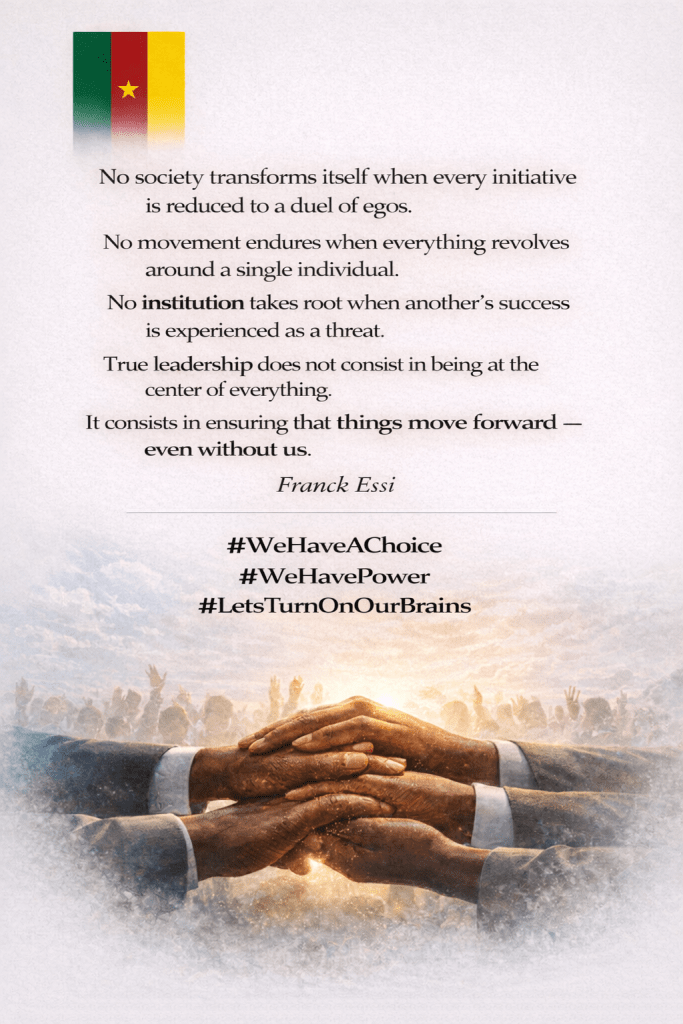
No society transforms itself when every initiative is reduced to a duel of egos.
No movement endures when everything revolves around a single individual.
No institution takes root when another’s success is experienced as a threat.
The urge to make everything about oneself produces the exact opposite of what it claims to seek:
it fragments collective forces, discourages genuine commitment, and drains the space of possibility.
Change demands something else.
It requires the ability to step aside without disappearing, to contribute without controlling everything, to support causes even when they do not carry our name.
True leadership does not consist in being at the center of everything.
It consists in ensuring that things move forward — even without us.
Only under these conditions do causes become institutions, initiatives become lasting dynamics, and development cease to be a slogan and become a shared reality.
Franck Essi
#WeHaveAChoice
#WeHavePower
#CivicEducation
#LetsTurnOnOurBrains
 franckessi.com