—
Another major obstacle to development lies in an attitude that has become almost reflexive: permanent suspicion toward others, the tendency to look first — and often only — for what is wrong in them.
Within this mindset, when others do something right, they are merely pretending.
When they do something wrong, they are revealing their true nature.
Doubt is no longer a tool of discernment. It becomes a total lens through which social reality is interpreted.
—
Suspicion as a Default Posture
Gradually, everything is filtered through mistrust.
Intentions are judged before actions.
Trajectories are disqualified before being understood.
Another person’s success is considered suspicious by definition.
In this mental universe, “hell is other people” — not because they are necessarily oppressive, but because they are presumed to be deceitful, calculating, and dangerous. Suspicion begins as a form of self-protection. But when generalized, it turns into a mode of social relation.
Trust is no longer something that must be earned.
It is something that is denied by default.
—
The Matrix of Prejudice
Suspicion rarely remains individual. It spreads, hardens, and becomes collective.
It turns into the matrix of multiple prejudices.
When others are systematically suspected, it becomes easy to reduce them to fixed identities: ethnic, regional, religious, or national. Suspicion then feeds tribalism, legitimizes xenophobia, and normalizes racism. Individuals are no longer judged as individuals, but as members of entire groups.
In such a configuration, difference is no longer a potential resource.
It is perceived as a latent threat.
—
The Collapse of Trust
Yet no society can function sustainably without a minimum level of trust.
Trust is not naïveté. It is the condition that makes collective action possible. Where suspicion dominates, alliances become fragile, temporary, and purely instrumental. Commitments are reversible. Cooperation is calculated in the short term.
In a climate of generalized mistrust, every collective initiative is immediately undermined by paralyzing questions:
What is he hiding?
Who really benefits?
At what point will I be betrayed?
The outcome is predictable: people prefer not to engage, or engage without ever fully committing.
—
An Obstacle to the Common Good
Suspicion thus makes the construction of a genuine common interest almost impossible.
Not because shared interests do not exist, but because there is no framework of trust within which they can be identified, defended, and sustained.
Where everything is suspect, the very idea of the common good appears illusory.
Collective action becomes unlikely.
Durable cooperation becomes nearly impossible.
Individuals retreat into their immediate circles — family, community, networks — hoping to protect themselves from the presumed duplicity of others. This retreat, however, further fragments society and weakens its capacity to address structural challenges.
—
Suspicion as a Poison to Development
Development requires the exact opposite.
It requires the capacity to trust without being blind,
to cooperate without being naïve,
to build alliances without demanding impossible guarantees.
A society that permanently suspects everyone condemns itself to collective impotence. It expends more energy monitoring one another than creating value. It chooses isolation over cooperation. It confuses vigilance with paralysis.
Overcoming “suspicionitis” does not mean denying real betrayals or ignoring documented abuses. It means refusing to allow fear of others to become the organizing principle of social life.
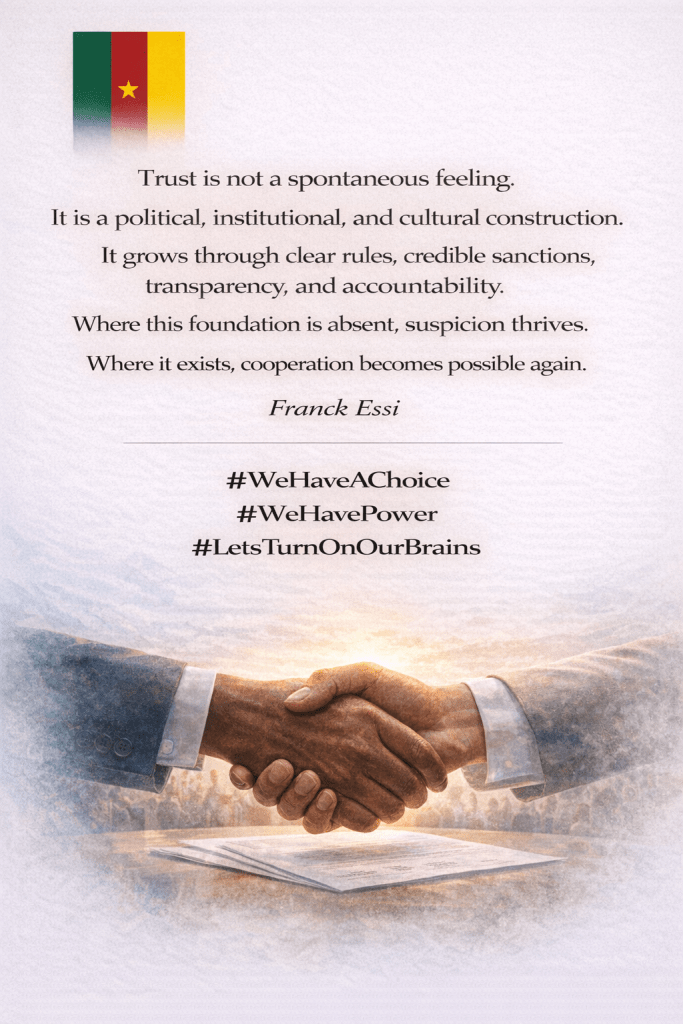
Trust is not a spontaneous feeling.
It is a political, institutional, and cultural construction.
It grows through clear rules, credible sanctions, transparency, and accountability.
Where this foundation is absent, suspicion thrives.
Where it exists, cooperation becomes possible again.
Development begins when a society accepts a demanding truth:
without a minimum of trust among its actors, no lasting transformation is possible.
Franck Essi
#WeHaveAChoice
#WeHavePower
#CivicEducation
#LetsTurnOnOurBrains
 franckessi.com