—
Another deep obstacle to development lies in a drift that has become almost normalized: the glorification of material wealth at the expense of knowledge, meaning, and ideals.
Knowledge is increasingly despised.
Wealth and power are increasingly worshipped.
Within this inverted value system, the most visible — and most socially recognized — indicator of success is no longer intelligence, usefulness, or contribution to the common good, but material accumulation. What one owns matters more than what one understands, embodies, or transmits.
—
The Moral Abdication of Elites
This situation did not arise spontaneously. It has been produced, sustained, and amplified by the failure — even the betrayal — of certain elites.
In an unregulated capitalist and consumerist environment, many of those who should have served as intellectual, moral, and civic reference points have disengaged. Knowledge has no longer been pursued to enlighten society, but to access wealth and power. Learning has become an instrument of domination rather than a tool of emancipation.
Instead of serving the people and the fundamental interests of the nation, these elites have often placed their skills at the service of personal enrichment and individual advancement.
—
When the Stomach Defeats the Mind
In this shift, the stomach has prevailed over the heart and the brain.
Desire has overtaken reason.
Immediate gratification has eclipsed long-term reflection.
Comfort has displaced responsibility.
Pleasure has supplanted meaning.
Within such a framework, one increasingly prefers to be ignorant but rich rather than lucid, educated, and modest. Success is no longer associated with wisdom, coherence, or social contribution, but with the ability to consume, display, and enjoy.
—
An Impoverished Conception of Life
Under this perspective, the purpose of life is no longer the pursuit of the Good, the Beautiful, the Just, the True, and the Useful — ideals that have historically structured civilizations and sustained collective projects.
Instead, it becomes the maximum accumulation of material goods and the continuous pursuit of pleasure, regardless of the social, human, or ecological costs. Questions of meaning are relegated to the background, sometimes even ridiculed.
Yet a society that abandons reflection on its ends eventually loses its direction.
—
A Major Obstacle to Change and Development
This hierarchy of values is not neutral. It is fundamentally incompatible with any serious ambition for transformation.
Development requires discipline, long-term thinking, intellectual rigor, and the ability to delay gratification in favor of collective benefit. It presupposes citizens capable of reflection, doubt, restraint, and projection beyond immediate self-interest.
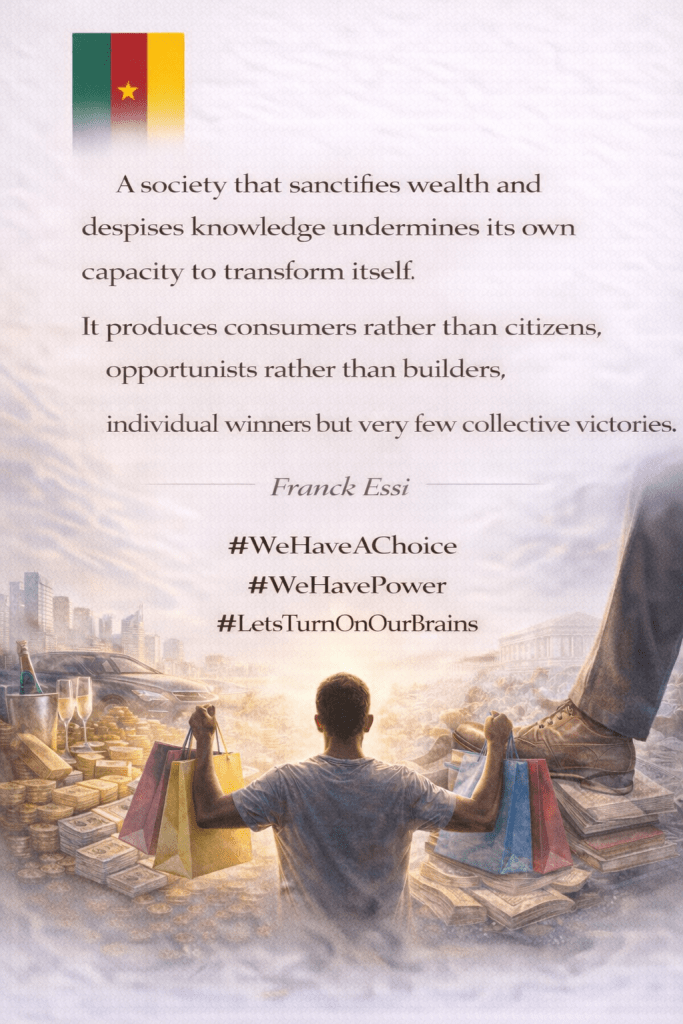
A society that sanctifies wealth and despises knowledge undermines its own capacity to transform itself. It produces consumers rather than citizens, opportunists rather than builders, individual winners but very few collective victories.
—
Reconnecting Material Progress and Ideals
The issue is not wealth itself, nor material progress as such.
The problem is wealth without a compass.
Sustainable development rests on a reconciliation:
between material progress and spiritual depth,
between economic efficiency and moral responsibility,
between technical advancement and meaning.
Without shared ideals, wealth becomes sterile.
Without a sense of the spiritual — in the broadest sense — power becomes brutal.
Without the primacy of knowledge and truth, wealth and power ultimately turn against the society that produced them.
Change begins when a society accepts a demanding but simple truth:
a society is not developed solely by what it possesses, but by what it chooses to value.
And no lasting transformation is possible when material accumulation becomes an end in itself rather than a means in service of a higher collective project.
Franck Essi
#WeHaveAChoice
#WeHavePower
#CivicEducation
#LetsTurnOnOurBrains
 franckessi.com