—
Another major obstacle to development lies in a deeply troubling drift: the normalization of corruption, to the point where it increasingly functions as an accepted social norm — even as a way of life.
In Cameroon, it is not uncommon for honesty and integrity to be perceived as anomalies, almost as offenses — not legal ones, but social ones.
Those who strive to remain upright are often viewed with irony, suspicion, or condescension. Their refusal to compromise is interpreted not as moral strength, but as a lack of intelligence, realism, or ambition.
Conversely, those who refuse corruption are mocked, marginalized, and sometimes actively undermined. They become inconveniences in a system that has learned to operate through informal arrangements, hidden transactions, and permanent compromise.
—
When Money Becomes the Ultimate Compass
Within this framework, what matters above all is the rapid accumulation of money — as much as possible, by whatever means necessary. The central question is no longer how success is achieved, but how much is accumulated.
Money thus becomes both the fuel and the final objective of corruption.
It turns into the ultimate indicator of social value:
- it defines success,
- it confers authority,
- it redefines intelligence,
- it even reshapes standards of beauty and respectability.
The origin of wealth becomes irrelevant. Questions of ethics, legality, or public interest are relegated to the background — sometimes openly ridiculed.
—
A Dangerous Inversion of Values
This situation produces a profound inversion of moral and civic reference points.
Integrity ceases to be a virtue.
Transgression becomes a sign of cleverness.
Corruption is no longer experienced as a failure, but as a rational strategy of adaptation.
In such an environment, the norm is no longer compliance with rules, but their circumvention. Those who refuse to play along are perceived as naïve, out of touch, or even suspect. Society thus sends a powerful — if implicit — message: to succeed, one must cheat.
This message is devastating, particularly for younger generations, who quickly learn that effort, merit, and competence are often insufficient — and sometimes irrelevant.
—
A Society That Undermines Itself
On such foundations, collective change and development lose all substance.
Why invest in common projects when the rules are systematically biased?
Why trust institutions perceived as captured?
Why respect norms that neither protect the honest nor reward competence?
When corruption becomes a social norm, it silently erodes the very foundations of society. It destroys trust, discourages honest initiative, weakens the state, and traps individuals in a vicious cycle in which participation in corruption appears necessary simply to avoid exclusion.
This is no longer merely a problem of individual behavior.
It is a systemic, cultural, and institutional problem — one that locks society into short-term thinking, predation, and generalized mistrust.
—
The Dead End of Development
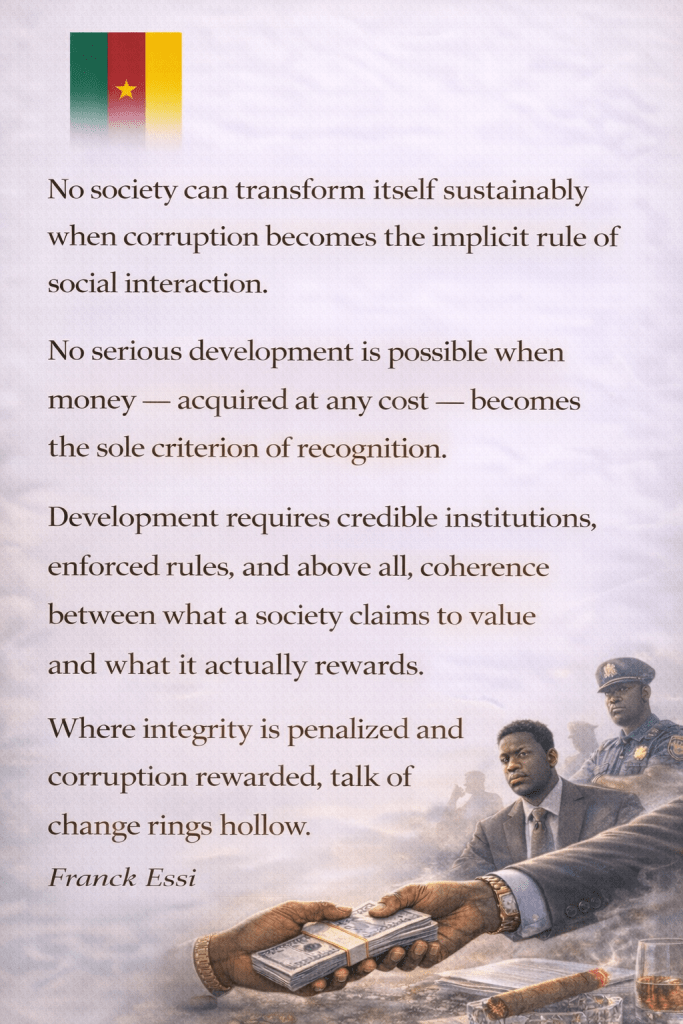
No society can transform itself sustainably when corruption becomes the implicit rule of social interaction.
No serious development is possible when money — acquired at any cost — becomes the sole criterion of recognition.
Development requires credible institutions, enforced rules, and above all, coherence between what a society claims to value and what it actually rewards. Where integrity is penalized and corruption rewarded, talk of change rings hollow.
Breaking with the normalization of corruption is not a matter of abstract moral appeals. It requires realigning incentives, restoring the social value of honesty, and ensuring that integrity is no longer a handicap.
Development begins when society sends a clear and consistent message:
corruption is neither a fatality nor a sign of intelligence, but a poison that impoverishes everything it touches.
As long as this message is not embodied in practices, institutions, and sanctions, change will remain a slogan — and development an empty promise.
Franck Essi
#WeHaveAChoice
#WeHavePower
#CivicEducation
#LetsTurnOnOurBrains
 franckessi.com