NB: This article was written in June 2021 and was originally published in the newspaper Germinal in December 2021.
—
Introduction
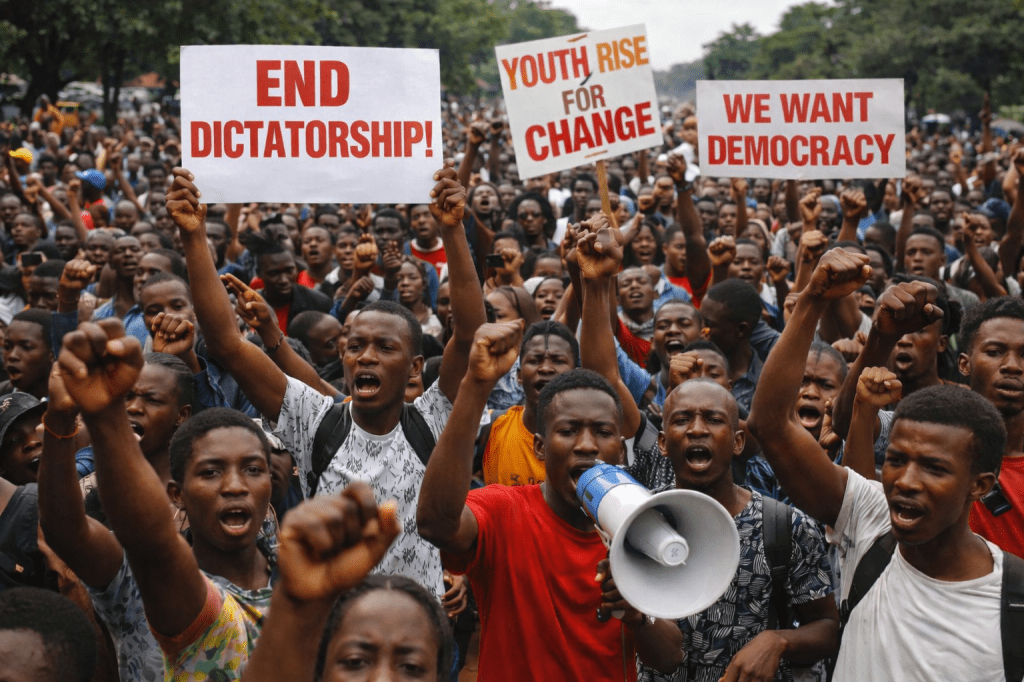
Attempts, initiatives and strategies deployed in Cameroon to achieve change at the top of the state or dismantle the neocolonial regime are numerous and long-standing. From resistance to German colonial penetration to the struggles for independence, from the fight for democratisation to the battles for real change and better governance, the same demand runs through history: to build a state ‘for and by Cameroonians’.
Despite these efforts, the ‘Cameroonian national problem’ remains unresolved and pressing. Resolving it remains the historic task of the current generation of militants and activists, mobilised within a constellation of civil society organisations and political parties.
To move forward, we must learn from yesterday’s advances and integrate today’s new realities, which are redefining the strategies for conquering and exercising power necessary for the transformation of Cameroonian society. It is in this context that this text proposes to explore a central element of the political construction to be put in place: the non-partisan path of citizen movements as a lever for overturning the balance of power and seizing power.
—
I – What are citizen movements?
1. What is meant by a citizen movement?
Citizen movements are political formations of a particular type. They bring together organisations and individuals who are involved in public life without assuming all the functions or embracing all the characteristics of traditional political parties.
Their essential difference is clear: as movements, they do not directly seek to seize state power. They work to create the conditions for its overthrow, or at least for a profound shift in public policy in favour of the working classes.
Here, the discussion draws on examples such as Stand Up For Cameroon, as well as other attempts at citizen platforms in Cameroon that have worked towards alternatives or change. These movements bring together political party activists, civil society actors, activists for specific causes, and citizens without any party affiliation or ambition.
These are political groups that aim to transform the existing political order by ousting the ruling oligarchy and initiating a process of rebuilding the state. The goal is to achieve a new public order that guarantees popular and international sovereignty, democracy, and the satisfaction of the needs of the poorest in a more structural, systematic, and effective manner.
2. What are citizen movements opposed to?
In a country like Cameroon, the citizen movement is defined by a dual dynamic that appears contradictory but is in fact complementary: radical rejection of the dominant order and a clear desire for a different social and political order.
On the one hand, there is the rejection of a regime perceived as oppressive, impoverishing and incapable of responding to the fundamental aspirations of the working classes. On the other hand, there is the desire for greater well-being, for real change or a radical alternative, opening up a new order that guarantees greater justice, greater freedoms and better satisfaction of the economic, social and cultural needs of the population.
Citizen movements are thus opposing a neocolonial and dictatorial regime, proof that the project of independence remains unfinished. This regime is based on a set of cultural, economic, legal, institutional, political and diplomatic mechanisms that trap populations in underdevelopment and restrict their freedoms. It remains deeply extroverted, politically and culturally, and driven by forces that perpetuate, in updated forms, the logic of slavery and colonization.
In their deployment, citizen movements confront the entire state apparatus controlled by this oligarchy, as well as its clientele within political and civil society. The regime finds support not only in certain sections of the majority, but also within part of the opposition, in associations, religious and cultural groups, trade unions, and in sociological communities, some of whose members are involved in “business”.
3. What is their rationale for action?
In order to bring about the departure of the regime and initiate a rebuilding of the state, citizen movements adopt a rationale for action focused on popular mobilization with a view to expelling the oligarchy from the centres of power.
Throughout the world, and in Africa in particular, this approach has sometimes led to the fall of authoritarian regimes and the opening of democratic transitions. To achieve this, citizen movements use several tactics, including:
- Relentlessly informing the most oppressed groups about their rights, their interests and the mechanisms of their oppression.
- Training and organizing activists and groups in struggle to give them the tools to mobilize and defeat the structures that oppress them.
- Mobilizing activists and populations through targeted campaigns to shift the balance of power in favor of the progressive or revolutionary camp.
- Building, strengthening and expanding alliances for action, through various platforms, to awaken and channel popular energies towards actions likely to bring down the regime.
Faced with a power that blocks formal channels of protest and renders institutional mechanisms meaningless, citizen movements act at best as a complement to traditional political forces and at worst as a radical alternative for overthrowing the ruling power.
This leaves one crucial question: in the Cameroonian context, is this path really viable?
4. Why consider them as relevant avenues for struggle?
The political deadlock observed in many African countries, including Cameroon, argues for the exploration of citizen movements as a means of bringing about systemic transitions. Three main arguments emerge.
Argument 1: better platforms for bringing together activists and campaigners
- There is widespread mistrust of political parties. Many citizens consider them to be all the same, disconnected from the interests of the people and incapable of bringing about real change, whether they are in power or in opposition.
- Traditional institutional channels for change are blocked: the electoral process is rigged, and the administration and electoral institutions are aligned with the ruling clique.
- Political parties are perceived as rigid, top-down, undemocratic, and often mirroring the systems they claim to fight against.
- Many activists contrast ‘political manoeuvring’ with ‘activism’, which is perceived as purer, more altruistic, more radical and more resistant to corruption.
In this context, citizen movements appear to be more appropriate political forms, capable of bringing together party activists, activists and ordinary citizens around common causes.
Argument 2: more effective dynamics than parties in recent decades
Recent decades show that authoritarian regimes rarely fall through elections alone. The examples of Tunisia, Egypt, Burkina Faso and Sudan lead to two observations:
- Dictatorships do not fall through the ballot box; they fall through popular uprisings.
- Wherever there has been change or transition, popular mobilisations, often led by citizen movements, have played a decisive role.
Mobilizations driven by citizen movements have thus proven to be more effective than electoral participation confined to the rules of the game imposed by dictatorships.
Argument 3: organizational characteristics suited to ‘democratic revolutions’
Faced with authoritarian regimes on the one hand, and a mobilised youth with little interest in traditional partisan engagement on the other, citizen movements are well-suited vehicles for driving democratic revolution.
Due to their relative horizontality:
- They gain flexibility in deployment, adaptation and response to power;
- They have an increased capacity to bring forth new leaders when visible figures are arrested or neutralised;
- They offer spaces for experimenting with democratic practices, making it more difficult to destroy them through repression alone.
—
II – What mistakes did progressive forces make in their quest for power?
The so-called progressive forces did not fail because of fate, but also because of their own limitations. Without claiming to be exhaustive, several recurring mistakes can be identified:
1. Acting in a scattered manner.
The lack of coordination in the face of the same adversary weakens the struggle. The government, on the other hand, maintains its power through synergy between political, economic, social, religious and traditional forces.
2. Failure to create common frameworks for evaluation and strategic diagnosis.
Without regular consultation, mutual understanding between leaders remains weak, analyses do not intersect, and alliances are difficult to build, especially in times of crisis.
3. Under-exploiting the capital of popular frustration.
The scandals and injustices that punctuate daily life are not systematically transformed into levers for mobilization. People often conclude that political organizations do not really defend their interests.
4. Failing to capitalize on victories, even partial ones.
Successes have been achieved on the social, civic and political fronts, but they are rarely studied or systematized. These victories are not transformed into reproducible methods, which leads to tactical and organizational setbacks.
5. Failing to draw inspiration from victories elsewhere.
From the Arab Spring to the change of government in Senegal, via the Sudanese revolution, there are many experiences that offer lessons to be adapted, rather than copied and pasted.
6. Not taking advantage of new internal and international opportunities.
The rise of concerns about democracy and human rights, the awakening of political consciousness in Cameroon, and new information technologies remain under-exploited.
These mistakes are compounded by internal weaknesses: a lack of human, material and financial resources, weak social and territorial roots, inadequate communication, and poorly managed internal contradictions. Hence the need for a renewed framework in which progressive forces, united in citizen movements, can hope to achieve their goals.
—
III – What contextual factors favour citizen movements?
For a citizen movement to succeed in overthrowing a dictatorship in a context such as that of Cameroon, certain favourable factors must be in place. These include:
1. An indisputable and widely recognised cause.
It must stand the test of time and be seen as legitimate by a large majority.
2. A sufficiently serious situation.
The cause must be central and dramatic enough for citizens to be willing to risk their freedom and their lives.
3. A problem of general scope.
It must concern everyone or almost everyone, in order to minimise divisions and artificial segmentations.
4. A population that is largely in favour of engagement.
This disposition can be measured through concrete signs: regular mobilisations, radicalisation of opinion, an increase in acts of disruption.
5. Legitimate leaders.
They must embody the aspiration for change and inspire real confidence in their integrity and determination.
6. Minimal political preparation of those mobilised.
Failing that, there must at least be a critical mass of leaders capable of guiding, channelling and sustaining the mobilisation over time, despite repression.
The more a movement succeeds in building or benefiting from these factors, the greater its chances of bringing about regime and system change.
—
IV – How can a citizen movement with a chance of success be built in Cameroon?
Beyond contextual factors, certain conditions are essential for building an effective citizen movement in the Cameroonian context.
- Coordinated and systematic action on jointly identified strategic issues (electoral code, freedom of assembly and demonstration, political transition, etc.). Synergy is not a luxury but a necessity imposed by the power of the regime.
- Pooling of technical, financial, human and material resources. Common sense dictates this, but the practice remains weak and constitutes a serious weakness of progressive forces.
- Active and concrete solidarity on issues raised by current events. The inability to mobilise together on specific issues makes joint mobilisation on broader issues illusory. Trust is built on a daily basis, and solidarity is proven through actions.
- Continuous political education of the people, targeting groups with high mobilisation potential. A citizen movement that wants to overthrow a regime must become a broad popular movement, driven by sustained information and awareness campaigns.
- Direct and symbolic deconstruction of the dominant order. This involves spreading an alternative narrative, delegitimising the regime’s ideological assumptions and instilling in people’s minds the conviction that the movement must be actively supported.
—
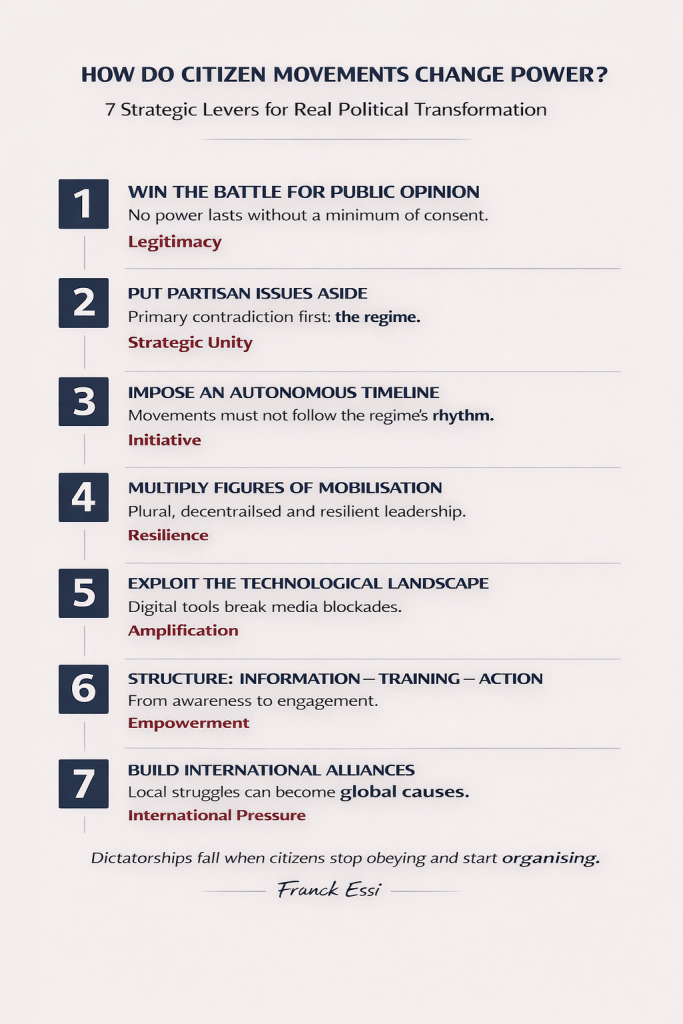
V – What tactics and strategies can be used to change power through citizen movements?
To achieve real change in the regime and system of governance, citizen movements must accomplish several tactical and strategic feats.
1. Win the battle for public opinion.
Even in an authoritarian regime, public opinion matters: if it does not govern, it influences. No power can last without a minimum of consent. It is therefore necessary to wage the battle of ideas and the cultural battle.
2. Put partisan issues and short-term interests aside.
When faced with a primary contradiction – the regime – secondary contradictions must be relegated to the background. The alliance between progressive forces must be built on a win-win logic oriented towards the common goal.
3. Impose an autonomous timetable.
The movement cannot be content to follow the institutional rhythm of the regime. It must set its own pace, while taking advantage of certain official dates, with the awareness that a dictatorship cannot be overthrown by scrupulously following its rules.
4. Increase the number of mobilisation figures.
The movement must become fluid, “gaseous”, plural. Like a hydra, it must have several heads capable of taking over when some are neutralised. Decentralisation – and sometimes compartmentalisation – can thwart the regime’s traps, while ensuring permanent accountability.
5. Exploit the new technological landscape.
In a closed media environment, social networks and digital tools are becoming major weapons of mobilisation. More and more movements are emerging in the virtual world and spreading into the real world.
6. Structure the triptych ‘Information – Training – Action’.
Informing, training and then taking action through regular campaigns must become the matrix of the movement. This process increases the number of active citizens and can lead to campaigns of civil disobedience, a formidable weapon for peoples facing dictatorships.
7. Build and strengthen international alliances.
This involves identifying allies capable of supporting, relaying and defending the cause on the world stage. In an interdependent world, a local struggle can take on global significance, particularly by influencing public opinion in states that support the regime and by mobilising the diaspora.
—
Conclusion
The elements presented here aim to shed light on the conditions for the success of a non-partisan movement aimed at changing power in Cameroon. Such a movement cannot be spontaneous or the result of chance: it must be built, learning from past and present experiences, taking on an insurrectionary dimension, educating and mobilising the people, promoting an alternative project of rupture and spreading a narrative capable of deconstructing the regime’s narrative about the past, present and future.
Above all, it must break with institutional routine and, through popular mobilisation, inflict repeated defeats on the regime until it flees and a genuine democratic political transition begins.
For one thing remains certain: we cannot expect different results by opposing the regime with the same actions as yesterday.
Franck Essi
 franckessi.com