My vision of Cameroon’s future and the meaning of development
By Franck Essi
NB: Text originally published in November 2018. This text also explains what I often mean or imply by « development ». It is a key word or concept that I often refer to extensively in my comments and reflections.
—
Unleashing political imagination in times of crisis
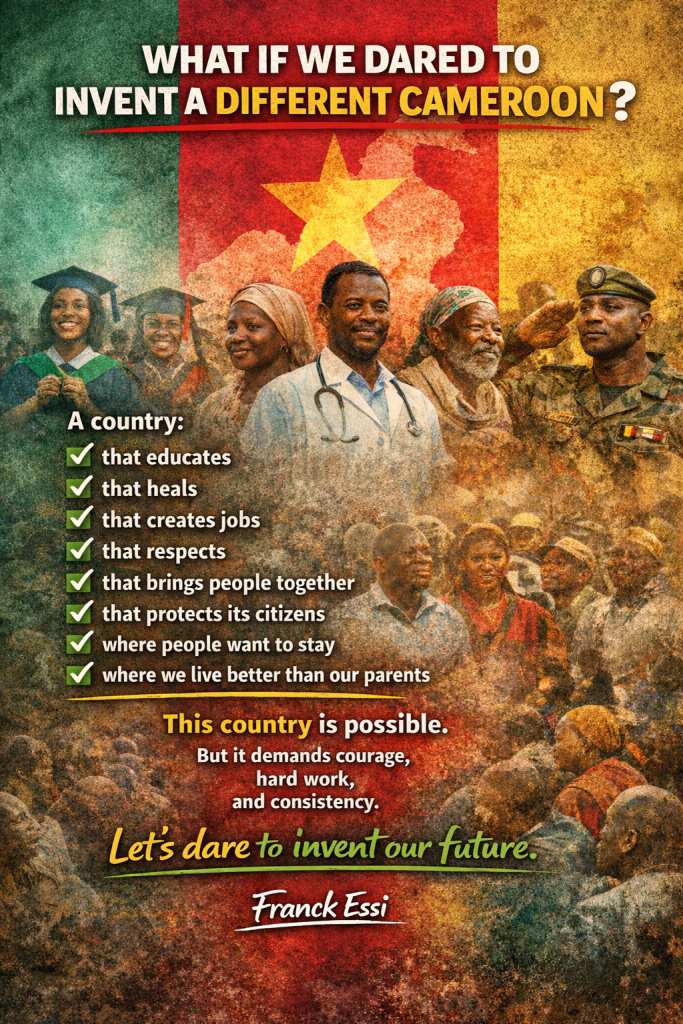
In this period of acute crisis and growing difficulties, I would like to invite us to engage in an essential but too often neglected exercise: unleashing our political imagination to envisage what we really have the potential to build and achieve.
Such an exercise becomes vital when the horizon seems blocked, when the country feels like it is going round in circles and when deadlock seems to have become our familiar landscape.
Yet history teaches us that great changes always begin with an act of collective imagination.
As Thomas Sankara suggested: « Let us dare to invent our future. »
So let us dare.
—
I. An education that trains builders of civilisation
A nation can never rise above the quality of its education system.
Let us imagine that in our country, education enables us to train some of the best human resources in the world.
⏺ Women and men steeped in their history, culture and values, which make them agents of change, in Cameroon and elsewhere.
⏺ Citizens with the mindset and skills that predispose them to be solution providers, innovators and inventors.
⏺ Minds capable of combining creativity, imagination and high-level technical skills.
⏺ People who are aware of their rights and duties, patriots not by slogan but by responsibility, determined to complete the work of those who came before them.
—
II. An exemplary state through the quality of its governance
Good governance is not a luxury: it is a condition for collective survival.
Let us imagine that we are the best-managed country in the world.
↗ A country where every penny of public money is allocated to the right priorities and used to solve the most pressing problems.
↗ A country where appointments are based on criteria of excellence that are transparent and known to all.
↗ A country cited as an example of efficiency and effectiveness in public spending.
↗ A country where citizens willingly pay taxes because they consider them fair, useful and well spent.
↗ A country that embodies transparency and accountability towards its citizens.
—
III. A humane, sovereign and equitable healthcare system
The value of a country is measured by how it protects human life.
Imagine a Cameroon where everyone can receive effective healthcare, regardless of their social class, origin, level of education or place of residence.
➡ A country where our own medicine plays a central role, reducing dependence on therapeutic, technological and financial dictates from elsewhere.
➡ A country where prevention and treatment mean that the population is among the healthiest in the world.
➡ A country where human life is sacred and where healthcare professions are seen as a vocation.
➡ A country where health centres are more welcoming than leisure complexes reserved for wealthy tourists.
—
IV. Full employment and the dignity of work as a social foundation
A society that devalues work destroys its own cohesion.
Imagine a country where full employment and decent work prevail.
✓ A country where work is mostly chosen and not endured.
✓ A country where workers’ rights are respected and where legal remedies actually work.
✓ A country where social democracy is not an abstract concept but a lived reality.
✓ A country where essential professions – education, health, food, social support – are valued.
✓ A country where retirement is no longer a source of fear.
✓ A country where work pays, where merit is recognised and effort rewarded.
—
V. An inclusive, confident and reconciled nation
A nation is not built against its diversity, but from it.
Let us imagine a country where people feel increasingly integrated.
▶ A country where coexistence is progressing and where everyone feels respected.
▶ A country where consensus around values, principles and institutions deepens every day.
▶ A country we are proud of.
▶ A country where difference is no longer perceived as a threat but as an asset.
▶ A country where positive preconceptions prevail and facilitate collective work.
▶ A country that, without denying identities, has fully succeeded in becoming a nation.
—
VI. An accepted memory and a reclaimed history
A people without memory is a vulnerable people.
Imagine a country where true history is taught.
📌 A country where the wounds of the past are acknowledged and treated through genuine collective therapy.
📌 A country where cities, streets and buildings honour our most illustrious historical figures.
📌 A country that does not deny its past but uses it to understand the present and invent the future.
📌 A country where the link between past, present and future generations is never broken.
—
VII. A democracy that truly represents the people
Democracy is not proclaimed: it is practised.
Imagine a country where leaders are truly representative of the people.
⚫ A country where elections are regular, transparent and widely accepted.
⚫ A country where power is not reserved for the richest, the best connected or those who inherit it.
⚫ A country where young people, women, people with disabilities and minorities participate fully in decision-making.
⚫ A country where leaders compete not with words, but with their ability to bring about real change in people’s lives, especially those who are most vulnerable.
—
VIII. Peace as a national competence and contribution to the world
Lasting peace is built, not achieved by chance.
Imagine a country where the art of conflict prevention and peaceful resolution is taken to the highest level.
– A country where diplomats and experts from around the world come to learn how to resolve social and political crises.
– A country where peace of heart and mind is a constantly deepening reality.
– A country that contributes, through the quality of its leaders and initiatives, to resolving major contemporary challenges on an African and global scale.
—
IX. Intergenerational synergy as a strategic force
No society progresses by pitting its generations against each other.
Imagine a country where synergy between young and old is a living culture.
✅ A country where young people do not see their elders as adversaries.
✅ A country where older people do not fear youth.
✅ A country where experience is combined with energy and innovation.
✅ A country where everyone, young and old, feels useful and recognised.
✅ A country where age is neither an automatic privilege nor a definitive obstacle.
—
X. Security forces serving citizens and the Republic
Security must protect, not terrorise.
Imagine a country where law enforcement and defence forces serve the citizens.
▪ A country where honest citizens do not fear the police.
▪ A country where only criminals fear the law.
▪ A country where those responsible for security are also defenders of human rights.
▪ A country where citizen protests are regulated, not repressed.
▪ A country where the army contributes to the construction of social infrastructure and disaster management.
—
XI. A country that people no longer flee, but that the world desires
When a country functions well, its citizens stay – and others want to come.
Imagine a country whose inhabitants no longer dream of leaving out of despair.
✓ A country whose citizens are respected everywhere.
✓ A country that rolls out the red carpet for its intellectuals, artists, workers and citizens.
✓ A country whose nationality is desirable.
—
XII. Restoring hope: living better than our parents
Real progress is measured by the hope that is passed on.
Let us imagine a Cameroon where the current generations are convinced that they will live better than their parents.
▶ An optimistic country.
▶ A country at ease with itself.
▶ A country where history regains its meaning: justice, social progress, solidarity.
—
My firm belief: We can turn this vision into a collective mission.
I don’t know about you, but I believe it is possible.
Our country could become that Cameroon. And in doing so, inspire other countries in Africa and around the world. It all depends on us.
The first condition is to believe in it, to work towards it and to keep this horizon constantly in our sights.
This is our mission.
It is our duty.
And in these dark times, giving up on the vision would already be a defeat.
Let us never forget that disorder, like order, is a product of the human mind. Thomas Sankara said that anything the human mind can conceive, it is possible to achieve. Without having the same level of certainty as him, I remain convinced of this: if we want to, we can always be, do and have better.
As the proverb says: « Shame on those who do not do better than their parents. »
Our challenges are great.
So are our dreams.
They demand greatness from us.
Refusing to imagine a different Cameroon means accepting the one that suffocates us.
So let us dare.
Let us dare to invent this country.
Let us dare to invent our future.
Franck Essi
African from Cameroon
Political activist
 franckessi.com