By Franck Essi

—
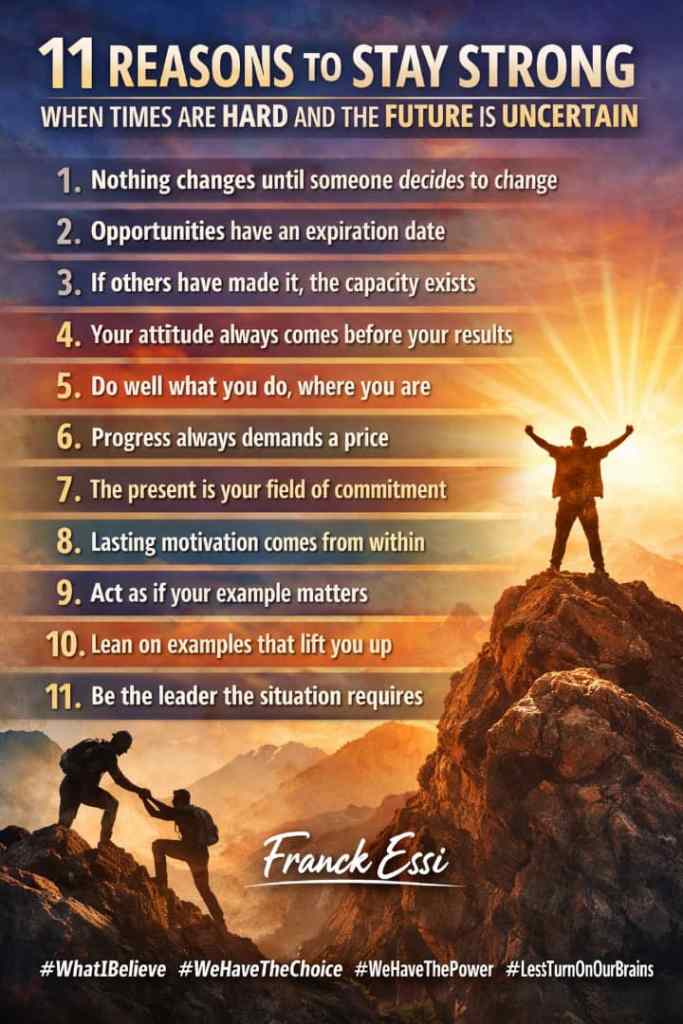
1. Nothing changes until someone decides to change
Over time, I’ve noticed a simple truth: the people who move forward are not those with fewer problems, but those who refuse to remain stuck.
A small step taken today is always worth more than a big plan postponed until tomorrow.
When times are hard, don’t first look for the perfect solution. Look for the possible action. Momentum creates clarity.
—
2. Opportunities have an expiration date
Many people believe they will get a second chance identical to the first one. That is rarely the case.
Circumstances change. People change. Windows close.
Committed people learn an essential rule early on: acting when the opportunity appears—even imperfectly—is often what separates those who move forward from those who explain why they couldn’t.
—
3. If others have made it, the capacity exists
Every time someone succeeds in a difficult context, they send a silent message: it is possible.
This does not mean it will be easy. It means obstacles are not final.
The change in your situation begins the day you understand that your potential is not determined by your environment, but by your perseverance.
—
4. Your attitude always comes before your results
Two people can live through the same situation.
One gets discouraged.
The other learns.
The difference is not the context, but the mindset.
Committed people consciously choose what they allow to dominate their thinking.
Where your attention goes, your energy follows.
—
5. Do well what you do, where you are
Great careers and solid lives are rarely built in spectacular moments. They are forged in ordinary tasks done well.
When you treat every responsibility seriously, you are training for those that will come later.
Excellence is a habit before it is recognition.
—
6. Progress always demands a price
Everything of value requires effort: discipline, patience, sacrifice.
Those who refuse to pay the price today often pay a higher one tomorrow—frustration, regret, stagnation.
Committed people accept a simple truth: ease costs more than effort.
—
7. The present is your field of commitment
You cannot lead yesterday.
You cannot control tomorrow.
But you can influence today.
Every well-used day strengthens your inner credibility.
Sustainable progress is the result of consistent daily decisions, not occasional bursts of effort.
—
8. Lasting motivation comes from within
If you wait for someone else to constantly motivate you, you will eventually give up.
Leaders learn to talk to themselves before listening to their fears.
You are stronger than you think—especially when you reconnect with your values and your sense of purpose.
—
9. Act as if your example matters
Because it does.
Someone is watching you, even if you don’t know it: a colleague, a child, a loved one.
The question is not, “Am I ready to be a role model?”
The real question is: “What kind of role model am I already?”
—
10. Lean on examples that lift you up
When doubt sets in, look at how those you deeply respect have acted.
Not to imitate them mechanically, but to draw inspiration from their discipline, courage, and coherence.
Good role models don’t give you excuses. They call you to a higher version of yourself.
—
11. Be the leader the situation requires
Leadership does not begin with a title. It begins with responsibility assumed.
In difficult times, the world does not need more commentary, but more stable, reliable, and committed people.
Decide to be one of them.
—
Conclusion
Hard times are not a useless detour.
They are often the training ground for strong leaders.
Stay strong not because everything will immediately be fine, but because you choose to become better, more disciplined, and more coherent—whatever the circumstances.
#WhatIBelieve
#WeHaveTheChoice
#WeHaveThePower
#LetsTurnOnOurBrains
 franckessi.com