AND NEW REQUIREMENTS FOR CITIZEN MOVEMENTS IN CAMEROON
Continuation of the article ‘On the need to explore social movements as a non-partisan approach to achieving democratic political transition’
—
In the article ‘On the need to explore social movements as a non-partisan approach to achieving democratic political transition’, published in 2021, it was argued that in the face of the deadlock of traditional institutional mechanisms, social and citizen movements could be credible levers for political change. This thesis was based on a clear observation: in many African contexts, elections no longer produce real change or transformation of the state.
Since then, events have confirmed this intuition… while revealing its limitations. In several countries, popular mobilizations have indeed contributed to opening up transitions, but observation of the ‘aftermath’ shows that the post-break has become the most fragile point in the process of change. Authoritarian restorations, militarization of power, prolonged transitions or institutional collapses have too often replaced initial hopes.
It is therefore necessary to extend the analysis by comparing the major waves of contemporary transition with the political realities that emerged from them, in order to draw more demanding lessons. These lessons are crucial for Cameroon, not because it is identical to these countries, but because it is exposed to the same structural risks.
—
I – A common structural difficulty: managing the aftermath of rupture
The experiences of Egypt, Tunisia, Sudan, the Sahel and Madagascar reveal a constant: citizen movements are more successful in bringing about rupture than in structuring a lasting political order to replace it.
This difficulty stems in particular from three factors:
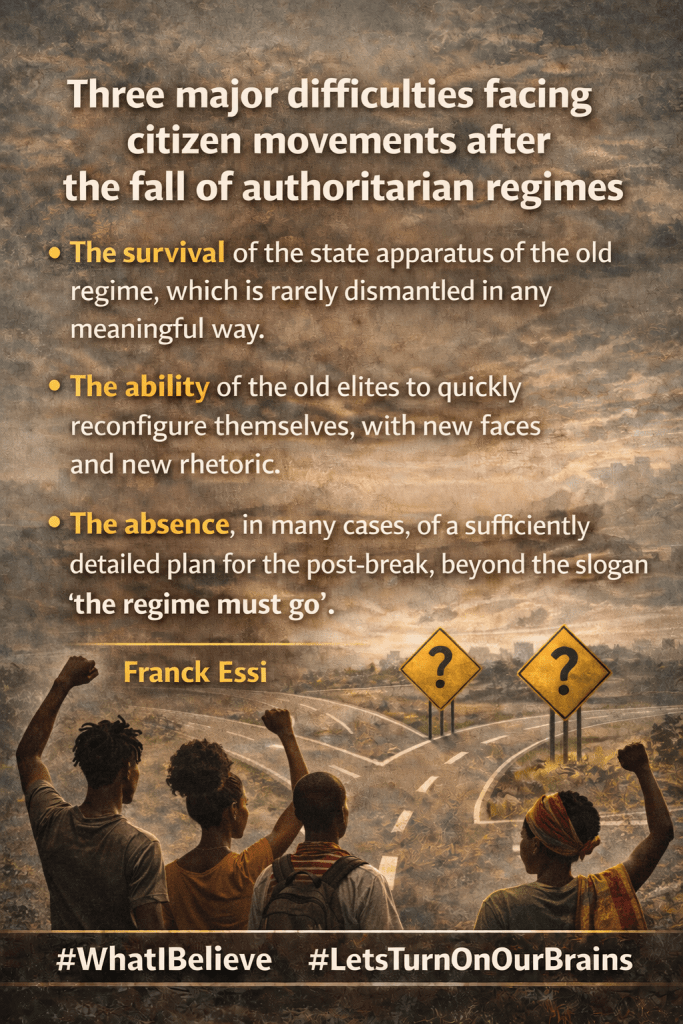
- The survival of the state apparatus of the old regime, which is rarely dismantled in any meaningful way.
- The ability of the old elites to quickly reconfigure themselves, with new faces and new rhetoric.
- The absence, in many cases, of a sufficiently detailed plan for the post-rupture period, beyond the slogan ‘the regime must go’.
It is from this constant that we must re-examine the major waves of recent transition.
—
II – The Arab Spring: founding act and lesson in reversibility
1. Egypt: rupture without dismantling the system
In Egypt, the 2011 uprising was a historic moment: a massive citizen mobilization overthrew a regime that was considered immovable. Expectations were immense: an end to authoritarianism, subordination of the army to civilian power, lasting democratic openness, social justice.
Very quickly, however, several major flaws appeared:
- The armed forces and security services were never truly reformed.
- The civilian forces that emerged from the mobilization fragmented, unable to produce a stable political coalition.
- The deep-rooted logic of the authoritarian state survived the fall of the leader, reconfiguring itself.
The transition led to an authoritarian restoration, in a renewed form but based on the same essential pillars. The gap is striking: while the citizen movements aimed for systemic transformation, the reality has been a reconcentration of power.
2. Tunisia: political openness without state transformation
Tunisia has long been presented as the positive exception of the Arab Spring. Real progress has been made there: constitutional process, political pluralism, expansion of civil liberties.
But this transition was based on a fragile balance. The state, in its deep structures, has not been transformed, and socio-economic expectations have remained largely unfulfilled. Gradually, mistrust of the political elite took hold, fuelled by the inefficiency of public action and the deterioration of living conditions.
This context paved the way for authoritarian recentralization, justified by the promise of ending the political and economic deadlock. Here again, the gap is clear: citizens aspired to a democracy capable of producing concrete results; they found themselves faced with a largely procedural democracy, powerless in the face of social emergencies.
—
III – Sudan: a civilian transition faced with the question of force
The 2019 Sudanese uprising is one of the most advanced examples of structured citizen mobilization. Resistance committees, professional organizations and civilian forces played a central role in the fall of a military regime that had been in place for decades.
The objectives were explicit:
- End military rule.
- Establish civilian rule.
- Launch a process of justice and state reconstruction.
But the transition was undermined by one decisive factor: the lack of effective civilian control over the armed forces. The coexistence of autonomous armed power centres, competition for resources and external interference gradually drained the transition of its substance, until it collapsed into war, making Sudan one of the world’s most serious humanitarian crises.
The gap here is tragic: the citizen movements aimed for a civilian state; the reality is the destruction of the state itself.
—
IV – The Sahel: a rupture confiscated in the name of sovereignty
In several Sahel countries, political ruptures were welcomed by a significant portion of the population, exhausted by the failure of civilian regimes to address insecurity and corruption. Weakened or marginalised citizen movements sometimes saw this as an opportunity for renewal.
The trajectory that followed is now well known:
- Indefinite prolongation of transitions.
- Gradual restriction of civil liberties.
- Marginalisation of citizen forces.
- Sustainable institutionalization of military power.
The discourse of sovereignty and ‘restoring order’ serves as a cover for a new form of power seizure. The gap is once again evident: where there were hopes for a popular rebuilding, a consolidated militarization of power is taking hold.
—
V – Madagascar: transition born of state failure
The case of Madagascar illustrates another configuration. Here, social mobilization is less the result of ideological conflict than of the collapse of the basic functions of the state: water and electricity shortages, deteriorating public services, and the perception of failed governance.
In the absence of a structured political outlet, this anger has created an institutional vacuum. The most organised actor – the military – has imposed itself as arbiter, ushering in a fragile and highly constrained transition.
Madagascar highlights several major risks:
- Confusion between rebuilding and simply suspending the constitutional order.
- The difficulty of quickly stabilizing the economy and essential services.
- Increased vulnerability to international pressure and conditionality.
Here again, the gap is clear: citizens were calling for a functional state; they ended up with a precarious military transition, exposed to multiple abuses.
—
VI – Lessons learned and concrete requirements for Cameroon
Cameroon has a distinctive feature: it has not yet undergone an open political transition, but it now has, before its eyes, all of the recent African experiences. This situation removes any excuse related to historical ignorance and, on the contrary, imposes increased strategic responsibility on the forces of change.
The lessons of these transitions allow us to identify several requirements for Cameroon.
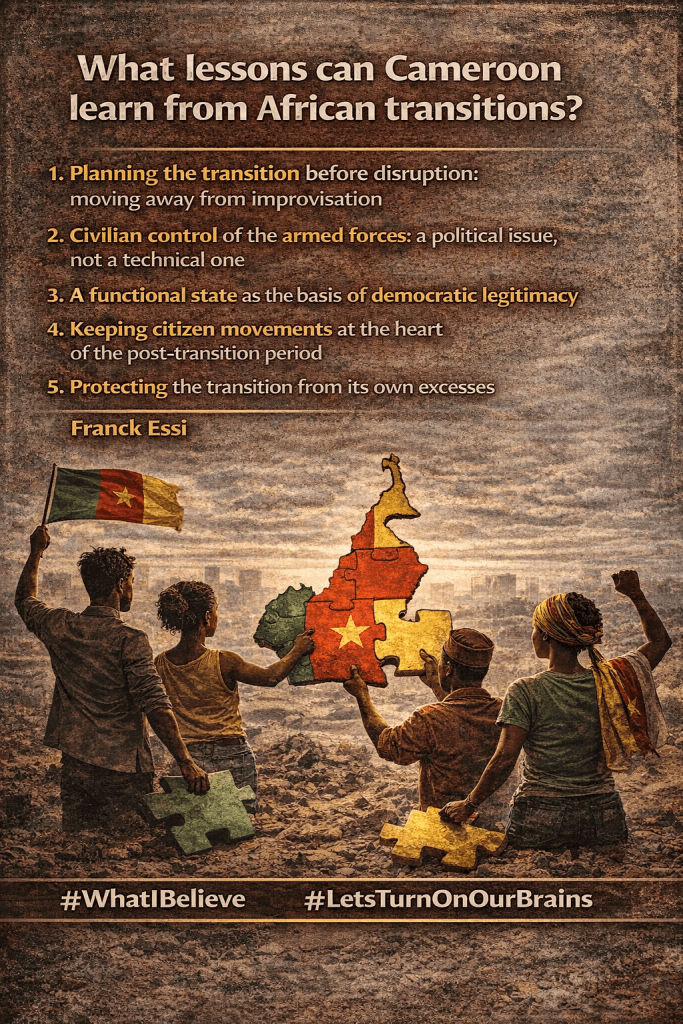
1. Think about the transition before the break: move away from improvisation
A common mistake has been to consider the transition as a ‘natural’ consequence of the fall of the regime, rather than a process to be anticipated, defined and structured.
In Cameroon, any serious dynamic of change must, even before it occurs:
- Define priority political objectives for the transition: institutional reform, rebalancing of powers, justice, overhaul of the security apparatus.
- Clearly define its duration, to avoid endless transitions that turn into new regimes.
- Identify the bodies responsible for steering the transition and the mechanisms for controlling them, in order to limit abuses.
Experience in the Sahel shows that the absence of a clear framework paves the way for the seizure of power, while the early years in Tunisia prove that relatively precise rules can, at least for a time, contain abuses. For Cameroon, the challenge is to avoid an improvised transition dictated exclusively by urgency and raw power relations.
2. Civilian control of the armed forces: a political, not a technical, issue
The case of Sudan has shown this in a dramatic way: the issue of control over the armed forces is central to any transition. As long as the security forces are not clearly subordinate to a legitimate civilian authority, the transition remains structurally unstable.
In Cameroon, this issue is particularly sensitive because of:
- The extreme centralization of security power.
- Persistent armed crises in certain regions.
- The historical role of the defense forces in preserving political order.
The experiences of Egypt and the Sahel show that if the army is not reformed, it tends to revert to being the ultimate arbiter of power. A transition that ignores this reality runs the risk of authoritarian restoration or lasting militarization.
This is not a question of demonizing the armed forces, but of recognizing that their role must be redefined politically at the outset of the transition, rather than postponed until later. The question is: how can this be achieved effectively and irreversibly?
3. A functional state as the basis of democratic legitimacy
Tunisia and Madagascar remind us of an essential lesson: democracy does not survive long after the failure of the state. When public services do not function, the economy deteriorates, and daily life becomes more difficult, popular support for the transition erodes very quickly.
In Cameroon, where social frustrations are already high, a transition that does not quickly deliver:
- A visible improvement in access to essential services.
- Clear signals of a fight against corruption.
- Minimal economic stabilisation,
would quickly be perceived as yet another disappointment, opening the door to authoritarian rhetoric about ‘restoring order’. The experiences of Tunisia and Madagascar show that people judge the transition first and foremost on its concrete effects, rather than on more abstract institutional reforms.
4. Keeping citizen movements at the heart of the post-transition period
A key lesson from these waves of transition is the rapid marginalization of citizen movements after the break. In Egypt, the Sahel and even Tunisia, the forces that drove the mobilization were sidelined in favor of better-organized political or military elites.
For Cameroon, this means that citizen movements must:
- Prepare to participate actively in steering the transition, rather than limiting themselves to the role of catalysts.
- Develop internal coordination and representation mechanisms in order to speak with an audible voice in the negotiating arena.
- Acquire expertise and capacity to monitor public policies in order to influence content and not just slogans.
Without this preparation, there is a high risk that the transition will be captured by a narrow coalition in the name of stability or efficiency.
5. Protect the transition from its own excesses
Finally, the experiences analyzed show that the transition must be protected not only from the old regime, but also from its own excesses.
For Cameroon, this means providing from the outset for:
- Mechanisms that make any authoritarian restoration very difficult.
- Safeguards against the militarization of power, even under the guise of security.
- Measures to limit the risks of institutional collapse (prolonged deadlocks, factional wars, paralysis of the state).
The cases of Sudan and the Sahel show that the absence of such safeguards turns the transition into an impasse, sometimes even a tragedy.
—
The great waves of transition in Africa have dispelled an illusion: that rupture alone is enough to produce democracy. Experience shows that the real challenge lies in the aftermath of the rupture, in the ability to build a more just, stable and legitimate political order.
For Cameroon, this lesson is decisive. All these experiences are now known. Almost all the mistakes have been documented. It is no longer a question of inventing something from scratch, but of drawing all the conclusions from what recent history has already shown.
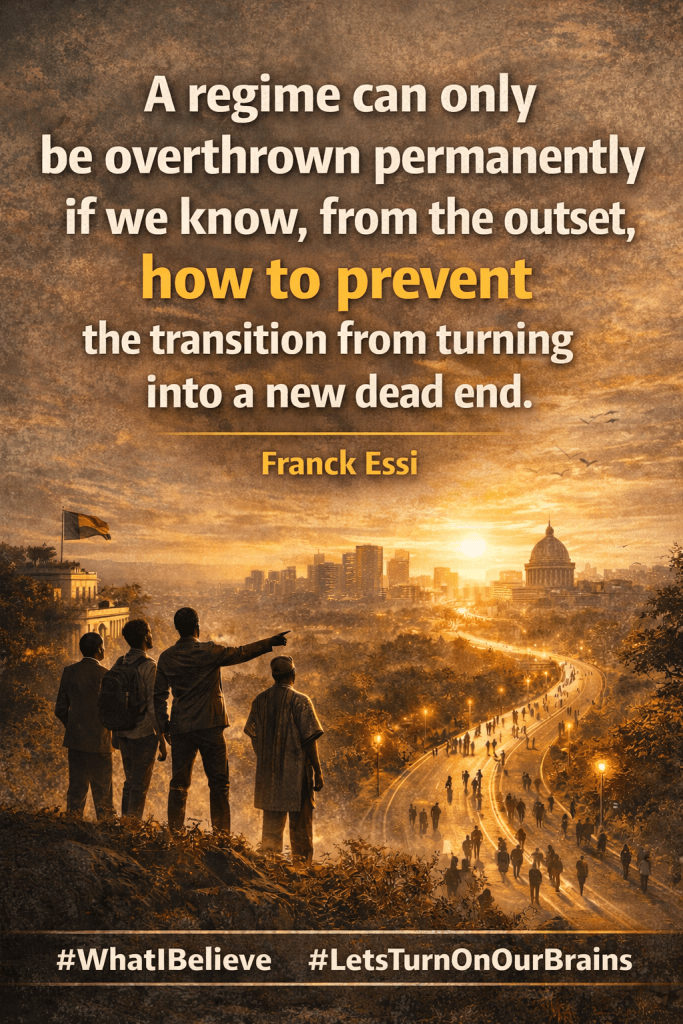
One thing is now certain: a regime can only be overthrown in a lasting way if we know, from the outset, how to prevent the transition from turning into a new impasse.
 franckessi.com