By Franck Essi
—
In so-called dominated countries, such as many African countries, we can observe at least three levels of consciousness, three types of mindset:
✔️ the dominated mindset
✔️ the rebellious mindset
✔️ the conquering mindset
These three postures summarize different ways of confronting the evils that afflict our societies and the relationship with Western countries, former colonizers often presented as their main source.
—
1) THE DOMINATED MINDSET
The dominated mindset mobilizes all its intelligence and resources merely to survive, while cursing the master who subjugates it.
At no point does it seriously consider rebellion.
At no point does it believe victory is possible.
Its intelligence and abilities are not put at the service of overturning the situation, changing the rules of the game, or inventing a future other than the one assigned by its oppressor. It internalizes the idea that the world is unjust and that it will forever remain on the side of the victims.
Steve Biko’s words apply perfectly here:
“The most potent weapon in the hands of the oppressor is the mind of the oppressed.”
Everything it does is first and foremost about survival. Its revenge is postponed to another world. Fortunately for it, this life offers other ways to dull the pain: God or the gods, football, beer, sex.
Its trademark lies in a few recurring phrases:
“What can we do?”
“There’s no point in…”
“Look for your share and keep quiet, my brother, my sister…”
“You think you’re going to change anything?”
“Don’t even try…”
—
2) THE REBELLIOUS MINDSET
The rebellious mindset is driven by anger — anger directed at the oppressor.
It seeks out, consumes, and circulates information that demonstrates the oppressor’s malevolence. Its intelligence and resources are mainly devoted to exposing plots, crimes, injustices, and humiliations.
It feeds daily on news of atrocities committed by its oppressor, to the point of devoting most of its thoughts, words, and actions to trying to destroy them.
Very often, this revolt remains confined to rhetoric and small-scale actions with limited impact.
For this mindset, well-being means the disappearance of the oppressor. Its only paradise is a world cleansed of them. It therefore defines itself fundamentally as oppressed, in permanent opposition.
Almost everything that happens is explained through the actions of the oppressor.
At times, it claims to be determined and ready for anything — until the day it realizes that the world is not as binary as it imagined. It begins to see that the oppressed can be willing, consenting, even complicit in their own chains.
It occasionally observes how a lack of analysis, knowledge, preparation, courage, and discipline explains many dead ends. Yet, because it does not know how to act concretely, it falls back into sterile denunciation.
Events change, the same dominating–dominated logics persist, the same criticisms are repeated. Nothing fundamentally changes.
Its cry of revolt eventually becomes a cry for nothing.
Yes, as Sankara rightly said, “only struggle liberates.”
But one must still know which struggle, and for what purpose.
Is it first about defeating the other, or about mastering oneself in order to confront external challenges more effectively?
The rebellious mindset has not always fully integrated that true emancipation also begins within.
It barks. The caravan moves on.
—
3) THE CONQUERING MINDSET
The conquering mindset is a mindset of struggle.
A struggle rooted in the memory of past battles, the injustices of the present — but above all in an unyielding will to win.
To overcome one’s fears, weaknesses, ignorance, inconsistency, lack of preparation, and inability to face the challenges of one’s time.
It is a mindset determined to assert itself fully, powerfully, and intelligently in the world. A mindset driven by an irrepressible aspiration to be, and by a formidable will to power.
It seeks mastery and sovereignty over itself and over its environment.
It refuses to choose between evil and the lesser evil.
It wants nothing less than the good.
It does not beg for justice — it fights for it. It does not deny the possible existence of God, of heaven or hell, but it works here and now to build its paradise and to thwart those who seek to prepare its hell.
It wants peace, but wages war against the enemies of its well-being.
It does not complain.
It knows that it owes its salvation only to itself.
It expects almost nothing from others.
It expects everything from itself.
Everything from itself.
For it, life without dignity is not life.
It is ready to pay the price.
It does not proclaim — it acts.
It does not promise — it builds.
It has its own codes, values, and objectives. It celebrates everything that makes it proud, free, strong, and fulfilled.
It is.
It unfolds.
Nothing stops it.
Neither defeat nor temporary victory defines it.
What defines it is the movement toward its ideal — an ideal conceived by and for itself.
It has made its own the words of Wole Soyinka:
“A tiger does not proclaim its tigritude: it leaps on its prey and devours it.”
—
Once this is said, only one question remains:
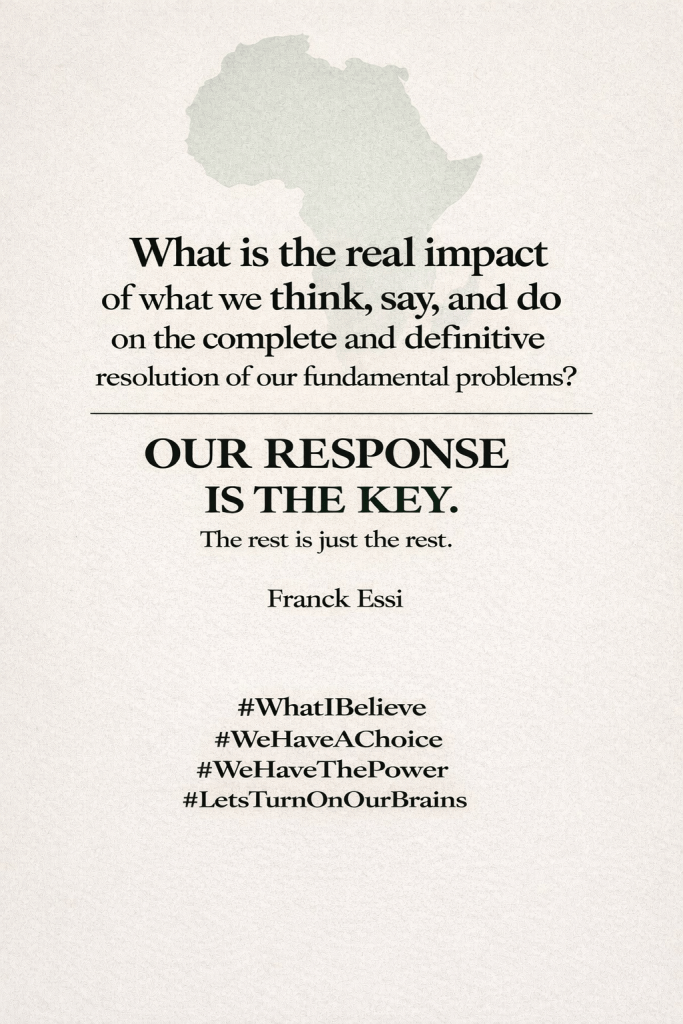
What is the real impact of what we think, say, and do on the complete and definitive resolution of our fundamental problems?
The rest is… the rest.
#WhatIBelieve
#WeHaveAChoice
#WeHaveThePower
#LetsTurnOnOurBrains
 franckessi.com