The Conquering Mindset as a Path to African Emancipation
By Franck Essi
—
In a previous piece entitled “The tiger does not proclaim its tigritude; it leaps on its prey and devours it,” drawing on a powerful intuition articulated by Wole Soyinka, we highlighted three major types of mindset found in contemporary African societies:
✔️ the dominated mindset,
✔️ the rebellious mindset,
✔️ the conquering mindset.
Three ways of thinking.
Three ways of responding to the world.
Three relationships to history, domination, and the self.
The first two help us understand why we stagnate.
Only one allows us to break free.
That is the one discussed here.
The one that clearly has our favor: the conquering mindset.
Africa will not emancipate itself through survival alone, nor through anger alone, but through mastery, discipline, and the conscious construction of its own power.
The real question, then, is how to develop this conquering mindset.
Below, I share—non-exhaustively—a number of key fronts on which this work must be undertaken.
—
The indispensable foundation: radical honesty with oneself
Before any strategy, any organization, and any action, the conquering mindset begins with a fundamental requirement: radical honesty with oneself.
It knows that no emancipation, no liberation, and no development can be built sustainably on lies, denial of reality, or the evasion of responsibility.
At the very core of the conquering mindset lies authenticity, radical honesty, and a constant quest for alignment between one’s life ideal, one’s thoughts, one’s words, and one’s actions.
This honesty is neither indulgent nor comfortable.
It serves a precise purpose: to develop responsibility, that is, the capacity to generate responses commensurate with the challenges one faces.
For as long as one refuses to lucidly acknowledge one’s share of responsibility, one condemns oneself to remain a prisoner of what one denounces.
Question to ask oneself:
Am I honest with myself about my responsibilities in what has happened to me, and about what I must concretely put in place to overcome it?
—
Breaking with survival as a horizon
The dominated mindset survives.
The conquering mindset lives.
Emancipation begins with a clear break from constant complaint, resignation disguised as wisdom, and fatalism presented as realism.
Complaining may bring relief.
But it does not liberate.
The African conquering mindset neither denies historical injustice nor the brutality of power relations.
It simply refuses to use them as excuses for immobility.
It grasps a simple yet unsettling truth:
as long as we speak more than we act, we remain governed.
Question to ask oneself:
What do I continue to tolerate or comment on today, when I could already begin to transform it through concrete action?
—
Stopping the oppressor from being the center of one’s life
The rebellious mindset remains trapped by what it fights.
It thinks the oppressor.
It speaks the oppressor.
It explains itself through the oppressor.
The conquering mindset breaks with this mental dependency.
It understands that whatever occupies your mind ultimately governs your life.
It does not deny global power relations.
But it refuses to make them the center of its imagination, its thoughts, and its actions.
It refocuses all its energy on one strategic question:
how can I become strong, coherent, and sovereign—here and now?
Question to ask oneself:
What decisive share of my time and intelligence is still being captured by what I oppose, instead of being invested in what I urgently need to build?
—
Putting an end to the savior illusion
No people has ever liberated itself by waiting.
No messiah.
No providential leader.
No external miracle.
Waiting is a sophisticated form of renunciation.
The African conquering mindset assumes radical responsibility:
if we do not act, nothing will change.
It does not beg for permission or recognition.
It starts where it is, with what it has.
Question to ask oneself:
If nothing changes in five or ten years, what will my personal share of responsibility in that inertia be?
—
Forging oneself through the discipline of tigritude
Tigritude is not a posture.
It is a discipline.
First, an intellectual discipline.
Rejecting the confusion between information and understanding. Reading, learning, comparing. Distinguishing moral indignation from strategic effectiveness.
Then, a moral discipline.
Refusing to win by losing oneself. Setting clear limits. Refusing to reproduce tomorrow what one fights today.
Also, an emotional discipline.
Not denying anger, but governing it. Transforming raw emotion into strategic clarity.
Finally, a discipline of action.
Acting without waiting for perfection. Moving forward, adjusting, correcting. Understanding that inaction always costs more than a managed mistake.
Question to ask oneself:
Which discipline have I neglected for too long, and what concrete decision must I make today in order to stop postponing the necessary effort?
—
Setting a course before setting out
There are no favorable winds for one who has no course.
There are no opposing winds for one who does.
Those who fail to plan plan to fail.
The plan is the antidote to randomness.
Clear vision.
Lucid strategy.
Precise sequencing of actions.
Without a plan, energy disperses.
With a plan, even limited means become formidable.
Question to ask oneself:
Am I able to clearly explain where I am going, how I intend to get there, and what I am prepared to sacrifice to achieve it?
—
Building before confronting
The conquering mindset does not begin with attack.
It builds.
Skills.
Organizations.
Alternatives.
Networks.
It understands that what is solidly built weakens the dominant order more surely than a thousand denunciations.
Question to ask oneself:
What am I building today that could still stand even if my anger or enthusiasm were to fade?
—
Inscribing oneself in a lineage of rupture
No conquering mindset is born in a vacuum.
To emancipate oneself does not mean starting from scratch.
It means consciously inscribing oneself within a lineage.
The African conquering mindset connects with those who dared to break, to think differently, and to act despite the price to be paid.
It does not idolize them.
It extends their movement.
It ensures that it is a worthy continuator of the Ancestors of the Future who came before.
Question to ask oneself:
What legacy am I truly transforming into action, rather than merely admiring through words?
—
From individual tigritude to collective endeavor
Owning one’s tigritude does not mean walking alone.
No single hand can tie a bundle.
Individual sovereignty only has meaning if it nourishes collective sovereignty.
The conquering mindset surrounds itself with demanding minds, avoids circles of lamentation, learns, transmits, trains, and uplifts.
Question to ask oneself:
With whom am I building something greater than myself, and what am I ready to pass on starting now?
—
The horizon as the only limit
The conquering mindset is engaged in continuous evolution.
This evolution has neither endpoint nor finality.
It understands that life is an infinite game, whose challenge is to ever more fully embody one’s ideal.
It is deeply concerned with the continuous transformation of its being and its environment.
It learns from everything, from everyone, beginning with a demanding reflection on its own experiences.
It knows that those who fail to learn from past mistakes condemn themselves to repeat them.
It has understood that the burden of every individual and every people is to resemble what is best in this world.
It lives by this conviction:
what the mind can conceive, it can achieve.
Its deepest wish is clear:
to transform a character of lead into a personality of gold.
—
My deepest conviction
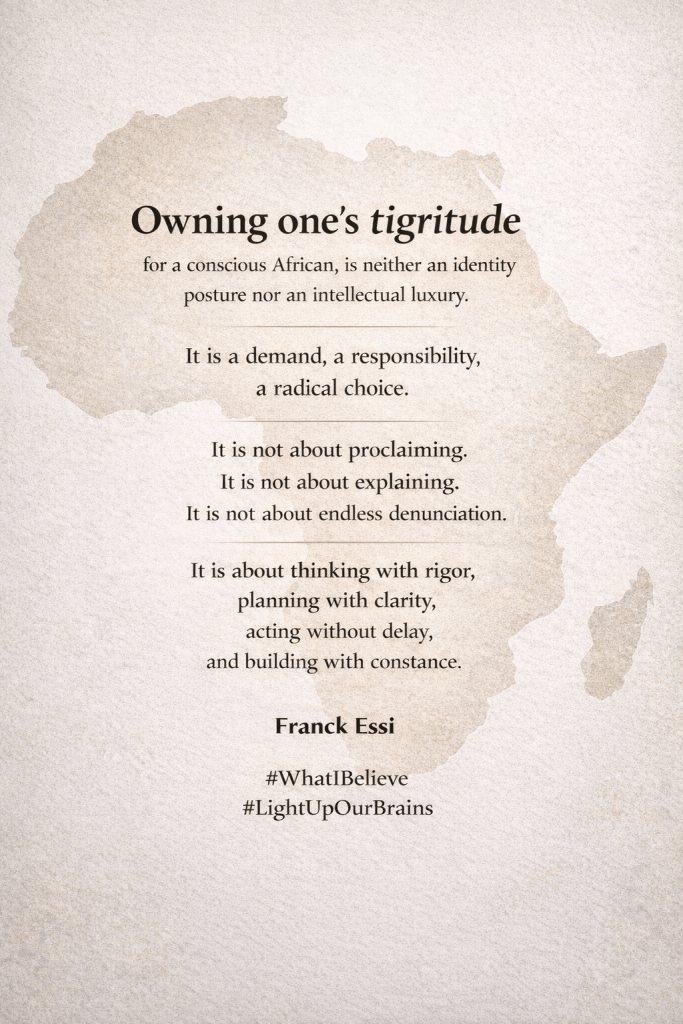
Owning one’s tigritude, for a conscious African, is neither an identity posture nor an intellectual luxury.
It is a demand, a responsibility, a radical choice.
It is not about proclaiming.
It is not about explaining.
It is not about endless denunciation.
It is about thinking with rigor, planning with clarity, acting without delay, and building with constancy.
The conquering mindset does not promise.
It advances.
It knows that dignity is not claimed.
It is conquered.
And it is on this condition—and on this condition alone—that Africa will stop commenting on its destiny and finally begin to shape it.
The rest is… the rest.
Read more reflections here:
👉 https://franckessi.com/
#WhatIBelieve
#WeHaveAChoice
#WeHaveThePower
#LightUpOurBrains
 franckessi.com