Thirty Years of Constitutional Revision: Democracy Promised, Power Confiscated
By Franck Essi
—
In the mid-1990s, under the combined pressure of African popular mobilizations and an international climate now favorable to liberal democracy, Cameroon embarked on a reform of its political order. The return to multipartyism, the recognition of freedoms of association, and the relative opening of the public space were the first visible signs of this mutation.
The Constitution of January 18, 1996, was to constitute its legal and symbolic culmination: a new pact between the State and citizens, founded on the balance of powers, decentralization, limitation of executive power, popular sovereignty, and the harmonious recognition of the country’s dual political, legal, and cultural identity — Anglophone and Francophone.
Thirty years later, the assessment is severe. The promises contained in this text appear largely unfulfilled. The democratic seeds it carried have remained, for the most part, stillborn.
What has gradually been put in place is not a democratic transition, but a form of authoritarian constitutionalism: a system that borrows the language and forms of constitutional democracy, while organizing, in practice, the methodical neutralization of counterpowers. The non-implementation, effective and timely, of decentralization — though conceived as an accelerator of development — and the non-balanced application of our dual identity — Anglophone and Francophone — have generated unprecedented politico-security crises, the effects of which now fracture the national pact itself.
Cameroon has thus experienced a creeping conservative revolution: institutional reforms in appearance, but preservation in depth of power relations. Multipartyism has become institutional window-dressing, without real hold on the political, economic, social, and identity dynamics that structure the country.
These thirty years of selective — or assumed non- — application of the Constitution have been marked by several heavy dynamics: the growing concentration of presidential power; the instrumentalization of law for political ends; the partial and delayed implementation of institutions provided for in the fundamental text; the normalization of the security exception; the progressive weakening of citizenship; and, now, an unprecedented national fragmentation.
It is in light of these dynamics that we must examine what the great constitutional promises of 1996 have become in practice.
—
The End of Term Limits: Constitutional Confiscation of Power
(Article 6, paragraph 2)
The 2008 constitutional revision constitutes a major turning point. The 1996 Constitution provided for a presidential term of seven years, renewable only once. By removing this limit, the 2008 revision eliminated one of the main safeguards won by the democratic struggles of the 1990s: the idea that alternation is not an accident, but a structuring principle of political life.
Henceforth, the presidential term is simply « renewable, » opening the way to an indefinite presidency. The lock is no longer juridical; it becomes purely political, in a system where all institutional levers are already concentrated in the hands of the executive.
Since then, the electoral contests of 2011, 2018, and 2025 have taken place in a profoundly unbalanced institutional framework: absence of credible electoral reform, electoral administration under political control, restriction of public freedoms, judicialization of political competition.
Official discourse invokes popular sovereignty. But how can one speak of free choice when the very conditions of choice are structurally distorted? The removal of term limits did not broaden democracy; it consecrated a regime of election without alternation, where the ballot serves as periodic window-dressing for personal power.
This change has gone, in the conventional phrase, in the wrong direction of History.
—
Perpetual Immunity: Constitutionalized Irresponsibility
(Article 53)
The same 2008 revision consolidated a second lock: the quasi-total political irresponsibility of the head of state for acts committed in the exercise of his functions.
Formally, the Constitution provides that the President of the Republic may be brought before the High Court of Justice for high treason and certain crimes. In appearance, this is therefore not absolute immunity, but framed responsibility.
In reality, this mechanism is inoperative. The High Court of Justice, though provided for by the Constitution, remains a ghost institution, indefinitely postponed to the Greek calends. No concrete political device allows for a genuine trial of the head of state or his inner circle.
In a country marked by the explosion of financial scandals, the regular imprisonment of senior officials, and the normalization of embezzlement of public funds, this de facto irresponsibility appears as insurance against any future accountability.
Two popular proverbs illuminate this political reality:
« Live by the sword, die by the sword »;
« Birds of a feather flock together. »
To escape this logic of historical responsibility, power has equipped itself with a constitutional shield. Thus emerges a monarchical conception of power: outside power, no salvation; outside immunity, no security.
—
The Senate and Inverted Decentralization
(Articles 55 to 62)
The 1996 Constitution had enshrined decentralization as a fundamental principle of state organization. It could be conceived as a house:
- decentralized communes constitute its foundations;
- regions are its walls;
- the Senate is its roof.
Yet in Cameroon, the roof was installed before the walls were erected and the foundations were consolidated. The Senate was installed in 2013, while regions were not yet functional and communes had neither real competencies nor adequate resources.
Worse still, senators were elected by an electoral college composed of municipal councilors whose political legitimacy was already exhausted, in a context where electoral participation is structurally low and competition locked. Decentralization was thus built on a legally legitimate but politically illegitimate basis.
Only in 2020, under the combined pressure of the Anglophone crisis and international injunctions, were regions established, twenty-four years after the Constitution. But these new institutions remain under tight supervision of the central state, deprived of significant autonomy, particularly in fiscal matters.
By constantly postponing decentralization, power has delayed one of the major levers of economic and social development. Proximity in decision-making, accountability of local actors, adaptation of policies to territorial realities have remained slogans. The result is twofold: a country administered in a centralized and inefficient manner, and local frustrations that transform into political anger.
The decentralization inscribed in the text has mutated, in practice, into simple bureaucratic deconcentration. Offices are moved, not power. And in so doing, an essential engine of balanced territorial development is blocked.
—
The Endless Saga of Asset Declaration
(Article 66)
Since 1982, official discourse has promised rigor and moralization of public life. The 1996 Constitution gave these promises clear legal translation: Article 66, which imposes asset declaration on public officials.
An organic law was indeed adopted to specify implementation modalities. On paper, the instruments exist. In reality, the obligation remains largely theoretical. The vast majority of officials subject to this constraint do not comply with the law, without any political or judicial consequence.
Instead, a pileup of institutions has emerged: National Anti-Corruption Commission (CONAC), National Financial Investigation Agency (ANIF), Special Criminal Court, Court of Auditors. Mechanisms multiply, reports accumulate, but corruption persists. Official reports themselves testify to this, as do international rankings.
Why not apply a simple, clear, and preventive measure?
Why refuse transparency on the enrichment of rulers?
The answer is political: the fight against corruption is proclaimed but rarely practiced. As the popular image says, a wolf may wear feathers, but it will never become a chicken.
—
The Constitutional Council: Guardian of the Text, Guarantor of the Status Quo
(Article 46)
Inscribed in the 1996 Constitution, the Constitutional Council was only installed in 2018. Twenty-two years of delay to put in place the body responsible for ensuring the supremacy of the fundamental law: this delay alone says something about the real place accorded to constitutional review in the architecture of power.
Since its installation, the Constitutional Council has become a central actor in electoral disputes. It holds in its hands the validation or invalidation of results, the supreme arbitration of claims, the official reading of popular will.
But far from embodying a counterpower, it has asserted itself as an instrument of status quo validation. Its successive decisions, in 2018 as in 2025, have systematically upheld the results proclaimed by the executive, despite numerous proofs of irregularities and reasoned challenges from opposition and civil society.
Thus, even mechanisms meant to protect the Constitution now participate in its instrumentalization: the form of law is respected, the spirit of the text is diverted.
—
The Permanent State of Exception: The Constitution Suspended
Since 2016, the crisis in the Anglophone regions has brought Cameroon into a new phase: that of the generalization of the security exception.
Mass arrests, civilians tried by military tribunals, restrictions on public freedoms, Internet shutdowns, militarization of daily life: so many practices that have progressively relegated the Constitution to the background, far beyond the conflict regions themselves.
Admittedly, the instrumentalization of security is not new. But what has been established during this decade is the normalization of the exception: the idea that the security threat — real, serious — justifies the durable suspension of rights, rather than the demand to restore the rule of law as a condition for security itself.
At the heart of this crisis, a fundamental dimension of the Constitution has been betrayed: the recognition of Cameroon’s dual Anglophone and Francophone identity as a richness to protect and organize. Instead of managing this duality through dialogue, respect for legal, educational, and administrative specificities, power opted for force, centralization, and assimilation. The consequence is an unprecedented politico-security crisis, lasting more than ten years, which has deeply damaged the bond of trust between part of the country and the central state.
Here again, the Constitution is invoked, bypassed, redefined according to the needs of the moment through decrees and emergency laws. It becomes a text that is taken out or put away as needed.
—
Thirty Years of Conservative Revolution
Four heavy trends emerge from these thirty years of constitutional life.
The first is that of a permanent conservative revolution. Each institutional reform is designed not to transform the system, but to preserve it. Texts are changed so that the regime remains, fundamentally, the same. The 2008 revision is its most brutal illustration: a use of derived constituent power to lock down constituted power.
The second is extreme concentration of power. The executive dominates the legislature, a large part of which is merely a transmission belt. The judiciary remains dependent, through appointments, careers, direct and indirect pressures. Institutional counterpowers — Constitutional Council, Court of Auditors, control institutions — are integrated into the architecture of domination rather than opposed to it.
The third is the weakening of citizenship. The people are reduced to an intermittent electoral role, without real capacity to control rulers between elections. Civic education is perverted, media are controlled, opposition is criminalized, unions and associations are monitored or co-opted. Popular sovereignty, proclaimed in the preamble, is progressively emptied of its substance.
The fourth trend is that of a country more divided than ever. The non-implementation, effective and timely, of decentralization — which could have corrected territorial imbalances and given concrete content to local development — has allowed a sense of abandonment and injustice to settle in many areas. The non-balanced application of our dual Anglophone and Francophone identity has transformed a historical richness into a political fracture. The politico-security crises that simmer or explode for more than ten years, in the North as in the West, in cities as in rural areas, are the symptom of a country that has never truly assumed its pluralism, neither territorial nor identity-based.
At the heart of this system, the Constitution plays a paradoxical role. It is not only ignored; it is performed against itself. One governs in the name of the Constitution, while organizing, through laws, administrative practices, and judicial decisions, the systematic distancing of its founding principles — including those that guarantee equality of citizens before the state, whatever their region, language, or legal heritage.
—
From Confiscated Constitution to Necessary Refoundation
The 1996 Constitution did not fail by accident. It was progressively emptied of its spirit by selective, calculated, politicized application of its provisions. Cameroon does not suffer from a lack of texts, but from a strategic use of law as an instrument of power conservation.
Therefore, it is no longer a matter of merely correcting a few isolated articles. Technical tweaks will not suffice. It is the political pact itself that must be rebuilt, within the framework of a refounding democratic transition, based on:
- effective limitation of power, through a return to genuine term limits and an end to de facto lifelong presidency;
- real accountability of rulers, through activation of mechanisms of accountability (High Court of Justice, Article 66, independent justice);
- real institutional balance, through guaranteeing judicial independence, autonomy of electoral management bodies, genuine decentralization with resources and competencies;
- popular sovereignty, through protection of public freedoms, securing political participation, and popular control of elected officials;
- assumed and institutionalized recognition of our dual Anglophone and Francophone identity, not as a threat to neutralize, but as a foundation from which to refound national unity on justice, respect, and equality.
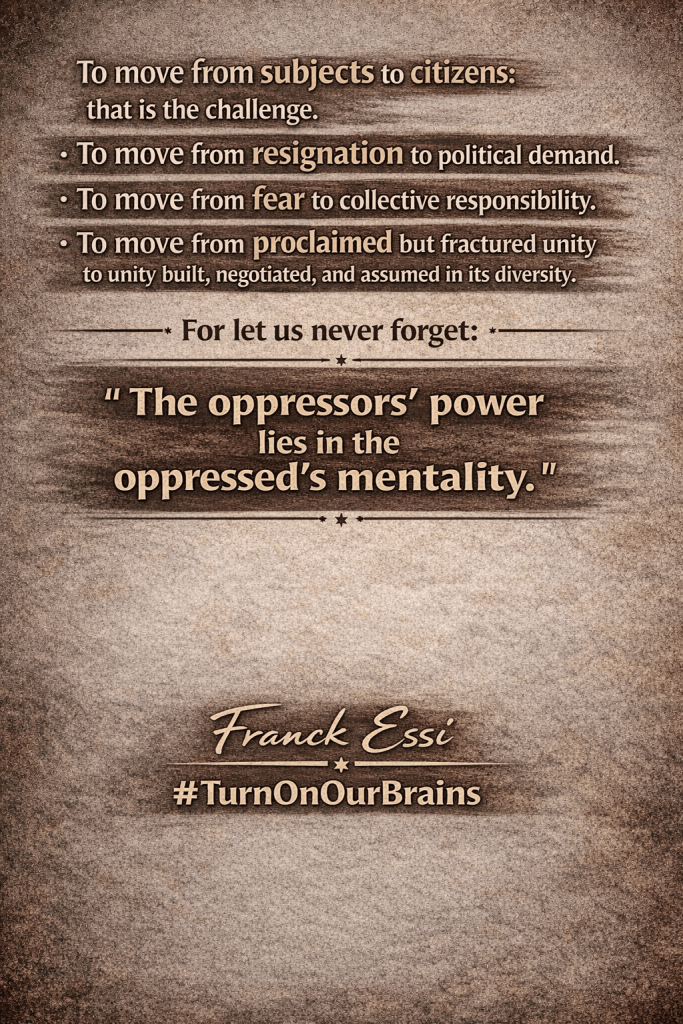
To move from subjects to citizens: that is the challenge.
To move from resignation to political demand.
To move from fear to collective responsibility.
To move from proclaimed but fractured unity to unity built, negotiated, and assumed in its diversity.
For let us never forget:
The oppressors’ power lies in the oppressed’s mentality.
The entire challenge of the coming years will be to break this mentality, so that the Constitution ceases to be a confiscated text and finally becomes what it should have been from 1996: the living expression of a people that governs itself, in all its regions, in all its languages, in all its diversity.
#TurnOnOurBrains
 franckessi.com