By Franck Essi
—
Preliminary note
The ideas presented in this text are my own and are strictly personal. They reflect my current views and ongoing reflections, which are likely to evolve as the debate and experiences progress. They do not in any way represent the official positions of the organisations of which I am a member, notably the Cameroon People’s Party (CPP) and Stand Up For Cameroon (SUFC). This text aims above all to provide, from my own perspective, an overview of the possible content and method of rewriting the Constitution in the context of a democratic and refoundational transition.
—
Introduction: from diagnosis to architecture
A few days ago, I proposed an assessment of the thirty years of ‘constitutional revision’ initiated by the text of 18 January 1996 (https://franckessi.com/2026/01/26/january-18-1996-january-18-2026/) . In it, I described, without mincing words, the gradual shift towards authoritarian constitutionalism: the forms of democracy, but the methodical neutralisation of countervailing powers; the text as a showcase, and practice as confiscation; the promise as a backdrop, and reality as a lock.
This new article is a continuation of that diagnosis — but with a different intention.
The aim here is to make a positive, concrete contribution that is as precise as possible: a constitutional architecture that could structure a democratic and transformative political transition in Cameroon. It is not a question of writing the Constitution, but of proposing axes, blocks, mechanisms. A compass. A foundation.
And I assume one fact: some of the ideas presented here are inspired by proposals put forward for years by Kah Walla, the Cameroon People’s Party (CPP) and Stand Up For Cameroon (SUFC), which have formulated clear institutional reforms on the executive, the electoral system, rights and decentralisation. This text offers a personal perspective and is solely my own.
—
1. The starting point: a constitution is not a text, it is an organised — and binding — promise
We have lived too long under the following illusion: ‘if the text is good, the country will be well governed’. The Cameroonian experience shows the opposite: a text can be relatively ambitious and remain permanently inoperative when the political system is designed to prevent its implementation.
Article 55 of the 1996 Constitution perfectly illustrates this betrayal: it provides for decentralisation, but refers the essentials to « the law « . As a result, the 2004 law was only truly implemented from 2019 onwards, and in a truncated form, with several circumvention mechanisms remaining in place. Twenty-three years of waiting for an application that was contrary to the spirit of the text.
This is one of the central conclusions of the 1996-2026 review: selective application, delayed institutions, neutralised counter-powers, trivialised security exceptions, weakened citizenship. And, more profoundly, a country where justice is perceived as the exception, not the rule; where too many decisions are made without transparency, accountability or concern for fairness.
Therefore, rewriting the Constitution must not be a literary exercise, nor just another ‘reform’. It must be a complete overhaul:
· Overhaul of the rules of power: who decides, how, under what controls and with what sanctions.
· Overhaul of the rules of trust: how citizens protect their rights and punish abuse without having to beg.
· Re-founding the rules of proximity: where does public money go, who manages it, how close to whom, with what capacity for action.
· Re-founding the common narrative: who we are, what we want to become, and how we embrace our differences without turning them into pretexts for domination.
In other words, a Constitution that organises not only powers, but also justice — as a principle for the distribution of rights, resources and responsibilities.
This is where my current position lies: the new Constitution must be a Constitution of Justice, Dignity and Unity in Diversity.
—
2. Founding values: Justice — Dignity — Unity in Diversity
The current motto — Peace, Work, Fatherland — has shaped the official imagination. But recent history has shown that peace without justice can be imposed silence, work without dignity can be organised survival, and homeland without equity can become private property.
I propose that the new Constitution enshrine, in Chapter I of the founding provisions, a set of explicit values that are not merely decorative, but interpretative and binding:
The Republic of Cameroon is a sovereign, democratic and social state, founded on the following values:
a) human dignity, equal rights and the advancement of fundamental freedoms;
b) justice as a requirement for fair treatment, equal access to the law and effective redress for harm;
c) unity in diversity, respecting linguistic, cultural and religious pluralism as a national asset;
d) the primacy of the Constitution and the rule of law;
e) universal suffrage, free and transparent elections, and full multipartyism.
This choice is inspired by constitutions that have made dignity, equality and fundamental rights interpretative founding values, rather than mere slogans. Justice is seen as the cornerstone: without it, neither freedom nor peace can endure; without it, unity becomes an empty injunction.
These values must then permeate the various blocks: independence of the judiciary, territorial equity, real equality, guaranteed public services, enforceable rights, mechanisms for redress and a culture of accountability.
—
3. Eight blocks for a new constitution
I propose structuring the discussion around eight blocks, each answering a simple question, in order to avoid the labyrinthine constitutions that are cited when they are convenient and forgotten when they are inconvenient.
—-
Block 1 — Popular sovereignty: from slogan to mechanisms
Question: who holds power?
Answer: the people, but through concrete mechanisms, not incantations.
To move from proclaimed sovereignty to exercised sovereignty, tools for control and participation are needed:
Citizen-initiated referendum (RIC) framework
· Threshold: 3% of the electorate for a legislative or repeal initiative; 5% for a constitutional initiative.
· Deadline: 18 months to collect signatures.
· Prior control: examination of conformity by the Constitutional Court before any vote (compliance with the Constitution and international law).
· Excluded areas: annual budget, treaties in force, intangible provisions.
· Quorum: 40% participation to validate a popular initiative referendum.
The idea is not to govern by permanent referendum, but to give the people exceptional leverage when institutions become entrenched.
Right of petition triggering mandatory parliamentary debate
Any petition gathering 100,000 signatures from voters requires a public debate within 90 days, with a reasoned response.
This is a way of transforming widespread indignation into structured questioning.
Mandatory institutional transparency
· Publication of parliamentary votes by name.
· Online publication of budgets and annual reports (in an understandable and technical format).
· Full publication of high court decisions within 30 days.
Here, justice is not just a result, it is also a method: making decisions taken on our behalf visible.
Constitutional protection for whistleblowers and journalism in the public interest
· Criminal immunity for whistleblowers acting in good faith on matters of public interest.
· Protection against dismissal and administrative reprisals.
· Protection of journalistic sources, except in limited cases (international crimes, terrorism) subject to a reasoned judicial decision.
—-
Block 2 — Limited executive: putting an end to the republican monarch
The question of the regime (presidential, semi-presidential, parliamentary) is not a doctrinal dispute; it determines the system’s ability to resist the personalisation of power. A culture of justice cannot be built within an architecture that mechanically produces unchallenged strongmen.
Proposed choice: a mitigated presidential system, with a technical Prime Minister, clearly distinct from ambiguous semi-presidentialism.
Strict limitation of presidential terms
· Duration: 5 years, renewable once.
· Intangibility clause: no revision may remove or relax this limit (see Block 8).
· Accounting: any term of office begun counts, regardless of the constitution in force at the time.
This is a way of enshrining in law the idea that power is a service of limited duration, not a lifelong career.
Rebalancing of executive and legislative powers
· Prime Minister appointed by the President, responsible for government coordination.
· Appointments to key ministries (Defence, Interior, Justice, Finance, Foreign Affairs) subject to confirmation by the Assembly by simple majority.
· Prime Minister may be dismissed freely, but after three dismissals in the same term, the fourth appointment requires a two-thirds vote of confidence from the Assembly: anti-disposable government mechanism.
· Regulatory power reserved for the President for defence and diplomacy; the rest is reserved for the government.
Regulated dissolution
· Dissolution is possible during a term of office, but only in the event of a clear institutional crisis (e.g. three motions of no confidence adopted in 12 months).
· Advisory, but public, opinion of the Prime Minister, the presidents of both chambers and the Constitutional Court.
· Prohibition on dissolution during the first and last years of the presidential term.
Strictly limited states of emergency
· Initial duration of 15 days, renewable once by decree; beyond that, parliamentary authorisation by a two-thirds majority.
· Proportionality review by the Constitutional Court, which may be referred to by one-tenth of parliamentarians.
· List of rights that remain inviolable even in a state of emergency: right to life, prohibition of torture, habeas corpus, right to a fair trial.
—-
Block 3 — Independent constitutional justice: the Constitution as a weapon for citizens
The aim is to transform the Constitutional Council into a genuine Constitutional Court, independent and accessible, which protects the constitutional promise rather than the regime.
Composition and appointment
· 11 judges, single 12-year term, one third renewed every 4 years.
· Appointment on the recommendation of a selection committee (judges, lawyers, academics, civil society, parliamentarians), then a 3/5 vote by Parliament in joint session.
· Strict incompatibilities: no recent partisan or governmental functions, no direct family ties to the highest executive authorities.
Jurisdiction and referral
· A priori review of laws (mandatory for organic laws), a posteriori review by Priority Preliminary Ruling on Constitutionality (QPC).
· National electoral disputes, arbitration of conflicts of jurisdiction between the State and the Regions.
· Referrals may be made by: the President, the Prime Minister, the presidents of both chambers, one-tenth of MPs or senators, the Defender of Rights, and by any litigant via QPC.
QPC: a real citizen mechanism
· Any litigant may raise the unconstitutionality of a law applicable to their dispute.
· Double filter (court of first instance then Supreme Court/Council of State) within strict time limits, referral to the Constitutional Court if the question is serious and new.
· Decision deadline: 3 months.
· Automatic and general repeal of the law deemed contrary to the Constitution.
Transparency and education
· Reasoned decisions, published in full in both official languages.
· Public annual report, debated in Parliament.
—-
Block 4 — Credible electoral system: without truth at the ballot box, there can be no lasting peace
The Constitution must establish the principles and safeguards, and refer the technical details to the electoral code.
Independent electoral body: a constitutional CENI
· 15 members from the judiciary, civil society, political parties, religious denominations and professional associations.
· Appointment by two-thirds of Parliament, non-renewable term of office, dismissal only for serious misconduct by decision of the Constitutional Court.
· Guaranteed autonomous budget (minimum percentage of the national budget, non-compressible during the financial year).
Constitutionalised electoral principles
· Transparency of the electoral register: online publication, possibility of challenge.
· Publication of results polling station by polling station, scanning of reports accessible to all.
· Equal access to public media and strict regulation of political financing.
· Accessible litigation: any voter at a polling station can challenge the results before a judge within a short period of time, with an accelerated procedure.
Two-round presidential election
· Absolute majority required, otherwise a second round between the top two candidates.
· Possible minimum participation clause to avoid purely legal but politically unstable legitimacy.
The technical elements (single ballot, counting rules, campaign procedures) are governed by an organic law adopted by a qualified majority.
—-
Block 5 — Territorial organisation: real autonomy, response to the Anglophone crisis
We must stop treating the ‘decentralisation vs federalism’ debate as a war of words. It is a structural choice.
Proposal: advanced asymmetrical regionalism, quasi-federal, with enhanced status for the Anglophone regions.
Constitutional existence of the 10 regions
· The 10 current regions are enshrined in the Constitution.
· None can be abolished or merged without a constitutional revision by referendum.
Exclusive regional powers
Basic education, primary health care, local economic development, land use planning, regional roads, agriculture and rural development, water and sanitation, culture and languages, community policing.
Shared powers (environment, tourism, community policing) and powers exclusive to the State (defence, diplomacy, currency, higher justice) are clearly defined.
Budgetary and fiscal autonomy
· Regional own revenue (property tax, business tax, vehicle tax, local fees, share of VAT).
· State transfers: at least 45% of net tax revenue redistributed to the regions according to an equalisation formula (population, level of development, area, tax effort).
Elected regional institutions
· Regional assemblies elected by proportional representation for five years.
· Governors elected by the regional assemblies, with a renewable term of office.
· Power to legislate in areas of exclusive competence.
Asymmetric status for English-speaking regions
· English as the exclusive official language of the regional administration.
· Education and judicial systems aligned with common law.
· Enhanced powers in the areas of culture, education and local justice.
· Guarantee of minimum national representation.
Interregional solidarity
· National equalisation fund to correct development inequalities.
· Specific contributions from economically advantaged regions (ports, resources) to finance disadvantaged regions.
—-
Block 6 — Effective fundamental rights: from principles to remedies
The key is this: a right without remedy or sanction is an empty promise.
Effective habeas corpus
· Maximum period of 48 hours for presentation to a magistrate.
· Any detention beyond this period without a reasoned judicial decision is declared arbitrary, with automatic compensation (lump sum per day) and personal criminal proceedings against the responsible officer.
· Creation of a specific offence of ‘arbitrary detention by a public official’.
Independent Ombudsman
· Appointed by two-thirds of Parliament, single seven-year term, guaranteed constitutional budget.
· Power to investigate, issue injunctions and refer cases directly to the administrative court in the event of non-compliance with his recommendations.
· Annual reports must be debated in Parliament.
Freedom to demonstrate under a declaration system
· 72-hour prior declaration (24 hours in case of emergency).
· Prohibition possible only after validation by a judge in summary proceedings within a very short time frame.
· Criminal sanctions against authorities who repress a demonstration deemed legal.
· Strict supervision of the use of force.
Socio-economic rights: progressive justiciability
· Recognition of rights to water, health, basic education and decent housing.
· Obligation for the State to take ‘reasonable’ measures to ensure their progressive realisation.
· Annual reports on the development of these rights; possibility of recourse in the event of inaction or manifest regression.
—-
Block 7 — Economic sovereignty and the fight against corruption
A modern constitution cannot ignore economic issues, at the risk of leaving essential matters outside democratic control.
Transparency of natural resources
· Mandatory publication of all oil, mining, gas and forestry contracts.
· Constitutional adherence to EITI standards.
Sovereign natural resource fund
· Fund financed by a fixed share (e.g. 30%) of extractive revenues.
· Mixed governance (State, producing regions, independent experts, civil society).
· Strict rules on deposits and withdrawals, with the following objectives: budget stabilisation, investment, intergenerational savings.
Constitutional anti-corruption commission
· Independent body, members appointed by two-thirds of Parliament.
· Power of investigation and criminal prosecution.
· Mandatory and public declaration of assets for all senior public officials, with heavy penalties for false declarations or unjustified enrichment.
Principle of fair and progressive taxation
· Inclusion of the principle of progressive taxation.
· Regulation of derogatory regimes (loopholes, exemptions) by objectives of general interest, assessed regularly.
—-
Block 8 — Revision, transition and intangibility: protecting the refoundation
Without protections, the refoundation would be easily reversible.
Three levels of revision
· Ordinary revision: qualified majority of both chambers.
· Substantial revision: qualified majority + mandatory referendum.
· Intangible core: non-revisable provisions (term limits, republican and democratic form, independence of the judiciary, existence of the Regions and their minimum autonomy, essential fundamental rights, political pluralism, equality and non-discrimination).
Intangibility provision
· Any revision violating these clauses is null and void.
· The Constitutional Court may annul it upon referral by any citizen or institutional actor.
Interim constitution and transition process
· National dialogue to define fundamental constitutional principles.
· Adoption of a time-limited interim constitution, establishing an elected Constituent Assembly, a fixed timetable and safeguards.
· Certification of the final Constitution by the Constitutional Court in accordance with the fundamental principles prior to a referendum.
—
4. Transitional justice and civilisational anchoring
Any process of constitutional reform must be accompanied by credible transitional justice — not to judge everyone, but to acknowledge suffering, establish difficult truths and enable a repaired coexistence.
Cameroon has a rich civilisational heritage: traditional modes of conflict resolution, practices of reparation, concepts of individual and collective responsibility. Cameroonian transitional justice must draw on this heritage, confront it with our contemporary requirements, and enshrine it in a constitutional framework.
This implies, in particular:
· Spaces of truth and memory that combine testimonies, historical work and the wisdom of communities;
· Reparation mechanisms inspired both by our traditions (symbolic reparations, rehabilitation, mediation) and international standards;
· Explicit recognition of the violence suffered by different regions and groups, as a necessary step towards rebuilding trust in the rule of law.
Here again, the aim is to articulate justice and peace without sacrificing one for the other.
—
5. A Cameroonian identity focused on African unity
Beyond the Anglophone and Francophone legacies, our Constitution and the institutions that derive from it must help to build a resolutely African Cameroonian identity.
This means:
· Embracing our linguistic and historical plurality without limiting ourselves to French and British models alone;
· Articulating our domestic law with African instruments of human rights, democracy and good governance;
· Enshrining in the Constitution a clear commitment to regional cooperation, free movement within Africa and continental integration;
· Educating citizens who see themselves as both Cameroonians and Africans, bearers of a broader project of unity.
The constitutional overhaul must not only settle our accounts with the past; it must also propel us towards the Africa we want to help build.
—
6. The method: a ‘bottom-up’ overhaul, protected against capture
The legitimacy of the new Constitution depends as much on its content as on the way it is drafted.
Five stages, with safeguards:
Local citizens’ assemblies
· Neighbourhoods, villages, campuses, trade unions, diaspora.
· Standardised rebuilding notebook, translated into the main languages.
· Participation supported by concrete measures (allowances, childcare, adapted schedules).
Communal conventions
· Consolidation of local proposals.
· Arbitration and prioritisation, with the election of regional delegates.
Regional conventions
· Summary of regional priorities, taking into account specific characteristics (particularly English-speaking areas).
· Production of regional texts.
National conventions on reform
· Large assembly of regional delegates.
· Thematic committees by block.
· Drafting of a preliminary Constitution, with explanations of the reasoning behind each choice.
Constituent assembly + referendum
· Elected assembly responsible for legal drafting and overall consistency.
· Mandate supervised (no questioning of the consensus reached at the conferences).
· Certification by the Constitutional Court, then referendum.
Essential safeguards:
· Total transparency (filming, public archives, minutes online).
· Traceability of citizens’ proposals (unique number and tracking).
· Imperative mandate for delegates, who can be dismissed in the event of betrayal.
· Committee of independent guarantors (national and international) with the power to issue warnings and suspend the process in the event of serious misconduct.
· Anti-disinformation mechanisms (independent fact-checking, guaranteed right of reply).
· Transparent, audited public budget, with no opaque financing.
—
7. Conclusion: from promise to pact
This architecture is not a fixed text. It is a proposed pact: a coherent set of values, principles, mechanisms and procedures, designed on the basis of the failures of 1996–2026 and successful African and international experiences.
The guiding principle can be summarised as follows:
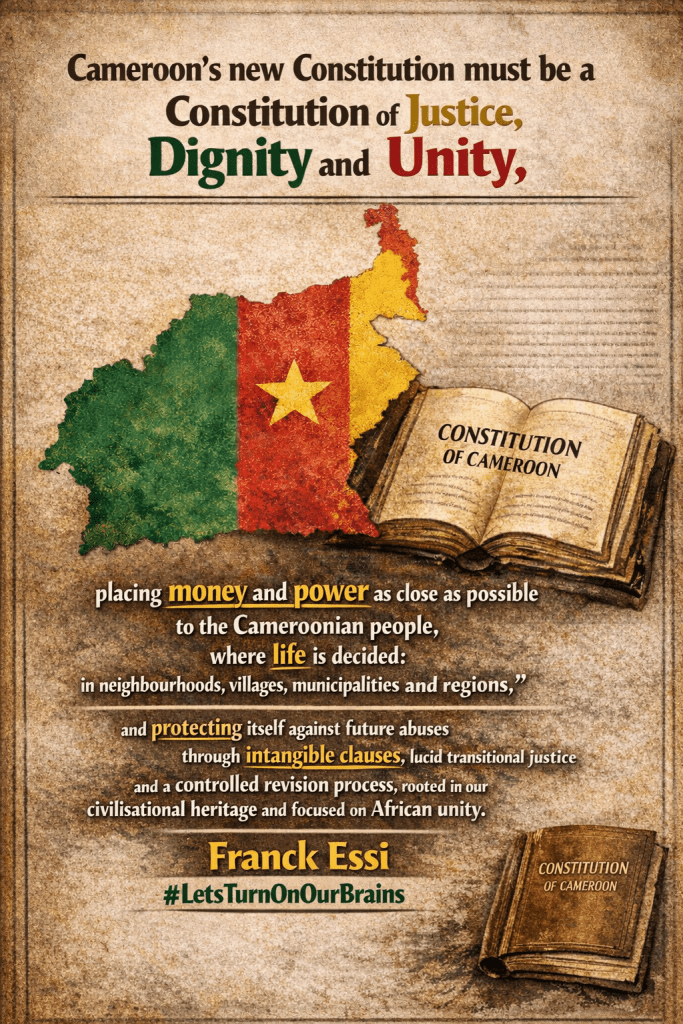
Cameroon’s new Constitution must be a Constitution of Justice, Dignity and Unity, placing money and power as close as possible to the Cameroonian people, where life is decided: in neighbourhoods, villages, municipalities and regions, and protecting itself against future abuses through intangible clauses, lucid transitional justice and a controlled revision process, rooted in our civilisational heritage and focused on African unity.
This text is my current position. It does not claim to exhaust the subject, let alone replace the collective debate that must follow. It is an invitation to discuss the substance — with rigour, courage and a demand for justice.
The ideas expressed herein are my own.
Franck Essi
#WhatIBelieve
#IdeasMatter
#WeHaveAChoice
#WeHaveThePower
#LetsTurnOnOurBrains
 franckessi.com