By Franck Essi
—
The desire to remain in power at the onset of the crisis
Eighteen years ago, Cameroon experienced a major political crisis triggered by the President’s initiative to amend the constitution in order to remove the limit on presidential terms, combined with an economic crisis caused by soaring prices for basic necessities.
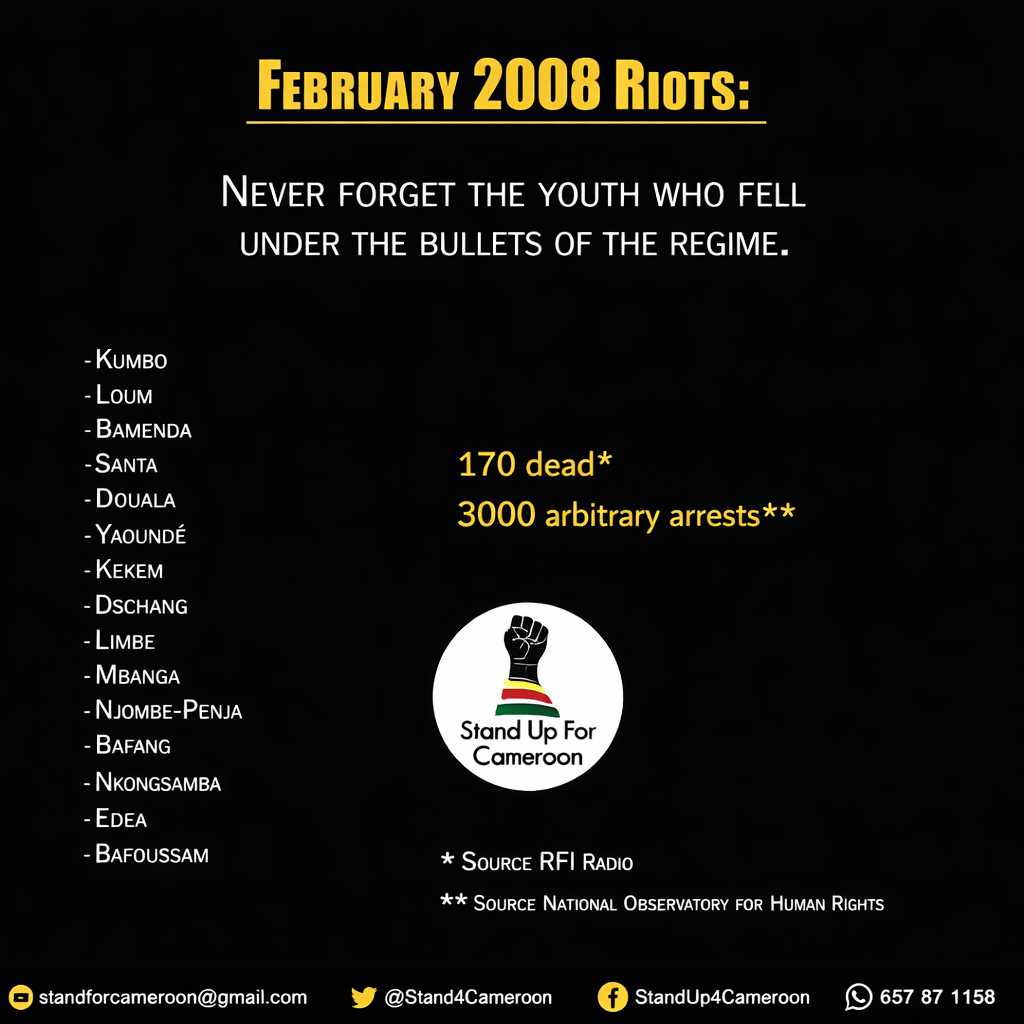
This double crisis sparked riots in various cities that shook the country from 25 to 28 February 2008. According to several civil society sources, these riots left between 139 and 170 people dead, while the government officially recognises only around 40 deaths. During these riots, there were also at least 3,000 arbitrary arrests.
—
Significant and serious human rights violations observed during the crackdown
According to the National Human Rights Observatory and other human rights organisations, the following violations have been documented:
- Numerous acts of intimidation and harassment against members of the political opposition, journalists and human rights defenders.
- Excessive use of force and attacks on the lives of unarmed demonstrators.
- Arbitrary executions and unlawful killings.
- Torture and other cruel, inhuman or degrading treatment or punishment.
- Failure by the authorities to care for the wounded and extortion of the population by law enforcement officers.
- Violations of the rights to freedom of expression, opinion, information, association and peaceful assembly.
- Arbitrary detentions and inhumane conditions of detention.
—
Serious malfunctions in the Cameroonian justice system during trials
The National Human Rights Observatory has documented numerous malfunctions in the Cameroonian justice system, marked by summary trials and a veritable denial of justice:
- Defendants brought in groups of 5 to 10 people, sometimes appearing in court only a few hours after their arrest; Hearings lasting only a few minutes, conducted at a frenetic pace, in violation of the Code of Criminal Procedure, the rights of the defence, the adversarial process and the presumption of innocence.
- Defendants not being informed of their right to legal representation or to remain silent.
- Absence of complainants and prosecution witnesses at the hearing.
- The unreliability of the identification of the accused, due to the absence of identity papers and the speed of the proceedings; minors tried as adults and convicted in flagrante delicto, in violation of the rules applicable to juvenile justice.
- The failure of the accused to sign the investigation reports and the failure of the prosecutors to draw up reports, in contravention of legal requirements.
- The failure to respect the right of the accused to prepare their defence, contrary to Article 300 of the Code of Criminal Procedure.
- Failure to consult criminal records prior to sentencing, making it impossible to assess the defendants’ criminal history.
- Lack of material evidence against many defendants, with judges invoking the ‘relativity’ of the concept of evidence rather than acquitting them as provided for in Article 365(3) of the Code of Criminal Procedure.
—
Commutation and remission of sentences
On 20 May 2008, President Paul Biya signed two decrees (No. 2008/0174 and No. 2008/0175) commuting and remitting the sentences of those convicted for the riots at the end of February 2008. Those sentenced to one year or less in prison had their sentences completely remitted, while sentences of more than one year were reduced by two-thirds.
However, prisoners detained for non-payment of fines cannot be released, nor can those who have appealed, as their convictions are not final. Virtually all those sentenced to prison terms were also sentenced to financial penalties (fines and costs); most of whom were unable to pay and lodged appeals, which greatly limited the real impact of these measures. An amnesty, expunging the convictions from the criminal record and truly freeing these young people, would have been a more appropriate response to the harm suffered.
—
Impunity as the government’s only response to violence committed by the security forces
According to the Cameroonian Constitution, the International Covenant on Civil and Political Rights and the African Charter on Human and Peoples’ Rights, the Cameroonian government is required to guarantee respect for the right to life, physical integrity, liberty and security of the person, as well as freedom of expression, association and assembly.
These standards also require that the arbitrary or excessive use of force or firearms by state agents be punished as a criminal offence. However:
- No independent and thorough investigation has been conducted into the circumstances leading to the use of lethal force by law enforcement officials.
- None of the perpetrators of the shootings that resulted in the deaths of civilians have been brought to justice or subjected to disciplinary sanctions.
- No systematic mechanism for compensation or reparation has been put in place for the victims and their families.
Only massive legal proceedings have been brought against civilians accused of disturbing public order, looting or destruction of property.
—
18 years on: post-election repression confirms the continuity of impunity
In February 2026, as we commemorate the 18th anniversary of the 2008 riots, the post-election crisis following the presidential election of 12 October 2025 has confirmed the persistence of the same repressive logic.
According to official figures released by the Minister of Territorial Administration, the crackdown on post-election protests left at least 16 to 20 people dead and led to the arrest of more than 800 to 1,243 people across the country.
The Office of the United Nations High Commissioner for Human Rights and several international organizations condemned the excessive use of force, killings and mass arrests. In a statement issued on 30 October 2025, the OHCHR expressed its ‘grave concern’ about the deaths and numerous injuries reported during the dispersal of the protests.
A few days later, on 4 November 2025, UN sources reported that security forces had killed at least 48 civilians during protests against the election results, while three gendarmes had also been killed, bringing the total number of deaths recorded by the United Nations to 51 at that date.
Faced with these official and UN figures, which were considered to be underestimated, the Collectif Défense Citoyenne, a Cameroonian civil society organisation, issued a statement on 17 November 2025 reporting a much higher provisional toll: approximately 2,500 arrests throughout the country, including more than 1,900 people still in detention between 3 and 16 November 2025 in seven regions of the country.
In its official statement of 28 November 2025, the Collective documented at least 39 deaths by gunshot attributable to disproportionate and illegal use of force, as well as arbitrary arrests and detentions, acts of torture and inhuman or degrading treatment, and short-term disappearances linked to illegal police custody.
In a press release dated 17 February 2026, four months after the post-election events, the Collective estimates that at least 2,000 people remain deprived of their liberty throughout the country, some of whom are being prosecuted before military courts for offences carrying particularly heavy penalties.
These figures illustrate a disturbing continuity with the practices observed in February 2008:
- Use of lethal force in response to largely peaceful demonstrations;
- Massive and arbitrary arrests;
- Prosecution used as an instrument of political repression;
- Lack of independent investigations and accountability for the security forces.
—
A country trapped in a cycle of repetition
The post-election repression of 2025 comes on top of the massive violations committed in the context of the conflict in the English-speaking regions (extrajudicial executions, torture, enforced disappearances, destruction of villages) and repeated attacks on freedom of expression and assembly against opposition parties and citizen movements. It shows that the lessons of February 2008 have never been learned, and that the impunity of that time is fuelling today’s abuses.
As long as the crimes of 2008 remain unpunished, the violence will continue and transform, affecting new generations of young Cameroonians who simply want to exercise their civil rights and live in a state governed by the rule of law.
—
The duty to remember and the demand for justice
It is absolutely important to remember that justice has still not been done for the victims of February 2008, and that the same practices of human rights violations continue to manifest themselves in the form of post-election repression, internal conflicts and harassment of dissenting voices.
This tragic page in our history can never be turned without:
- The establishment of an independent investigation into the events of February 2008 and the post-election repression of 2025.
- The prosecution and punishment of the perpetrators of serious violations, regardless of their rank.
- The review of summary and unfair trials, and the release of all persons detained for peacefully exercising their political rights.
- Compensation for victims and their families, and official recognition of the State’s responsibilities.
- The construction of memorial sites, including a martyrs’ square for the young people killed in February 2008, and monuments dedicated to the victims of subsequent crackdowns.
Like other countries facing recurring episodes of political violence, Cameroon will sooner or later have to engage in a genuine process of transitional justice, combining truth, justice, reparations and guarantees of non-repetition.
—
Tribute to the young people of February 2008
On this 18th anniversary, we pay tribute to the young Cameroonians who, in February 2008, paid with their lives for their aspirations for freedom, social justice and political change. Their bloodshed heralds and illuminates the current struggles against electoral fraud, authoritarianism and the confiscation of power.
We also include in this tribute all the victims of post-election repression and the conflicts that followed, for it is the same chain of impunity that links their broken destinies. The best tribute we can pay them is to refuse to forget, to document the violations, to support the families and to continue the fight for a free, just and democratic Cameroon.
Honour and eternal respect to our martyrs of February 2008 and to all those who have since fallen for the dignity and freedom of the Cameroonian people.
#JusticeAndMemory
#CitizenDefence
#PoliticalTransition
#StandUpForCameroon
 franckessi.com