The strategic lessons of an unfinished popular uprising
By Franck Essi
—
There are events that history turns into myths even before we have understood them. February 2008 in Cameroon risks being one of them: sufficiently celebrated to feed a collective memory, insufficiently analyzed to inform a strategy. Yet memory without lucidity is a trap. It perpetuates pain without opening up new paths. Eighteen years on, those who support systemic change in Cameroon need not only to remember, but to understand.
Here is what, in retrospect, the events of February 2008 teach us about the conditions, limits and requirements of a struggle for the profound transformation of a state.
—
Lesson 1: Popular anger without political organization remains an energy that the regime can absorb
February 2008 was a spontaneous explosion. Powerful, widespread, geographically extensive — Douala, Yaoundé, Bafoussam, Bamenda, Ngaoundéré, all the major cities vibrated at the same time. It was no small thing. It was even historic.
But this explosion had no leadership, no program, no structure capable of transforming it into a lasting political force. It was pressure without leverage. The regime waited for the pressure to subside — first by repressing, then by promising (a few symbolic measures on prices) — and then continued, unperturbed, on its course.
The lesson is fundamental: popular anger is a raw material, not a finished product. An insurrection without political organization behind it is doomed, sooner or later, to be co-opted, neutralized or repressed. It can shake a regime. It cannot replace it.
For today’s struggles, this means that mobilization is not enough. Citizen energy must be organized, coordinated and politically supervised. Any movement that wants to bring about change in Cameroon tomorrow must be capable not only of filling the streets, but also of proposing a credible and structured alternative — a vision, legitimate actors and a process.
—
Lesson 2: The regime’s resilience is based on the fragmentation of its opponents
In February 2008, while young people were dying in the streets, the opposition political class as a whole was nowhere to be seen. Some parties hesitated. Others offered lukewarm condemnation. Still others attempted to hijack the movement without having supported it.
The regime, for its part, was united. Behind a single man, a single line: repress, then pretend to listen. The disproportion between the cohesion of power and the fragmentation of those who challenged it was overwhelming.
This asymmetry has not changed. In 2025, it was still evident: faced with a contested election and a serious post-election crisis, the forces of change remained scattered, unable to unite their energies around a common position.
The lesson is clear: a regime does not fall under the weight of protest alone. It falls when its opponents succeed in building a strategic unity capable of opposing it with a coherent front. Unity does not require uniformity. It requires the discipline not to let ego and leadership squabbles destroy what could be a collective force.
For those who support systemic change, the priority is not to convince the regime. It is to convince each other that there is something greater than each of their organizations. This convergence is not a luxury: it is a condition for strategic survival.
—
Lesson 3: The regime used the crisis to consolidate its power — not to reform it
This is perhaps the most bitter, and most instructive, lesson.
In February 2008, the people said no. The regime responded with repression, then with the constitutional revision of April 2008 — which removed term limits. In other words, it used the moment of crisis not to concede, but to accelerate the locking down of the system.
This pattern — crisis → repression → reinforcement of authoritarianism — is not accidental. It is a conscious and proven strategy. A crisis that is not controlled by the opposition is, for a skilful authoritarian regime, an opportunity to consolidate its grip under the guise of urgency or necessity.
We saw the same mechanism at work after 2018: the Anglophone crisis and electoral protests led not to sincere dialogue, but to more repressive security laws and increased militarisation.
The strategic lesson is this: any popular pressure, if not accompanied by the ability to convert the balance of power into negotiation or controlled rupture, risks serving the interests of the regime. Systemic change cannot be improvised in the heat of a riot. It must be prepared, documented and planned — with scenarios, alliances, interlocutors and fallback positions.
Supporters of change must learn to think in terms of transition, not just resistance. Resistance is necessary. But resistance without a vision for the future is energy going round in circles.
—
Lesson 4: The international community is a lever, not a saviour
In 2008, the international community looked on. A few muted condemnations. A few communiqués. And then business as usual. Cameroon’s partners continued their relations with the regime, the constitutional revision was endorsed amid general indifference, and the deaths of February 2008 did not carry much weight in the chancelleries.
This is no surprise. It is a constant in African international politics: foreign powers rarely support the people against the regimes they have tamed. They support stability — even stability based on repression — because stability serves their economic and geopolitical interests.
This does not mean that international leverage is useless. It means that it must be used in a lucid and instrumental way: documenting violations, calling on regional institutions (African Union, ECCAS), mobilising diasporas, building alliances with international human rights organisations — not so that they can ‘save’ Cameroon, but to reduce the regime’s room for manoeuvre and increase the political cost of repression.
The lesson is one of strategic autonomy: change in Cameroon will come from Cameroonians, or it will not come at all. The international community can create conditions, but never victories.
—
Lesson 5: The memory of victims is a political resource that must be actively cultivated
The deaths of February 2008 were almost immediately erased from the national public debate. No commission of inquiry. No trials. No official recognition. Total institutional silence, complicit in forgetting.
And yet, every time activists dared to talk about 2008 again — in the media, on social networks, in the diasporas — they caused a stir. Because the memory of the victims is a living political resource. It legitimizes the struggle, it creates a narrative continuity between past and present struggles, and it delegitimizes the regime by constantly reminding it that it has blood on its hands.
The movement for systemic change must deliberately invest in the work of memory: documentary, artistic, commemorative, legal. Not out of sentimentality. Out of strategic calculation. A people who know where they come from are more difficult to manipulate, more difficult to discourage, more difficult to silence.
—
What all this means for today
Eighteen years after February 2008, Cameroon has still not obtained justice for its dead. But it is also not the same country it was in 2008. An entire generation has grown up carrying, consciously or not, the legacy of this rupture. Social media has changed the conditions of mobilization and documentation. The Anglophone crisis has added an extra dimension to the divide between the state and its citizens. And the post-election crisis of 2025 showed, once again, that the regime was not invulnerable — but also that it was not going to fall on its own.
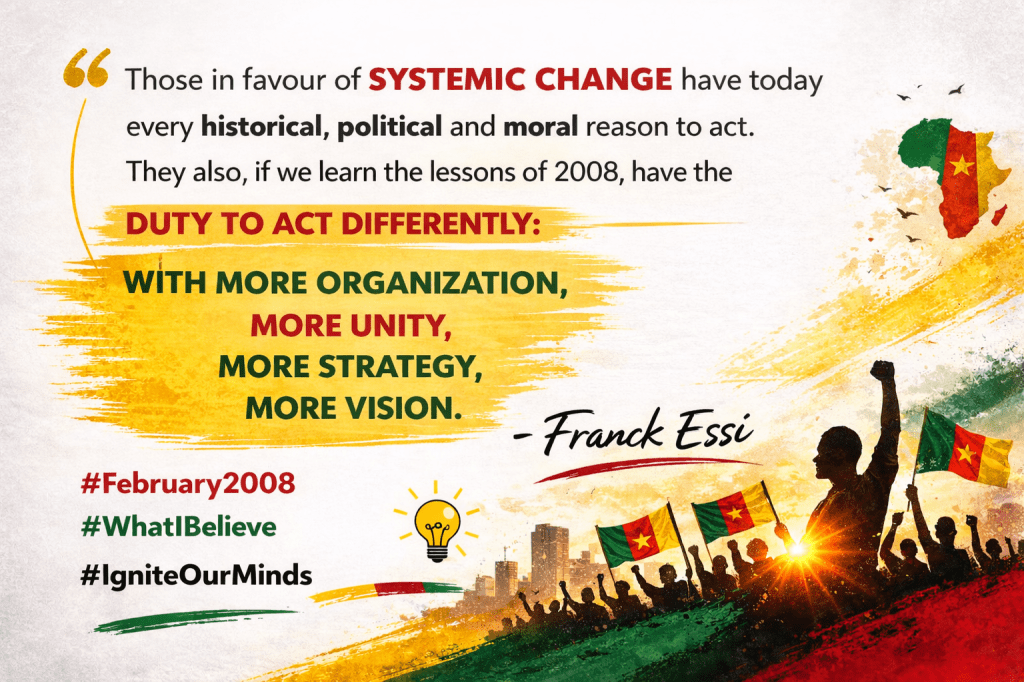
Those who support systemic change now have every historical, political and moral reason to act. They also have, if we learn the lessons of 2008, an obligation to act differently: with more organization, more unity, more strategy and more vision.
February 2008 showed us what the Cameroonian people were capable of risking.
What we must build now is something worth taking that risk for.
A sovereign political transition, driven by the people, based on justice, truth and the democratic rebuilding of the state — not as a utopia, but as a concrete project, prepared, demanded and imposed by those who refuse to let their country continue to be slowly destroyed.
This project is the purpose of Stand Up For Cameroon.
And it needs you.
Franck Essi
Activist for democratic transition in Cameroon
#WhatIbelieve
#IdeasMatter
#WeHaveChoices
#WeHavePower
#Let’sUseOurBrains
#StandUpForCameroon
 franckessi.com