How the future of a country was stolen with a pen and 157 raised hands
By Franck Essi
—
On 10 April 2008, in the National Assembly in Yaoundé, something died. Not a man, but a promise: the basic contract between the Cameroonian people and those who govern them.
To understand what happened that day, we need to go back.
—
1996: A Constitution that was supposed to change everything
After the political struggles of the early 1990s – “ghost towns”, repression, and the democratic wave sweeping across Africa – Cameroon adopted a new Constitution in 1996. A key gain, wrested from the regime by the opposition and civil society, was the limitation of presidential terms to two consecutive seven‑year mandates.
In other words, no president could legally rule for more than 14 years.
This was a democratic safeguard, meant to prevent the country from belonging indefinitely to one man. It was not a gift from those in power, but a counterpart obtained in exchange for extending the presidential term from five to seven years. It was a political compromise and a solemn commitment.
In 2004, Paul Biya ran again while clearly presenting that term as his last. Voters made their choices on that basis. The people renewed his mandate for seven years believing it would be the final one.
February–April 2008: Betrayal in two stages
First stage – February 2008: The people say no.
When it became clear that Paul Biya intended to revise the Constitution to remove term limits, Cameroonians took to the streets. Not only because of the soaring prices of fuel and basic goods – although poverty and hardship were real – but because they were being told that the man who was supposed to leave in 2011 had decided to stay indefinitely. Their 2004 vote suddenly looked like a mere formality. The contract had been broken unilaterally.
The repression that followed left more than 100 dead according to independent organizations, and thousands under arrest. It was the blood of the poor, shed in defense of a constitutional safeguard that the privileged were about to erase.
Second stage – 10 April 2008: Parliament rubber‑stamps the hold‑up.
Just weeks after crushing the protests in blood, the ruling party reconvened the National Assembly. The vote was swift: 157 in favor, 5 against. MPs from the SDF walked out, denouncing a “constitutional coup d’état”– and they were right.
Article 6(2) of the Constitution was rewritten. Where it had previously said “renewable once”, it now simply said “re‑eligible”. No limits. No end. Forever.
To crown it all, another change enshrined total immunity for the President for acts committed while in office. In practice, this meant he could never be held legally accountable – not for 2008, not for anything else.
—
The changes nobody talked about
Most people remember the removal of term limits, but other, less visible tweaks pointed in the same direction: weakening Parliament and concentrating more power in the presidency. Among them:
– Stronger presidential power to dissolve the National Assembly
– A procedure to indict the President made virtually impossible
– Constitutionalized presidential immunity, shielding him even after leaving office
This was not a reform. It was a systematic locking of the regime, tailor‑made for one man.
—
The bill we are still paying in 2026
The decisions taken on 10 April 2008 are not just history. You can see their impact in today’s Cameroon:
→ 44 years in power. Paul Biya came to power in 1982. We are in 2026. A whole generation has been born, grown up and grown old without ever knowing another head of state. No country can develop in a healthy way when everything revolves around one person for more than four decades.
→ Hollowed‑out institutions. Extreme personalization of power kills institutions. The National Assembly votes what it is told to vote – the 157 raised hands of 2008 proved that. Courts protect the regime instead of citizens. The administration obeys a ruler, not a Republic.
→ A predictable 2025 presidential election. Thanks to the 2008 revision, Paul Biya could run again in 2011, in 2018, and again in October 2025 at 92. The post‑electoral crisis that followed – killings, mass arrests, imprisoned opponents – is a direct extension of what was planted in 2008.
→ Impunity as a system of rule. The constitutionalized immunity of 2008 means that crimes committed since then – the killings of February 2008, documented torture, arbitrary arrests in 2025 – are likely to remain unpunished as long as the current regime stands. Responsibility was erased first; abuses deepened afterwards.
→ A youth pushed into exile or silence. A country without alternation is a country without horizon for its youth. When a 25‑year‑old Cameroonian born in 2001 has known only Biya, when social mobility depends on loyalty to the system rather than merit, and when dissent risks prison, leaving becomes a survival strategy, and staying in silence a daily humiliation.
—
What this reveals: an elite that has seceded from its people
We must call things by their name.
What happened in 2008 was more than a political manoeuvre. It marked the formal split between the ruling elite and the Cameroonian people.
On one side, an oligarchy – political, administrative, economic – that stopped serving the common good long ago. An elite that preferred to amend the Constitution rather than reform the economy. That ordered live ammunition to be fired at hungry youth rather than lower food prices. That constitutionalized its own impunity instead of accepting accountability. That, again in 2025, chose arrests and killings over dialogue.
This elite has not merely abandoned the people. It has effectively turned against them – through laws, bullets, prison cells and diplomatic passports.
On the other side, a resilient, creative, hard‑working people keeping the country afloat despite a state that extracts from them rather than serves them. A people who said no in 2008, no in 2018, no in 2025 – and who were met, time and again, with repression.
—
Refoundation: not an option, but a historical necessity
Stand Up For Cameroon is clear: we will not get out of this crisis simply by changing the man at the top of the same pyramid.
What is needed is a refoundation of the Cameroonian state – deep, inclusive and rooted in popular sovereignty.
Refounding the state means recognizing that the current institutions were designed to perpetuate a system, not to serve a people. It means acknowledging that the 1996 Constitution, already skewed towards concentration of power and then further distorted in 2008, is no longer a sufficient foundation for a just and modern Cameroon.
Refounding the state means initiating a political transition under the control of the people – not secretly negotiated among elites, not grudgingly conceded by a cornered regime, but imposed by the sovereign people: in the streets, at the ballot box, within civil society, in the diaspora, and through every Cameroonian who refuses to normalize what is abnormal.
Such a transition must lay the groundwork for a new social contract:
– A new Constitution co‑written with the people, not by a rubber‑stamp Parliament
– Strict presidential term limits, restored and firmly protected
– Independent institutions: judiciary, army, electoral management
– Truth and justice for the victims of the 1990s, 2008, 2018 and 2025
– Genuine decentralization, returning real decision‑making power to regions and local communities
—
What we owe to the dead of February 2008
They took to the streets with bare hands to defend a constitutional safeguard. That safeguard was eventually removed, but their struggle must not vanish with it.
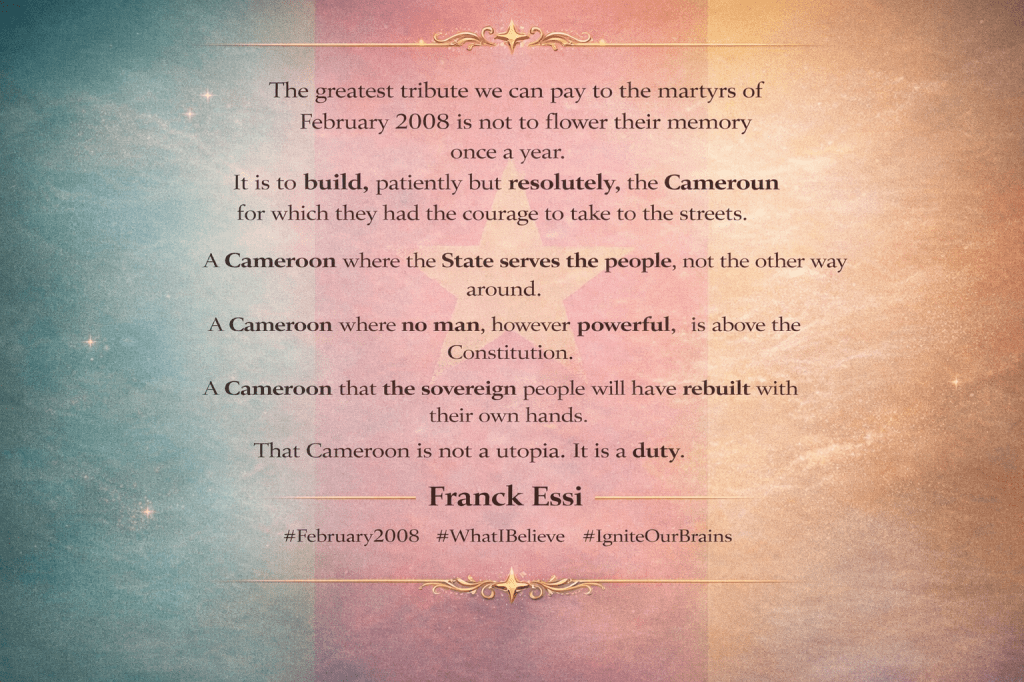
The best way to honour the martyrs of February 2008 is not to remember them once a year; it is to build, step by step, the Cameroon they had the courage to imagine.
A Cameroon where the state serves the people, not the other way round.
A Cameroon where no man, however powerful, is above the Constitution.
A Cameroon that the sovereign people will have refounded with their own hands.
That Cameroon is not a dream. It is a responsibility.
🕯️ Honour and eternal memory to the martyrs of February 2008 and to all those who have since fallen for the dignity of the Cameroonian people.
Franck Essi
Activist for democratic transition in Cameroon
#Febuary2008
#WhatIbelieve
#IdeasMatter
#WeHaveChoices
#WeHavePower
#Let’sUseOurBrains
#StandUpForCameroon
 franckessi.com