By Franck Essi
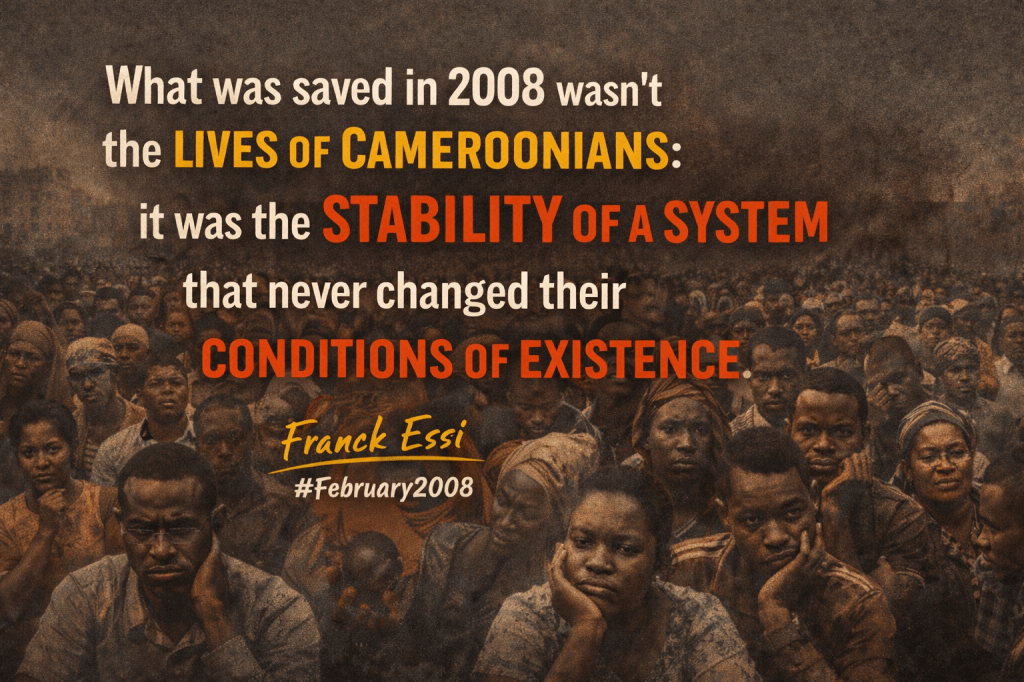
—
In February 2008, Cameroon staggered under the combined shock of soaring living costs and a deep political crisis, resulting in one of the most violent protest episodes in its recent history.
Eighteen years later, with poverty still affecting nearly two out of five Cameroonians and unemployment and the high cost of living remaining citizens’ top concerns, one question imposes itself: what is left of the emergency socio‑economic measures announced to extinguish the February 2008 fire?
—
I. February 2008: A Dual Crisis the State Was Unprepared to Handle
The “hunger riots” of February 2008 did not come out of nowhere. They crowned fifteen years of structural adjustment, stagnant incomes, deteriorating purchasing power and the gradual dismantling of public services. When transport unions called a strike against rising fuel prices at the pump, the streets went up in flames — because, internally, they had been burning for a long time already.
But the anger was not only economic. It was political. In the weeks before, word spread that Paul Biya was preparing a constitutional revision to remove presidential term limits — a safeguard wrested in 1996 after years of struggle, after the “villes mortes”, after the blood of a lost decade. That democratic lock was about to be broken. Cameroonians understood this and said no.
For several days, Douala, Yaoundé, Bafoussam, Bamenda, Limbe and Buea were the scene of blockades, barricades and clashes. The human toll remains disputed to this day: 44 deaths according to the official version, at least 139 according to the National Observatory for Human Rights, and up to 170 according to early RFI estimates. At least 3,000 arbitrary arrests were documented. The ensuing trials were summary, unfair, and conducted in blatant disregard of basic defence rights.
What the 2008 riots exposed was a State that had already seceded from its people — long before the people took to the streets.
—
II. The 2008 Package: Buying Time, Not Building a Future
Confronted with this anger, the government reacted in two stages: first bullets, then promises. This is the classic modus operandi of regimes that have neither the will nor the project to reform themselves.
Economic concessions came quickly:
→ A reduction of 5 to 6 CFA francs per litre at the fuel pump, granted under pressure from transport unions at the end of February.
→ On 7 March 2008, a 15% salary increase for civil servants and the military, plus higher housing allowances — about 170,000 public sector workers were concerned.
→ A freeze or cut in certain duties and taxes on basic necessities.
→ Promises of hiring in the civil service and support for youth employment.
The budgetary cost of these measures was estimated at over 200 billion CFA francs for 2008 alone. The IMF immediately raised concerns: the expenditure‑to‑GDP ratio worsened, fuel subsidies jumped by more than one percentage point of GDP, and the so‑called “technical partners” sounded the alarm.
In essence, what the government did was buy the loyalty of the civil service and transport unions, and secure the time needed to carry out the April 2008 constitutional revision. The social measures were the anaesthesia. The revision was the operation.
For the vast majority of Cameroonians — informal workers, subsistence farmers, people without access to formal circuits — this package had only a marginal impact on daily life.
—
III. MIRAP: The Perfect Symbol of a State Pretending to Act
In 2011, the government went one step further in institutional staging. By decree of 1 February 2011, it created the Mission for the Regulation of Supplies of Basic Consumer Products (MIRAP).
On paper, the mandate was ambitious: stabilize food prices, fight speculation, organize periodic markets in major cities, build food security stocks and influence supply chains.
Between 2011 and 2016, the government highlighted 1,361 periodic markets organized in Yaoundé and Douala, 70,671 tonnes of products sold and cumulative turnover of 20 billion CFA francs. These figures exist. But they conceal several less flattering realities.
What MIRAP never managed to do:
→ It remained confined to major cities, essentially Yaoundé and Douala, and never became a genuine national regulatory tool. Rural Cameroon — where food poverty is structurally deepest — was practically never covered.
→ It never imported a single basic consumer product, even though import flows were precisely where price leverage was most expected.
→ It operated as an ad hoc distribution structure — pop‑up markets during periods of tension — rather than as a real agricultural or trade policy instrument: no durable structuring of smallholder value chains, no organized short circuits, no strategic stocks capable of influencing prices over the medium term.
→ With an annual budget subsidy of only 800 million CFA francs, it never had the means that matched its proclaimed mission.
What MIRAP did produce instead:
→ Unpaid salaries for staff.
→ Waves of resignations.
→ Documented suspicions of embezzlement.
→ Disputed internal governance, far from the standards expected of a serious regulatory institution.
MIRAP condenses the regime’s method into a single institution: create a structure, give it a grandiose name, showcase a few output numbers, starve it of resources and let mismanagement run its course, then keep brandishing it as proof of a willingness to act. It is budgetary political fiction.
—
IV. Fuel Prices: A Poorly Distributed Rent, a Brutal Exit
Since 2008, the government has presented the maintenance of fuel prices below import cost as a form of “social support” to the population. This framing needs to be unpacked carefully, because it feeds two symmetrical errors.
1. A regressive mechanism, not a pro‑poor policy
The data are clear: holding the current structure constant, urban motorized households, fuel‑intensive firms and organized transporters capture the largest share of the price advantage linked to administered fuel prices. Poor rural households — minimally motorized and living from subsistence agriculture — benefit far less in terms of direct fuel consumption. There is a clear regressive pattern: a disproportionate share of public resources goes to those who need it least.
And the amounts involved are considerable:
→ Over 1,000 billion CFA francs in 2022.
→ 640 billion in 2023.
→ 263 billion in 2024.
→ 80 billion planned for 2025 under IMF pressure.
These are resources that were not channeled into agriculture, rural energy, health, education or vocational training.
2. A brutal reform that hits the poorest first
The second, symmetrical error is to assume that scrapping this support abruptly mainly hurts the better‑off.
The increase in pump prices does not stop with the taxi driver or the industrial firm. It passes through to freight costs and then to the prices of food and basic goods. After the hikes of February 2023 and February 2024, several analyses point to double‑digit inflation in food and transport in multiple regions, with documented impacts on food security for the most vulnerable households.
Yet it is precisely the poorest households — in precarious urban areas as well as in rural zones — that devote the largest share of their income to food and essential transport. Even if they do not consume petrol directly, they pay, at the market and in collective transport, the bill for the “reform”. And the few compensatory measures put forward by the government — pay rises for civil servants, a handful of ad hoc transfers — cover only a minority of formal workers, whereas mass poverty is concentrated in the informal sector and subsistence agriculture.
We end up with a stark paradox: a policy presented as necessary to correct a regressive mechanism, in the way it is implemented, generates an inflationary shock that hits first those who never really captured the rent. The problem is therefore not only that a poorly targeted device was maintained for too long. It is that its dismantling was organized with the same indifference to the poorest as that which had presided over its creation. Poorly targeted on the way in. Brutal on the way out.
—
V. DSCE, SND30 and AFCON: The Money Was There. It Went Elsewhere.
The Growth and Employment Strategy Paper (DSCE), adopted in 2010 as the decade’s roadmap, promised:
→ average growth of 5.5%,
→ a significant reduction in under‑employment,
→ and a drop of more than 10 percentage points in the poverty rate.
The outcome was a far cry from these ambitions: average growth of about 4.5%, poverty reduced by barely 3 points and massive under‑employment persisting. The government itself acknowledged that the objectives had not been met, using the euphemism “mixed results”.
The 2020–2030 National Development Strategy (SND30) is even more ambitious: a growth target of 8.5% by 2025, electrification at 95%, paved roads at 12% of the network, and credit to the economy at 23.2% of GDP.
Mid‑term performance is far from these targets:
→ real growth around 3–4%,
→ electrification at 77.8%,
→ paved roads at 9.5%,
→ credit to the economy at 17.5%.
These are the government’s own figures. This is not the opposition speaking. It is the mirror that official statistics hold up to the regime — and that reflection is brutal.
Meanwhile, Cameroon found the resources to host the 2021 Africa Cup of Nations (AFCON). The total cost is estimated at several hundred billion CFA francs, with massive documented cost overruns: the Olembé stadium, initially budgeted at 163 billion, ultimately cost over 215 billion. Overall estimates put total AFCON‑related spending at up to 3,000 billion CFA francs.
We are not saying that hosting AFCON was meaningless. We are saying this, precisely: a State that keeps repeating it cannot adequately fund district hospitals, rural roads and schools, yet manages to mobilize hundreds of billions for a prestige football event with unexplained cost overruns, is not short of money. It is short of priorities that serve its people. The money was there. It simply did not go where it could have transformed Cameroonians’ lives.
—
VI. Poverty Does Not Lie
According to the fifth household living conditions survey (ECAM5), 38.6% of Cameroonians — around 10 million people — live below the national poverty line, set at 813 CFA francs per day. Not 813 CFA for leisure. 813 CFA to live. To eat. To get healthcare. To send one’s children to school.
Under‑employment is estimated at over 77% of the active population. This figure may be the most telling: the vast majority of working Cameroonians do not find decent, stable and adequately paid jobs. They survive, piece together livelihoods, “get by” — an expression often used with superficial admiration that barely conceals the collective shame of a country that has failed to create the jobs its youth deserves.
Afrobarometer surveys confirm what everyone feels: in 2024, unemployment and the high cost of living remain the top two issues that Cameroonians want their government to address — exactly as in 2008.
Eighteen years of strategic plans, speeches, MIRAP, poorly distributed oil rent and large‑scale projects with questionable social returns — and Cameroonians are still giving the same answers to the same questions. It is the most damning verdict possible.
—
VII. The Real Balance Sheet: A Stabilized Political Order, a Social Contract Never Rebuilt
The balance sheet of the socio‑economic measures adopted after the 2008 riots is, strictly speaking, two‑fold and deeply unequal.
What “worked”:
→ In the short term, the measures calmed open unrest in major cities.
→ They preserved the loyalty of the civil service, a strategic pillar of regime stability.
→ They bought the government the time needed to carry out the April 2008 constitutional revision.
→ They helped avert a scenario of generalized disorder amid international price shocks.
What did not work — and was probably never designed to:
→ Poverty did not fall significantly: 38.6% poor in 2026, versus a –10 point target for the DSCE decade.
→ Under‑employment remained massive: more than 77% of the labour force.
→ Successive strategic plans missed their targets on key indicators.
→ MIRAP, the main institutional instrument created in response to the crisis, never had the coverage, means or governance consistent with its stated ambition.
→ The rent derived from keeping fuel prices below cost benefited mainly the better‑off, weighed heavily on public finances, and its hasty reduction — without credible social safety nets — produced an inflationary shock that hit the poorest households hardest.
→ Considerable resources were devoted to prestige spending with questionable social returns, while development targets remained out of reach.
The conclusion is inescapable: these measures served to stabilize a political order. They did not rebuild a social contract.
This is not a moral judgment. It is a reading of facts, figures and trajectories. A regime that “raises” civil servants’ salaries while more than 77% of the labour force is under‑employed, that maintains a poorly distributed rent for fifteen years and then scraps it without credible compensation, has made a clear political choice: protect the segments that guarantee its institutional survival, and manage the rest on a day‑to‑day basis.
In this, one more time, the dead‑end of Cameroon’s development path becomes evident.
Franck Essi
#Febuary2008
#WhatIbelieve
#WeHaveChoices
#WeHavePower
#Let’sUseOurBrains
 franckessi.com