How Cameroon’s Failing Governance Turns a Distant Crisis into an Immediate Threat
By Franck Essi
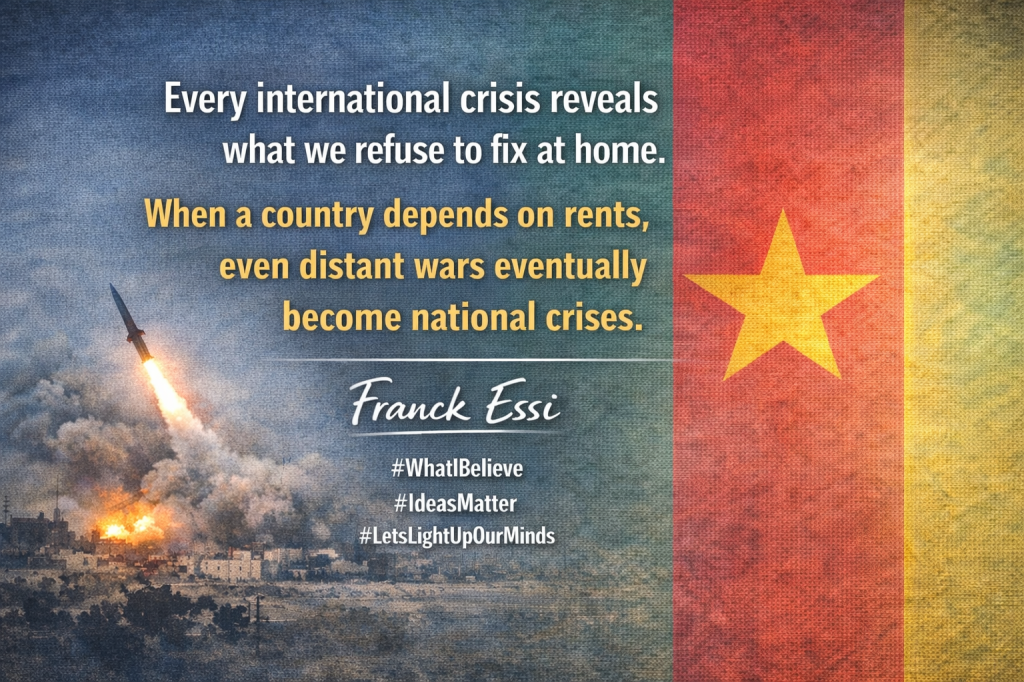
There is a comfortable tendency in official Cameroonian discourse to treat international crises as distant turbulence, unrelated to the internal fabric of inequalities and vulnerabilities. The military confrontation between the United States, Israel and Iran serves as yet another reminder of the political, economic and security costs of this posture.
Every missile fired between Tehran, Tel Aviv and Washington eventually lands — in Douala, Maroua or Bafoussam — as a rise in the price of fuel, bread, medicine or urban transport. To refuse to see this is to maintain the illusion that external shocks are inevitable, when in fact they first and foremost expose internal governance choices.
—
1. The Ruined Sonara and the Strait of Hormuz: How Cameroon Pays for the Same Crisis Twice
The first impact mechanism is energetic. When tensions explode in the Middle East, markets anticipate disruptions at the Strait of Hormuz, through which approximately one-fifth of the world’s oil transits. Prices surge, and for Cameroon, the chain reaction is immediate.
Since the fire at Sonara in May 2019 — the country’s only refinery — Cameroon has been importing all of the refined petroleum products it consumes, through a trader-based supply mechanism that has been in place for more than five years. Between January and October 2025, nearly 1.8 million metric tonnes of fuels were imported in the absence of an operational refinery, deepening the trade deficit and leaving the country exposed to every fluctuation in world prices.
In this structure, a rise in the price of crude marginally improves export revenues while massively increasing the cost of fuel imports and subsidies. The state budget, already structurally strained, absorbs a growing share of these additional costs, which then feed through into the price of transport, electricity, agricultural inputs and food.
This situation must be named for what it is: not a geological or technical inevitability, but the result of a repeated political decision not to restore national refining capacity within a reasonable timeframe. Despite interest from several investors, the Sonara rehabilitation project has been stalling for six years. The ruling coalition prefers to manage the import rent on petroleum products rather than disrupt the circuits it controls.
Fuel subsidies are as much a political regulation tool as an economic one. Their adjustment responds to the risk of social unrest, while benefiting the most motorized groups far more than the poorest households. To touch this system is to touch a pillar of the architecture of power.
—
2. 543 Billion FCFA in Cereal Imports: The Social Explosion Brewing Below the Surface
The second shock is alimentary and social. Cameroon depends heavily on imports for wheat, rice, part of its maize, medicines, agricultural inputs and numerous industrial inputs. When Middle East tensions drive up maritime freight costs, insurance premiums and energy prices, all of these products become more expensive simultaneously.
In 2024, cereal imports reached a record 543.7 billion FCFA, an increase of around 40% compared to 2023. Rice alone accounted for 318.5 billion FCFA, up 59% year-on-year, while wheat weighed in at 214 billion FCFA. India and Thailand supply more than 90% of imported rice, and France remains the main wheat supplier. In these conditions, every international tension translates directly into a drain on households’ real income, with no margin for adjustment whatsoever.
It is the most vulnerable households that absorb these shocks first — in working-class neighbourhoods, isolated rural areas and urban peripheries. These are the same people who, in February 2008, took to the streets to protest against the cost of living, and were met with a crackdown that cost dozens of lives — without any justice being served or any structural reform being undertaken.
Eighteen years later, the economic structure has not fundamentally changed. The capacity of that social anger to resurface remains intact, all the more so as price increases compound informal unemployment, stagnant wages and the absence of meaningful safety nets.
And yet Cameroon possesses some of the most fertile agricultural land in Central Africa. Its food dependency is not an inevitable development delay: it is the result of an economic structure that has systematically favoured import circuits — easier to control, more generous in distributable rents — at the expense of local production, storage and processing value chains. Here too, these are political choices.
—
3. The Port of Douala Serves Four Countries — But Cameroon Transforms Nothing
The Port of Douala serves not only Cameroon, but also Chad, the Central African Republic and, partially, Niger. This position should represent a major strategic asset for a regional industrialisation policy capable of capturing part of the value added associated with these flows.
In practice, Cameroon is embedded in global trade circuits as a transit point for raw materials and an entry point for finished goods — with no coherent industrial policy to locally transform these flows. In 2024, Cameroonian ports saw growing volumes of imported goods transit through, concentrated among a small number of Asian and European suppliers, further amplifying vulnerability to logistical and geopolitical shocks.
Every disruption of maritime routes linked to Middle East tensions translates into higher freight costs, supply delays and added costs for already fragile sectors — agriculture, transport, agri-food industry, construction. In a country where formal employment remains the exception, these shocks feed massive informal unemployment, falling incomes in small commercial activities and diffuse social frustration.
Cameroon’s gas potential illustrates this paradox. The Hilli Episeyo floating liquefaction unit, off the coast of Kribi, has a capacity of approximately 1.2 million tonnes of LNG per year, with part dedicated to the domestic market. Other gas infrastructure projects are under development, in partnership with Perenco and the National Hydrocarbons Corporation. But without a clear industrial vision and rigorous governance, these projects risk confining themselves to exporting molecules, reproducing the oil model: capturing short-term rents rather than building durable productive capacity.
—
4. Boko Haram and the Weapons of World War: A Far North Already on Its Knees
Contemporary conflicts generate flows of small arms, militarized drones and war technologies that feed parallel markets far beyond their original theatres. For Cameroon, which has been facing the Boko Haram insurgency and other forms of instability in the Far North for several years, this reality is anything but theoretical.
But the increased circulation of arms linked to Middle Eastern crises only worsens a situation whose roots are first and foremost domestic: chronic underdevelopment of the region, economic marginalisation of its populations, weak public service presence, massive youth unemployment. Security budgets themselves are partially captured by politico-military networks before reaching operational units on the ground — weakening the field response and perpetuating a cycle of inefficiency and rent-seeking.
The question must be raised explicitly: to what extent has the persistence of these threats become an element of political management, used to justify extraordinary budgets, restrictions on freedoms and opaque arrangements in the name of national security? What international crises bring are additional weapons and technologies. What they encounter on the ground are unresolved social and institutional fractures.
—
5. At the UN, Cameroon Votes or Abstains — But Never Carries Any Weight
On the diplomatic front, Cameroon will sooner or later be called upon to take positions in multilateral forums — the UN, the African Union, ECCAS — on the developments of the Middle East war. Since the end of the Cold War, the country has practised a diplomacy of convenience: abstentions, absences and vague declarations, rarely taking assumed and coherent positions.
This posture is often presented as a wisdom of neutrality, designed to avoid upsetting any partner. In reality, it means that the diplomatic apparatus is primarily oriented towards regime preservation — seeking quiet support and minimizing constraints — rather than towards the clear defence of defined and debated national interests.
In a world fragmenting into rival blocs, systematic abstention is not neutral. It sends a signal of weakness or availability, and leaves others to define the rules of the commercial, energy and security game. On dossiers as concrete as maritime security, supply corridors, sanctions or the reform of global governance, Cameroon settles for being present without carrying any weight.
A diplomacy of interests would require identifying a few priority axes — food security, energy security, logistical corridors, technology transfers — and building diversified alliances around these objectives. It would also mean being accountable for the positions taken, before Parliament and public opinion, rather than leaving foreign policy in the opacity of restricted circles.
—
What Every Crisis Proves Once Again: The Regime Manages Rents, Not the Country
International crises do not create vulnerabilities — they lay them bare. Everything that the Middle East war reveals about Cameroon existed before the first missile was fired: uncorrected energy dependence, structural food fragility, absence of industrialisation, exposure to logistical shocks, diplomatic invisibility.
These are choices. Repeated choices, made by a ruling coalition that has placed the management of external rents — oil, gas, imports, aid — at the heart of its reproduction model. Naming them as such is not a rhetorical exercise: it is the prerequisite for any transformation, because it forces the question of political responsibility, transparency and accountability.
—
5 Levers to Break Free — If the Political Will Existed
International crises also create windows of opportunity for countries capable of anticipating and reorienting their policies. The question is whether those who govern have any interest in reducing the vulnerabilities from which they themselves profit.
Lever 1: Rebuild a national refining capacity.
Energy sovereignty requires a binding timetable for restoring national refining capacity — possibly on a regional co-investment model — alongside a massive deployment of hydroelectric, solar and gas infrastructure serving the domestic market. Setting a verifiable trajectory for progressively exiting dependence on fuel imports would be a first test of seriousness.
Lever 2: Turn gas into an industrial lever, not a new rent.
The Hilli Episeyo floating unit at Kribi represents a genuine window of opportunity in a context of high world prices. But it requires imposing quotas of gas at regulated prices for local industry, earmarking a transparent share of revenues for a productive infrastructure fund, and making public the contracts binding the state to its partners.
Lever 3: Produce what we eat, instead of importing what we could grow.
Reducing food dependency requires massive investment in local value chains, rural infrastructure, storage and processing. The goal is to substitute the import rent — rice, wheat, oils, sugar — with a national production rent, supported by public procurement policies, subsidised credit and targeted protection of strategic value chains. Cameroon has the land and the producers. What is missing is the political decision to prioritise them over importers.
Lever 4: Choose a few industries and stick with them.
Industrialization requires an explicit choice of sectors with strong potential for import substitution — refined petroleum products, construction materials, agri-food, agricultural inputs — with dated objectives, public indicators and firm commitments on access to energy and infrastructure. Every year without an operational refinery, without a strategy for local transformation of timber, cocoa or cotton, is one more year in which the country settles for being a corridor rather than a producer.
Lever 5: Define a diplomatic line and own it.
A diplomacy of interests would begin with a clarification of priorities: securing maritime routes, diversifying partners based on technology transfer and local job creation, and defending a clear position on food and energy security in regional and global forums. This implies the capacity to say no to certain unbalanced agreements, and to say yes to partnerships that require internal reforms but reinforce real sovereignty.
—
Sovereignty Is Not Decreed — It Is Fought For, or It Is Lost
Sovereignty lies neither in discourse nor in a flag. It is measured by a country’s concrete ability to weather an international crisis without being swept away by it. Tested against the Middle East war, Cameroon appears as a resource-rich but resilience-poor state — after four decades of managing national wealth as an instrument of political survival rather than as a lever of transformation.
The structural reforms that could have built this resilience — in energy, agriculture, industry, diplomacy — have been regularly sacrificed to maintain a system of rents and dependencies. The question is no longer simply how Cameroon will navigate this crisis. It is whether those who govern have any interest in building a less vulnerable country — or whether their political survival depends precisely on maintaining these fragilities.
As long as this question is not raised in the public arena by political, social and economic forces capable of contesting the definition of the national interest, the grand formulas about sovereignty will remain exactly what they are: formulas.
Franck Essi
#WhatIBelieve
#IdeasMatter
#LightUpYourMinds
 franckessi.com